

On this page
In the mid-19th century, manufacturers relied heavily on natural materials like ivory, horn, and tortoiseshell to make everyday items. As demand grew, these materials became expensive and scarce. In response, a Birmingham metallurgist named Alexander Parkes set out to find a synthetic alternative.
At the 1862 International Exhibition in London, Parkes revealed his solution, earning a bronze medal for his efforts (Wikipedia). He named it Parkesine. Today, it is widely recognised as the world's first man-made plastic, a breakthrough that proved humanity could engineer entirely new materials rather than simply harvesting them from nature.
How did an electroplater turn to chemistry?
Born into a family of brass lock manufacturers, Parkes apprenticed at a brass foundry before joining the Elkington electroplating works in Birmingham. He was a prolific inventor who ultimately held at least 66 patents across his lifetime (Wikipedia).
Before he invented plastic, his most famous work was in metallurgy. In 1843, he developed a chemical method to electroplate fragile, non-conductive objects. When Prince Albert visited the factory in 1844, Parkes presented him with a silver-plated spider's web, demonstrating the astonishing precision of his technique (Wikipedia). He also invented the Parkes process in 1850, a clever industrial method for extracting pure silver from lead ore that relies on the fact that silver is far more soluble in zinc than in lead.
What was Parkesine made of?
Parkesine was a semi-synthetic thermoplastic, meaning it could be heated, moulded into shape, and then set hard as it cooled. Parkes patented the material in 1856.
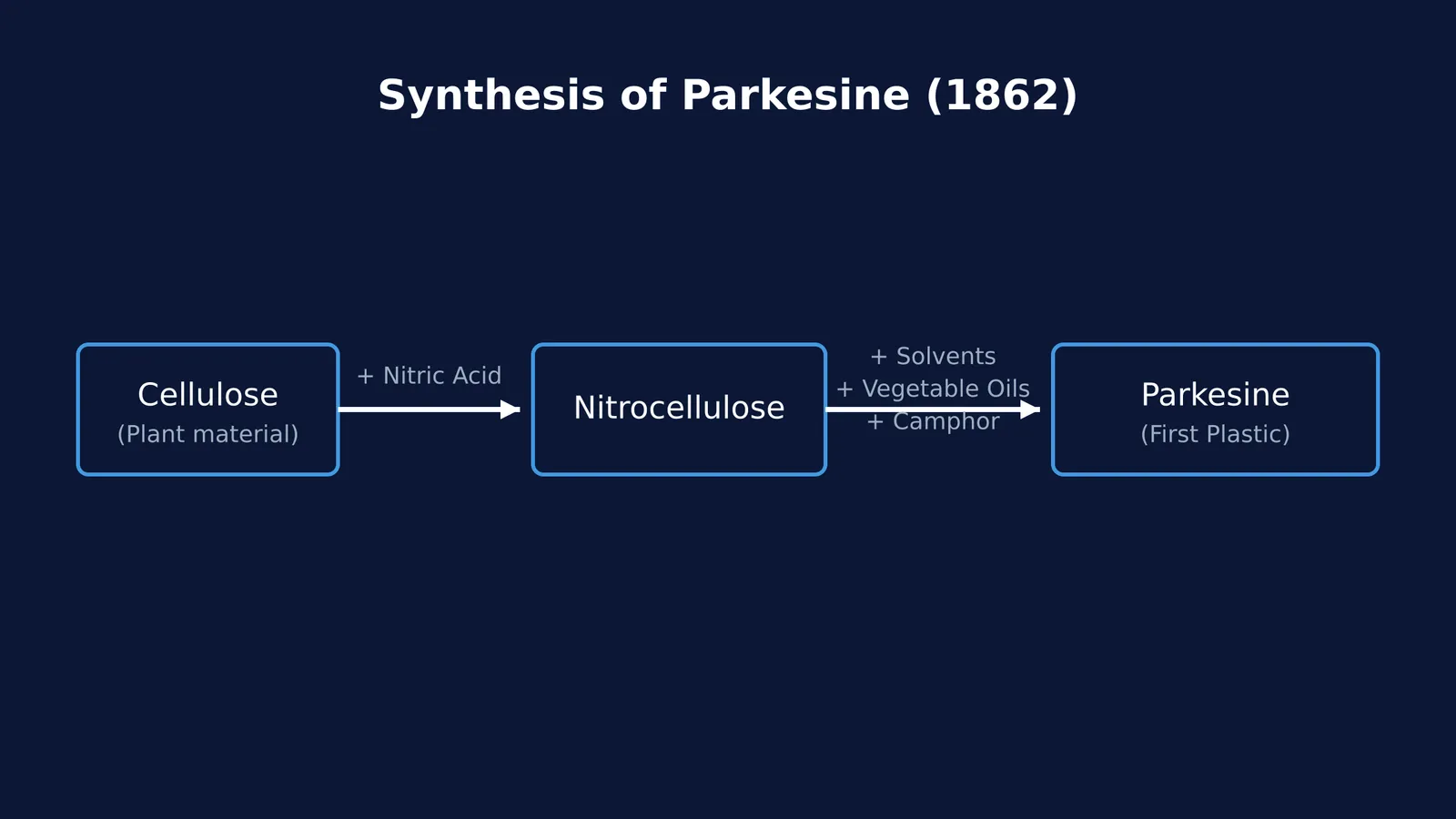
To create it, Parkes started with cellulose, the main structural component of plant cell walls. He treated the cellulose with nitric acid to produce nitrocellulose, and then dissolved it in solvents like wood naphtha or alcohol. By mixing in vegetable oils and camphor, he created a dough-like substance that could be dyed to mimic ivory or tortoiseshell. At the 1862 exhibition, he displayed combs, buttons, knife handles, and decorative medallions made from this new compound.
For students learning organic chemistry, the shift from natural polymers to semi-synthetic derivatives is a key milestone. You can explore similar structural naming conventions in Naming carbon compounds in Class 10: prefixes, suffixes, examples.
Why did the Parkesine Company fail?
Turning an invention into a profitable business proved difficult. In 1866, Parkes founded the Parkesine Company in Hackney Wick, London, aiming to mass-produce his plastic at a low cost.
To keep prices down, Parkes used cheaper, lower-grade raw materials. The resulting products were highly flammable, prone to shrinking, and tended to crack over time. Because of these quality issues, the Parkesine Company ceased trading in 1868, just two years after it began (Wikipedia). Parkes was a brilliant chemist but struggled to scale his laboratory success into reliable factory production.
How did Parkesine lead to Celluloid?
Although Parkes's business failed, his chemistry laid the foundation for the modern plastics industry. An associate named Daniel Spill took over the patents and developed a similar material called Xylonite. Meanwhile, other innovators were building on these ideas; for instance, you can read about August Wilhelm Hofmann and the amine chemistry you still study to see how synthetic chemistry was expanding rapidly in this era.
In the United States, John Wesley Hyatt improved upon Parkes's formula. By refining the use of camphor as a plasticiser, Hyatt created Celluloid in 1869, which became the first commercially successful plastic. He originally developed it as a substitute for the ivory used in billiard balls. (For more on the early pioneers of chemistry education, read about Jane Marcet and the chemistry book that inspired Faraday.)
The story of Parkesine shows how understanding the underlying structure of a material allows scientists to change its physical properties. If you are trying to master these chemical concepts, the Concept Library contains every concept in physics, chemistry, biology, mathematics and computing, each with its own lesson and its place in the map. When you encounter a topic that feels difficult to grasp, Fermi's AI tutor can step in. It works out what you already know, builds a plan for the session, and teaches through it — writing on a board, drawing the figure, running the simulation, and checking understanding as it goes.


