

On this page
The history of the light bulb is often told as the triumph of one inventor, but it was the product of decades of work by engineers around the world. In Russia, Alexander Nikolayevich Lodygin made a significant breakthrough several years before Thomas Edison's famous carbon filament bulb. Lodygin's invention tackled one of the main challenges of early lighting: keeping the light-emitting element from burning up when exposed to the air.
What was Alexander Lodygin's 1874 incandescent lamp?
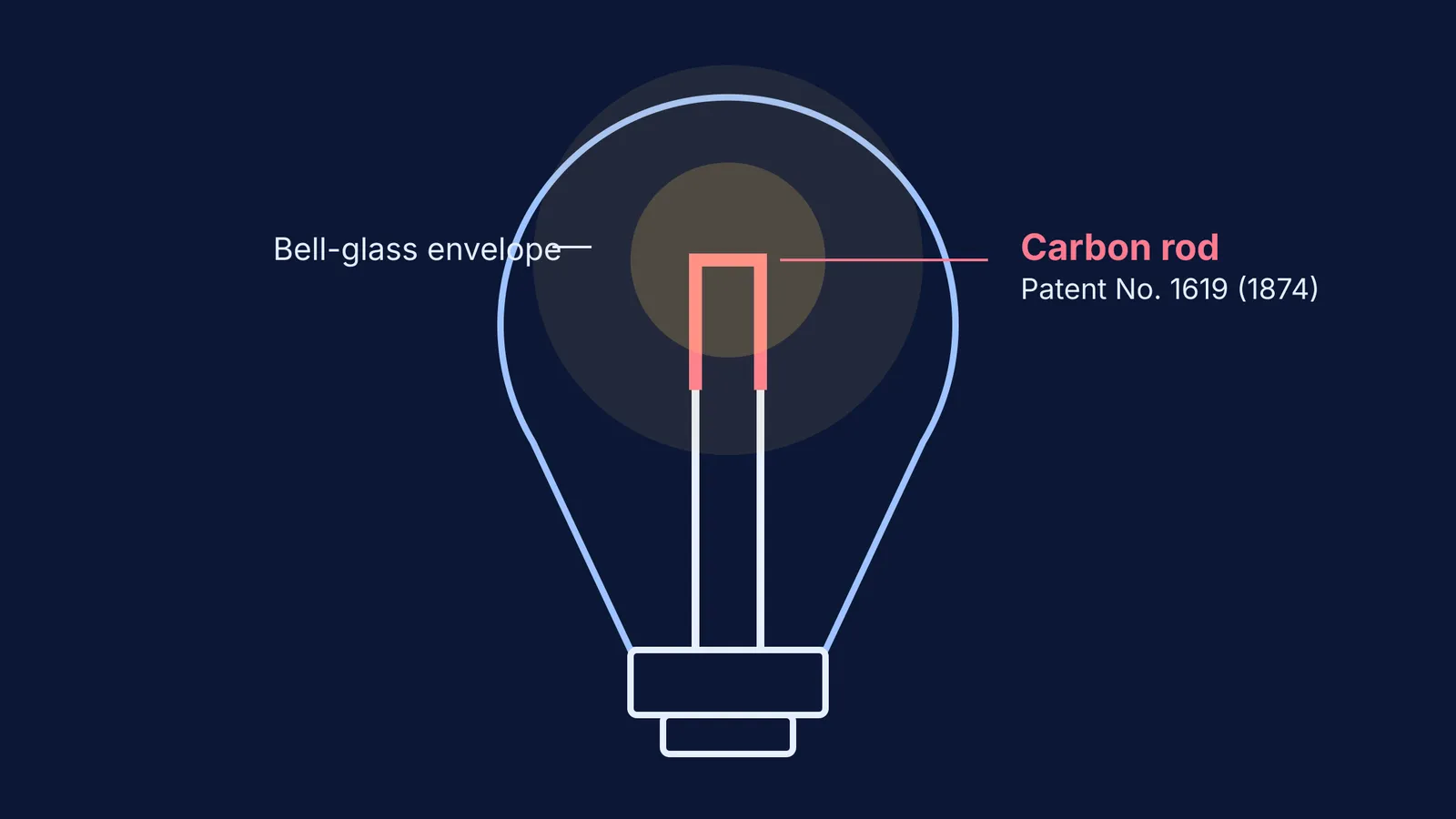
In 1872, Lodygin applied for a patent for an incandescent lamp, which was officially granted as Russian Patent No. 1619 on July 11, 1874. For this invention, the St. Petersburg Academy of Sciences awarded him the prestigious Lomonosov Prize.
His design was one of the first to be used practically outside a laboratory. In 1873 and 1874, he conducted experiments with electric lighting on ships and city streets in St. Petersburg, marking one of the earliest examples of public lighting using incandescent electricity. If you are comparing early lighting inventions, Joseph Swan and the carbon filament light bulb is a good starting point to see how other engineers approached the same problem in parallel.
How did the early carbon lamp work?
Early attempts at electric lighting often failed because a wire heated to incandescence would quickly react with oxygen in the air and break. Lodygin solved this by enclosing a thin carbon rod—rather than a wire—inside a sealed glass bulb.
To stop the carbon from burning away, he placed a very thin carbon rod under a bell-glass. This protected the carbon from the air and allowed it to glow brightly.
Understanding how current, resistance and heat interact is a core part of physics. If you want to explore how a material's dimensions change its electrical properties, the physics of stretching a wire: how its resistance changes with length relies on the same principles that govern a lamp's filament. For students struggling to picture these ideas, the Fermi Simulation Lab has interactive simulations for the ideas that are easier to see than to read, letting you observe how changing a circuit's variables alters the result.
Framework: Evaluating a filament material
When early engineers like Lodygin tested new materials for light bulbs, they had to balance three main physical properties. You can use this same framework to understand why the industry eventually moved away from thick carbon rods:
Melting point: The material must survive extreme heat without melting or snapping. A higher operating temperature produces a whiter, more efficient light.
Electrical resistance: Higher resistance generates more heat for a given current (P = I²R). Carbon rods had relatively low resistance, meaning they required high currents to heat up. This demanded thick, expensive copper wiring to distribute the power across a city grid.
Vaporisation rate: The material must not evaporate quickly inside the bulb, which would blacken the glass and eventually break the circuit.
Why did Lodygin switch from carbon to tungsten?
Lodygin knew that a better material was needed to make electric lighting commercially viable on a large scale. In the 1890s, after moving to the United States, Lodygin began experimenting with refractory metals. These are metals with extremely high melting points, such as tungsten, molybdenum, and chromium. Because tungsten can be heated to much higher temperatures without melting or evaporating, it produces a brighter light than carbon and operates more efficiently.
When learning about the properties of transition metals in chemistry, the logic behind choosing one element over another can be difficult to memorise. Fermi's AI tutor can work out what you already know and build a plan for the session, helping you understand the periodic trends that make metals like tungsten ideal for high-temperature applications.
What happened to Lodygin's tungsten patent?
Lodygin formally outlined his new approach in January 1893, when he applied for a U.S. patent titled "Illuminant for Incandescent Lamps". He proposed a manufacturing process where metals like tungsten were chemically deposited onto a temporary base wire. The patent was granted as U.S. Patent No. 575,002.
At the time, tungsten was notoriously brittle and difficult to draw into a fine wire. However, its theoretical advantages were clear. In 1906, Lodygin sold his tungsten filament patents to the General Electric Company (GE). GE's engineers eventually perfected a method for making ductile tungsten wire, which went on to become the undisputed industry standard for incandescent bulbs for nearly a century. Lodygin's shift from a carbon rod to a tungsten filament anticipated the final, lasting form of the traditional light bulb.


