On this page
Every time you write a DNA sequence like ATGC, you are naming molecules that a German chemist's lab pulled out of cell nuclei more than a century ago. What he did was patient chemistry: take the material from cell nuclei, break it apart, and identify each piece. Here is how, who helped, and a simple way to keep the five bases straight for exams.
Who was Albrecht Kossel?
Albrecht Kossel was born in Rostock on 16 September 1853 and died in Heidelberg on 5 July 1927, according to his Wikipedia biography. He trained in Strasbourg under Felix Hoppe-Seyler, ran the chemistry division of Berlin's Physiological Institute from 1883, moved to Marburg in 1895 and to Heidelberg in 1901.
His starting material was nuclein, the phosphorus-rich substance Friedrich Miescher had pulled out of cell nuclei. Read that earlier chapter in how Friedrich Miescher discovered nuclein. Kossel showed that nuclein had a protein part and a non-protein part. The protein side led him to histones; the other side led to the nucleic acids.
How did Albrecht Kossel discover the bases of DNA?
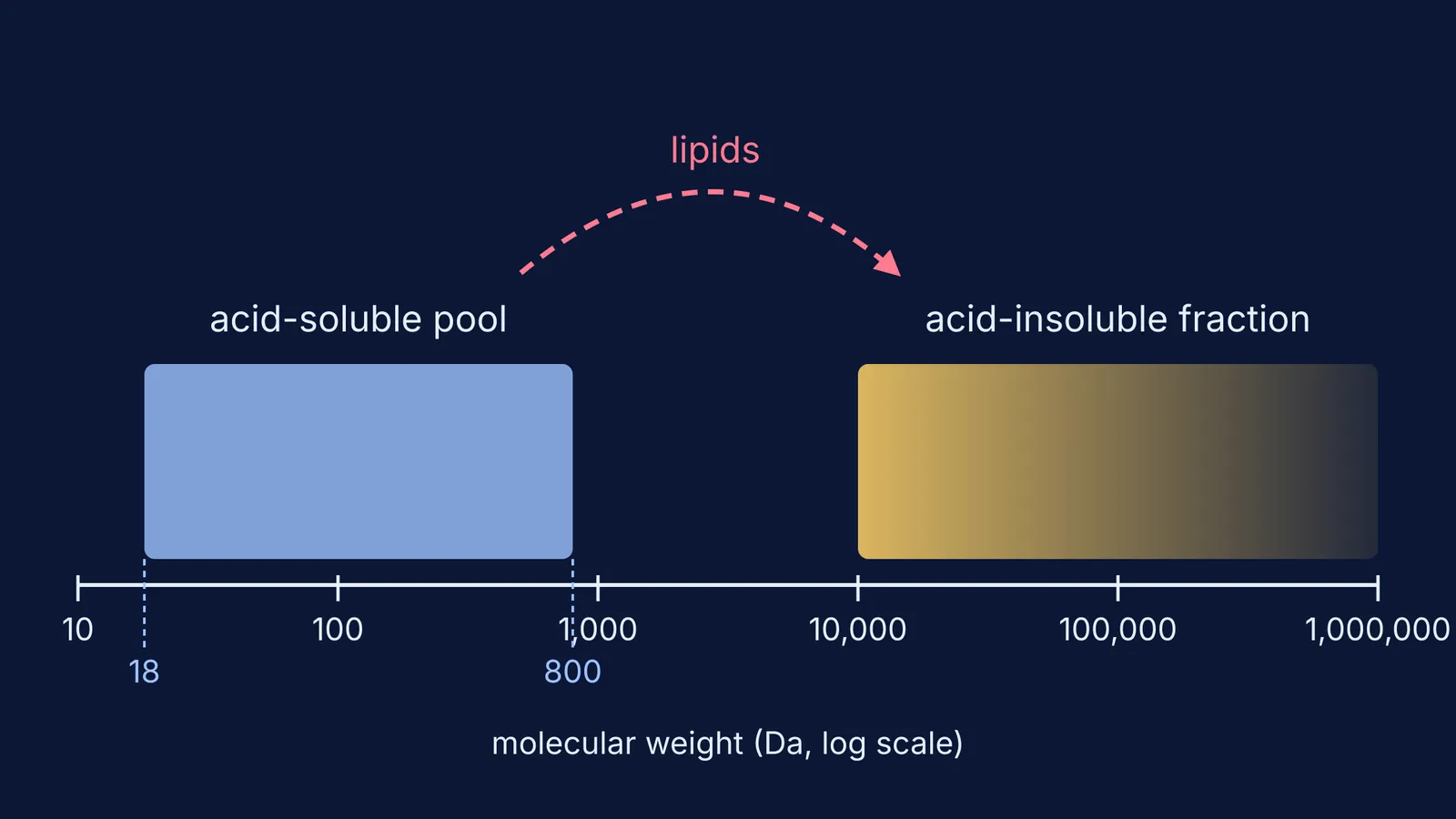
The short answer is hydrolysis: splitting a large molecule into small pieces and then identifying each piece. A 2019 history in the Journal of Biological Chemistry describes what Kossel's laboratory found: hydrolysing nucleic acids gave phosphoric acid, a sugar suspected to be a pentose, and a set of purine and pyrimidine bases that depended on where the nucleic acid came from.
The original papers show the order in which the bases appeared:
1885, adenine. Kossel published "Ueber eine neue Base aus dem Thierkörper" ("On a new base from the animal body") and later that year "Ueber das Adenin". He named it from the Greek word for gland because his sample came from the pancreas, as the adenine entry explains.
1893, thymine. Kossel and Albert Neumann published "Ueber das Thymin, ein Spaltungsproduct der Nucleïnsäure", "thymine, a cleavage product of nucleic acid". It came from calf thymus glands, hence the name (thymine entry).
1894, cytosine. The same pair described the preparation and cleavage products of nucleic acid; cytosine was hydrolysed from calf thymus tissue (cytosine entry).
1901, uracil. Alberto Ascoli, a student of Kossel, published "a new cleavage product of yeast nuclein" in Hoppe-Seyler's journal. The uracil entry dates the discovery to 1900.
Did Kossel discover all five bases himself?
Not quite. Guanine was first isolated in 1844 by the chemist Julius Bodo Unger from guano, seabird droppings used as fertiliser, which is where its name comes from (guanine entry). Uracil came from Ascoli, and its name had been coined in 1885 by Robert Behrend (uracil entry). Some summaries credit Kossel with all five, but the fairer version is this: his lab found adenine, thymine and cytosine, his student found uracil in nucleic acid, and his hydrolysis work showed that all five belong to nucleic acids.
His lab also noticed that the source mattered. The JBC history describes two kinds: yeast nucleic acid and thymus nucleic acid, which differed in one pyrimidine base (uracil versus thymine) and in their sugar. Today we call them RNA and DNA, which is why uracil belongs to RNA and thymine to DNA.
A neat twist came in 2021: researchers tested a sample of Miescher's own salmon-sperm nuclein, found significant levels of uracil, and concluded that his historic isolate contained RNA as well as DNA (Biological Chemistry, 2021).
Kossel received the 1910 Nobel Prize in Physiology or Medicine "in recognition of the contributions to our knowledge of cell chemistry made through his work on proteins, including the nucleic substances" (Nobel Prize summary). How the bases fit together needed later work, including the base counts in how Erwin Chargaff's rules pointed to DNA pairing.
How can you remember the five bases for exams?
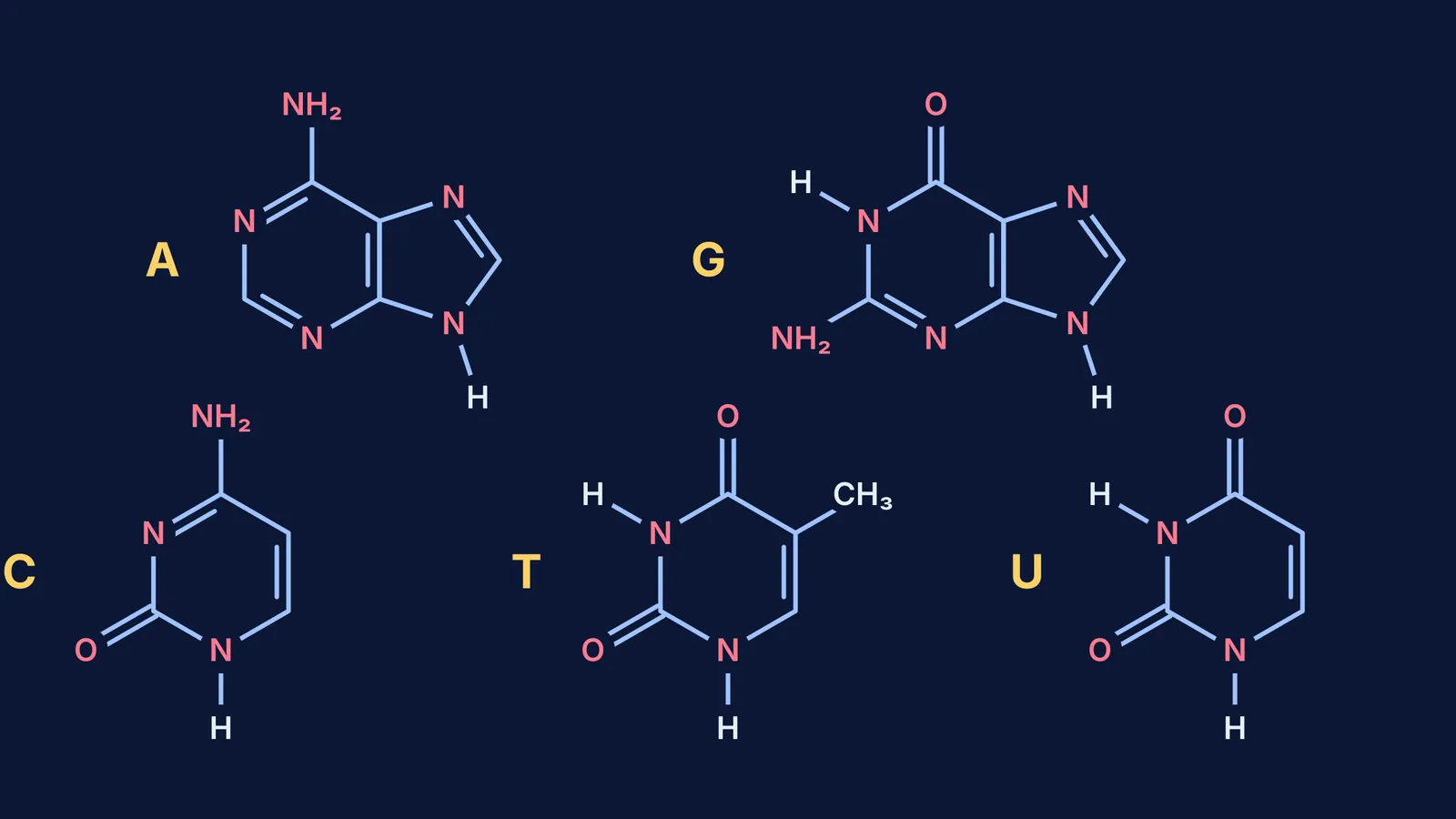
Learn one line per base: letter, ring type, where it is found and where the name comes from.
A, adenine: purine (two rings), DNA and RNA, named for a gland (pancreas).
G, guanine: purine, DNA and RNA, named for guano.
C, cytosine: pyrimidine (one ring), DNA and RNA, named for the cell (name origin).
T, thymine: pyrimidine, DNA only, named for the thymus.
U, uracil: pyrimidine, RNA only, found in yeast nuclein.
Two hooks: "Pure As Gold" for the purines A and G, and "CUT the PY" for the pyrimidines C, U and T.
Then run this quick self-test:
Draw a two-ring shape and a one-ring shape. Write the right letters under each.
Cover the list and write all five bases with DNA, RNA or both.
Explain to a friend or parent, in one sentence, how Kossel found them.
If you mix up bases, nucleosides and nucleotides, read nucleosides vs nucleotides: the chemistry of DNA and RNA units next. And if purines and pyrimidines still blur together, the Fermi Concept Library gives every concept in chemistry and biology its own lesson and its place in the map, so you can see where the bases fit.
Next time you write ATGC, remember that each letter stands for a piece that chemists once cut out of nucleic acid and named.