

On this page
Abu Bakr al-Razi (865–925 CE) was a Persian polymath who helped transform alchemy into an experimental science. Before his work, the study of matter was often obscured by mystical symbols, secretive language and the elusive pursuit of transmuting lead into gold. Al-Razi focused instead on what substances actually did in a laboratory setting. In his landmark book *Sirr al-Asrar* (The Secret of Secrets), he published a rigorous taxonomy of materials and the tools needed to manipulate them (Wikipedia). His drive to organise the natural world laid the groundwork for modern chemistry.
How did Al-Razi classify chemicals?
Al-Razi created a broad, logical system that divided all known matter into three primary categories: animal, vegetable and mineral (Wikipedia). This empirical grouping was based on where the materials originated and how they behaved under heat. Animal substances included derived materials like hair, blood and urine, while vegetable substances covered plant extracts and fermented liquids.
However, his most detailed and influential work was on the non-living world. Grouping things by their observable chemical behaviour is exactly what students do today when they study functional groups or the periodic table. If you are learning how modern elements relate to each other, the Fermi Concept Library explains the physical patterns that group different substances.
What was the mineral classification of Al-Razi?
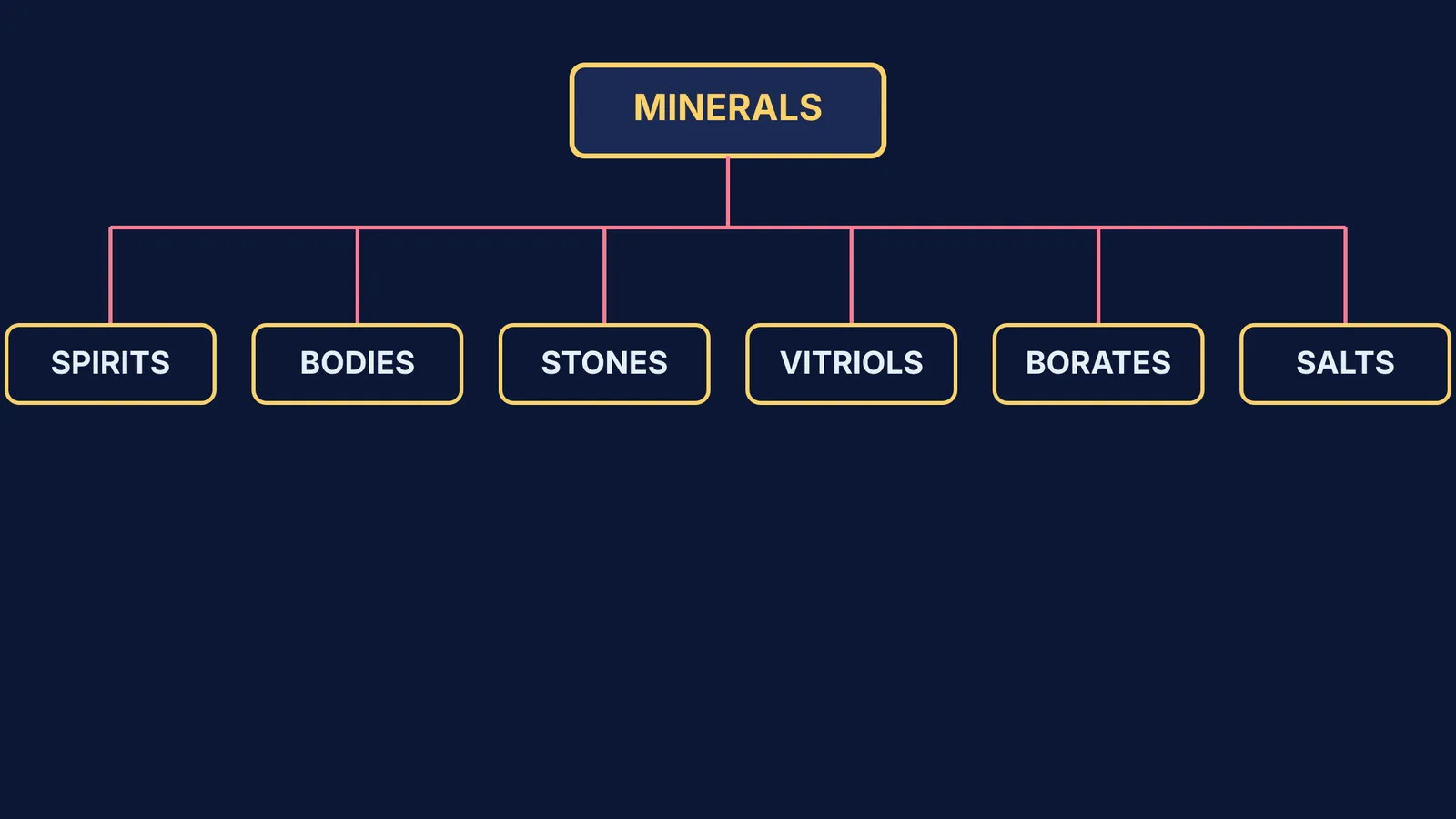
Al-Razi broke the mineral kingdom down into six distinct categories based on their reactions, volatility and physical state. According to *Sirr al-Asrar*, he classified 13 stones, 11 salts, seven metals, seven borates, seven vitriols and four "spirits" (Wikipedia).
His groupings were highly practical:
Spirits (al-arwah): Volatile substances like mercury and sulphur that sublimate or "flee" when heated.
Bodies (al-ajsad): Malleable metals such as gold, silver, iron and copper.
Stones (al-ahjar): Stable ores and minerals like lapis lazuli, malachite and glass.
Vitriols (al-zajat): Impure sulphates, including green vitriol and alum.
Borates: Alkaline fluxes like natron, which were essential for glassmaking and metallurgy.
Salts (al-amlah): Various extracted salts, including rock salt, brine and ashes.
What laboratory tools did Al-Razi use?
Al-Razi did not merely list chemicals; he documented the exact laboratory equipment needed to process them. He classified his chemical instruments into two classes: tools for melting metals, and utensils for transmutation and distillation (Wikipedia).
For high-temperature smelting, he listed the crucible, bellows, blacksmith's hearth and iron moulds. For gentler processing, he described the alembic (a specialised distillation head), the retort, glass flasks, phials, beakers, funnels and the mortar and pestle (Wikipedia). Many of these precise shapes are still found in school chemistry laboratories over a thousand years later. If you want to see how these distillation and separation techniques function without setting up actual glassware, you can test them safely in the Fermi Simulation Lab.
Al-Razi's emphasis on reproducible experiments and clear documentation set a high standard for scientific writing. His approach shares much with other meticulous historical pioneers, such as Al-Zahrawi and the surgical instruments of Al-Tasrif or Li Shizhen and the great compendium of medicinal substances.
How to categorise substances like a pioneer
When you study chemistry, applying Al-Razi's observational mindset can help you memorise properties faster. If you are struggling with a long list of unfamiliar compounds, try processing them through a logical framework:
State the origin: Is the compound organic (carbon-based, traditionally animal or vegetable) or inorganic (mineral)?
Test the volatility: Does it evaporate easily at room temperature (like his "spirits") or stay solid under extreme heat?
Check solubility: Does it dissolve completely in water (like his salts and vitriols)?
Observe the structure: Is it a malleable metal (a "body"), or a brittle, crystalline stone?
By asking these structural questions, you turn rote memorisation into an active investigation. If you get stuck on a difficult chemistry problem while working through these rules, Fermi's AI tutor can hold a line of reasoning across a session, noticing where you are stuck and deciding whether to explain, ask or show. Asking questions and systematically testing properties is exactly how chemistry was built.


