

On this page
In the 9th century, the House of Wisdom in Baghdad was a bustling centre of translation and scientific discovery. Among its leading figures was the Persian astronomer Al-Farghani, known in the West as Alfraganus. Born in the Fergana Valley in modern-day Uzbekistan, he became a prominent member of the Abbasid court. While earlier astronomers like Ptolemy had built complex mathematical models of the cosmos, Al-Farghani translated those dense proofs into a clear, descriptive map of the universe.
His major work, *Jawāmiʿ ʿIlm al-Nujūm* (The Compendium of the Science of the Stars), is best known today by its translated title, *Elements of Astronomy*. Translated into Latin in the 12th century by scholars like John of Seville, it became a standard textbook in Europe for centuries.
Who was Alfraganus?
Al-Farghani was an astronomer who stripped away the heavy geometry of Ptolemy’s *Almagest* to make the heavens understandable for students and non-specialists. For medieval Europe, *Elements of Astronomy* was the ultimate accessible guide to the cosmos.
The poet Dante Alighieri relied heavily on Al-Farghani’s descriptions of celestial spheres when constructing the cosmology for the *Divine Comedy* and the *Convivio*. By offering a quantitative scale for the universe, Al-Farghani gave readers a concrete way to picture the heavens, stripping away the impenetrable mathematics while keeping the structural framework intact.
How did Al-Farghani measure the Earth's size?
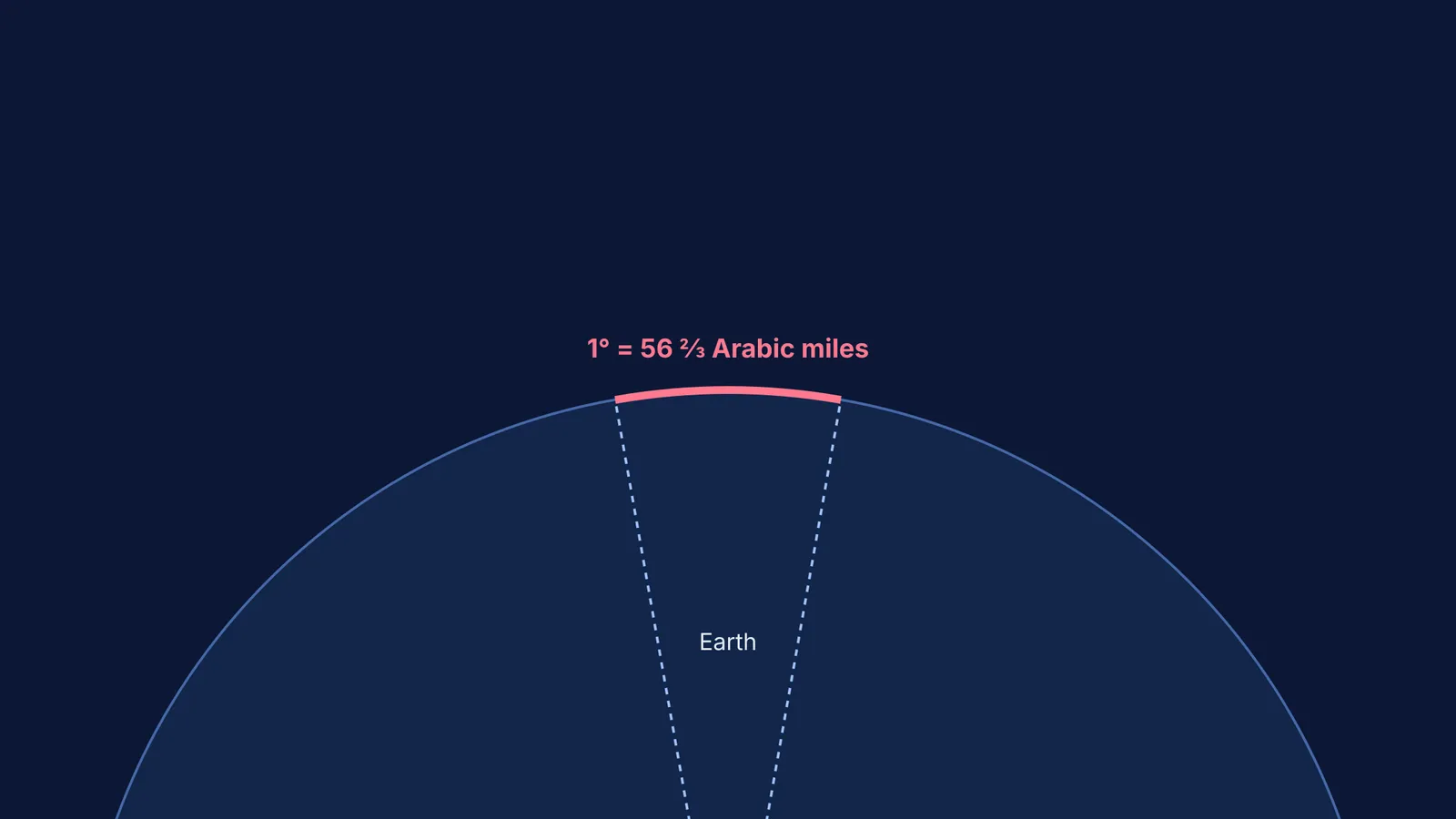
During the reign of Caliph al-Ma'mun, Al-Farghani participated in a major survey to measure the size of the Earth. He recorded that one degree of the Earth's meridian measured exactly 56 ⅔ Arabic miles.
Using this meridian arc, he calculated the total circumference of the Earth to be 20,400 Arabic miles.
The golden rule of unit conversions
Columbus's historical miscalculation is a stark reminder of why units matter. When working through physics or astronomy problems, you can avoid similar errors with a quick unit-check routine:
Identify the system: Are you using SI (metres, kilograms) or another unit system?
State the conversion factor: For Al-Farghani's data, 1 Arabic mile is generally estimated between 1,800 and 2,000 metres.
Carry units through the calculation: Treat units like algebraic variables. If they do not cancel out correctly, the formula is set up wrong.
How did he model the universe?
Al-Farghani did more than measure the Earth. He was the first to describe the universe as a series of nested spheres. In this model, he calculated the diameter of the Earth to be 64,000,000 cubits and estimated the distance to the Moon to be 1,210,000 miles.
When you read about historical astronomy, picturing nested spheres, epicycles, and orbital apogees can be difficult. The Fermi Simulation Lab has interactive simulations for the ideas that are easier to see than to read, helping you build a mental model of orbital mechanics.
What else did Al-Farghani build?
Beyond his astronomical writings, Al-Farghani was an accomplished engineer who applied his mathematical knowledge to practical problems. Later in his life, he moved to Cairo, where he composed a detailed treatise on the astrolabe around 856. At the behest of the Abbasid caliph al-Mutawakkil, he supervised the construction of a large measuring instrument called the New Nilometer on Rawda Island in Old Cairo. Completed in 861, this monumental structure allowed engineers to precisely measure the height of the Nile River during its annual flood, a measurement crucial for predicting agricultural yields for the season.
Al-Farghani's legacy lies in this accessible quantification. By clearly stating the dimensions of the Earth and the heavens, *Elements of Astronomy* gave centuries of scholars the numbers they needed to map their place in the universe.
Read more:


