

On this page
The 9th-century scholar Abu Hanifa al-Dinawari is considered the founder of Arabic botany. Born in the region of western Iran, he was a true polymath who combined his education in grammar with a deep interest in the natural world. His encyclopedic work, the *Book of Plants* (*Kitab al-Nabat*), moved the study of flora beyond simple medical herbalism into a systematic science. For students of biology today, his methods of careful observation and ecological thinking offer a clear blueprint for mastering complex natural systems.
Who was Abu Hanifa al-Dinawari?
Abu Hanifa al-Dinawari was a 9th-century intellectual who integrated astronomy, agriculture, and linguistics into the study of nature. He is considered the founder of Arabic botany due to his major work, the *Book of Plants* (*Kitab al-Nabat*) 1. Living during the Islamic Golden Age, he combined empirical field observations with a deep knowledge of ancient Arabic poetry and language.
Educated in the grammatical traditions of Basra and Kufa, al-Dinawari approached natural sciences with the precision of a philologist 1. His text did not just list plant names; it sought to understand the environment, soil pedology, and seasons that allowed crops to thrive 1. By preserving the oral traditions of the Arabian Peninsula alongside his direct scientific observations, he created a botanical dictionary that served as the primary authority in the Islamic world for centuries. He drew upon earlier, now-lost works by Muslim scholars such as al-Shaybani and Ibn al-Arabi, weaving their findings into a comprehensive framework 1. Beyond botany, he authored influential books on mathematics, astronomy, and history, bridging the humanities and the exact sciences 1.
What did the Book of Plants describe?
The *Book of Plants* was an encyclopedia originally spanning six volumes, though only the third and fifth volumes survive completely today, with the sixth reconstructed from later citations 1. In these surviving sections alone, al-Dinawari described 637 different plant species in extraordinary detail 1.
He went far beyond simple identification. He detailed the physical structure of plants and categorised them systematically according to their habitats, such as deserts, mountains, or riverbanks. He also wrote extensively about early soil science, explaining the different qualities of ground and which types of earth were most suitable for specific wild and cultivated plants 1. Because he integrated poetic usage and etymology into his descriptions, his work functioned as both a scientific treatise and a sophisticated botanical lexicon 1.
His work represents the culmination of a tradition that treated botanical writing as a rigorous science 1. It laid the foundation for later scholars, such as the famous Andalusian botanist Ibn al-Baitar, who expanded upon this systematic catalogue to document thousands of medicinal and agricultural plants across the Islamic world 1.
Why did he study plant growth stages?
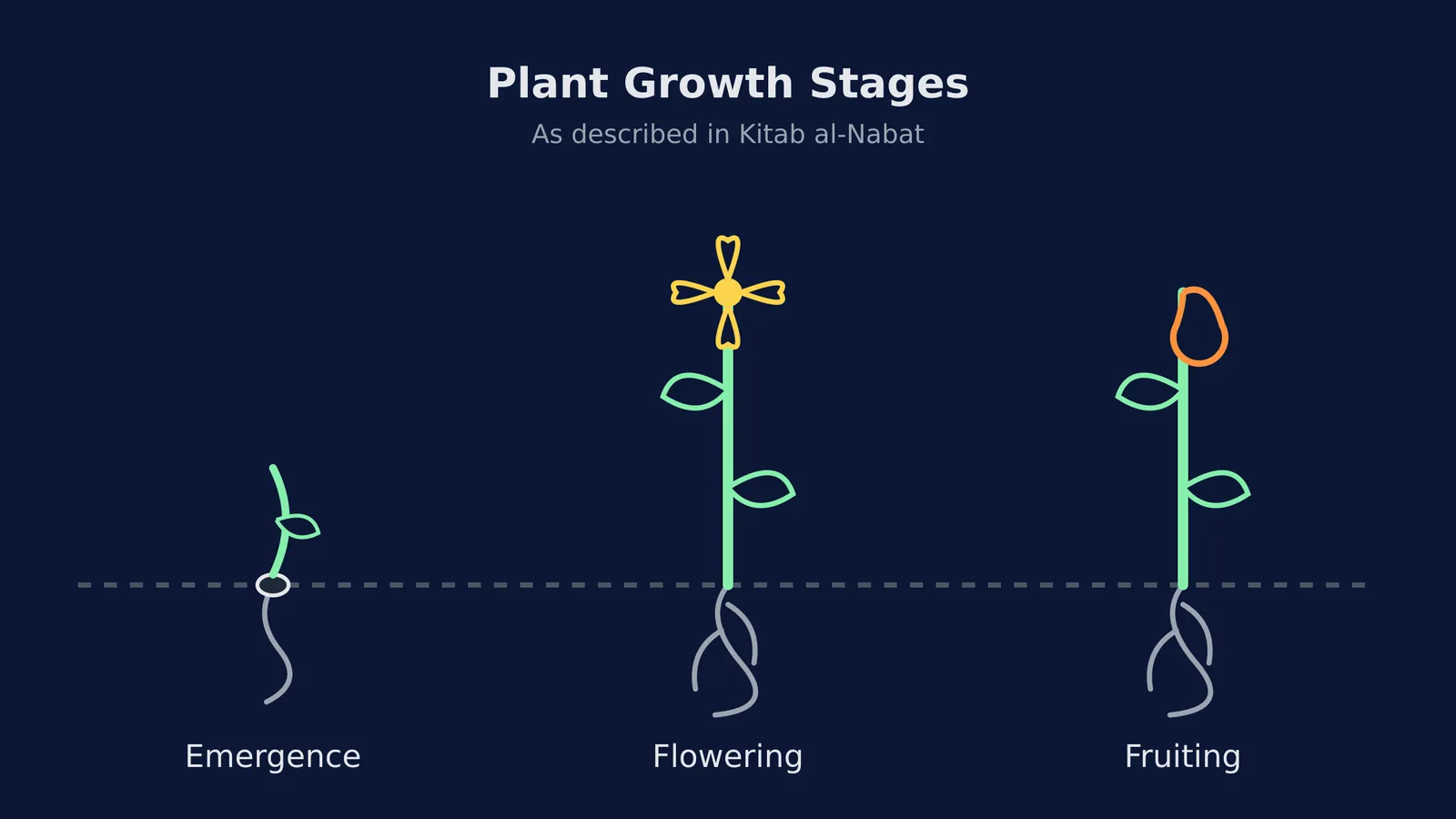
Al-Dinawari observed the phases of plant growth in rigorous detail, documenting the emergence of the plant from the soil, the production of flowers, and the development and ripening of fruit 1.
By tracking these stages, he connected botanical life cycles to astronomy and meteorology. He noted how the sun, moon, lunar phases, and seasonal changes like rain, thunder, and winds directly influenced agriculture and plant behaviour 1. He even documented how specific wind patterns or the appearance of certain constellations could indicate the optimal time for sowing or harvesting.
This systematic approach meant that studying plants was no longer just about finding a quick herbal cure. It was about understanding the organism in its own right. He explored how environmental factors shaped plant evolution and adaptation, an idea that predated modern ecology by hundreds of years. By looking at the whole system, he could explain not just what a plant was, but how it lived and changed over time.
How can you build study habits from systematic observation?
Al-Dinawari did not just memorise isolated facts; he looked at the whole system, from the soil up to the weather. When you study biology for school or competitive exams, you can adopt the same active learning approach to make your study hours more effective:
Trace the full cycle: Instead of memorising parts of a flower in isolation, follow the process of reproduction from start to finish. For example, trace the Ploidy of endosperm, nucellus and embryo sac through every step of cell division to see how the mature seed actually forms.
Connect the environment: Understand how external factors drive internal physical changes. Just as al-Dinawari studied the wind and sun, you can explore how Phototropism, geotropism and other tropic movements dictate how plants respond to light and gravity in your environment.
Classify logically: Build your own categories based on shared traits rather than reading flat lists. The Plant kingdom for NEET-UG becomes much easier to master when you group algae, bryophytes, and gymnosperms by their defining evolutionary features and habitats.
If you struggle to connect these isolated biological facts into a coherent picture, Fermi's AI tutor can work out what you already know and build a plan for the session, drawing the figure and checking your understanding as it goes.


