

On this page
In early nineteenth-century northern Italy, the silk industry was in crisis. Silkworm farms across Lombardy and Piedmont suffered devastating losses from a plague local rearers called *calcinaccio* or *mal del segno*, known in France as muscardine. Healthy caterpillars feeding on mulberry leaves turned sluggish, died within days, and hardened into chalky white, brittle mummies.
Most naturalists attributed the disease to spontaneous generation, sour air, or damp rearing sheds. Agostino Bassi (1773–1856), an Italian naturalist in Lodi who had studied under Lazzaro Spallanzani at the University of Pavia—drawing directly on Lazzaro Spallanzani's experiments on spontaneous generation—suspected a living agent was at work. Over a 25-year investigation, Bassi proved that the killer was an external parasitic fungus (Porter, 1973). His 1835 monograph delivered the first experimental proof of the germ theory of disease.
What was the silkworm disease that threatened Europe's silk industry?
Sericulture was an economic lifeline for rural communities across northern Italy and southern France. When muscardine struck, entire rearing houses (*bigattaie*) collapsed in days. Cultivators watched as feeding larvae stiffened into chalk-like sticks coated with a fine white powder.
Because this coating resembled mineral lime (*calcina*), farmers assumed the disease sprang from internal chemical imbalance, poor food, or damp weather. In the first volume of his monograph, *Del mal del segno, calcinaccio o moscardino*, published in 1835, Bassi recounted years spent testing whether poor conditions could generate the disease spontaneously (Bassi, 1835). He confined healthy caterpillars in foul air, subjected them to extreme cold, and fed them wet leaves. None of these stressed insects contracted muscardine. The affliction appeared only when a caterpillar touched an infected insect or contaminated rearing trays.
How did Agostino Bassi prove that muscardine was caused by a fungus?
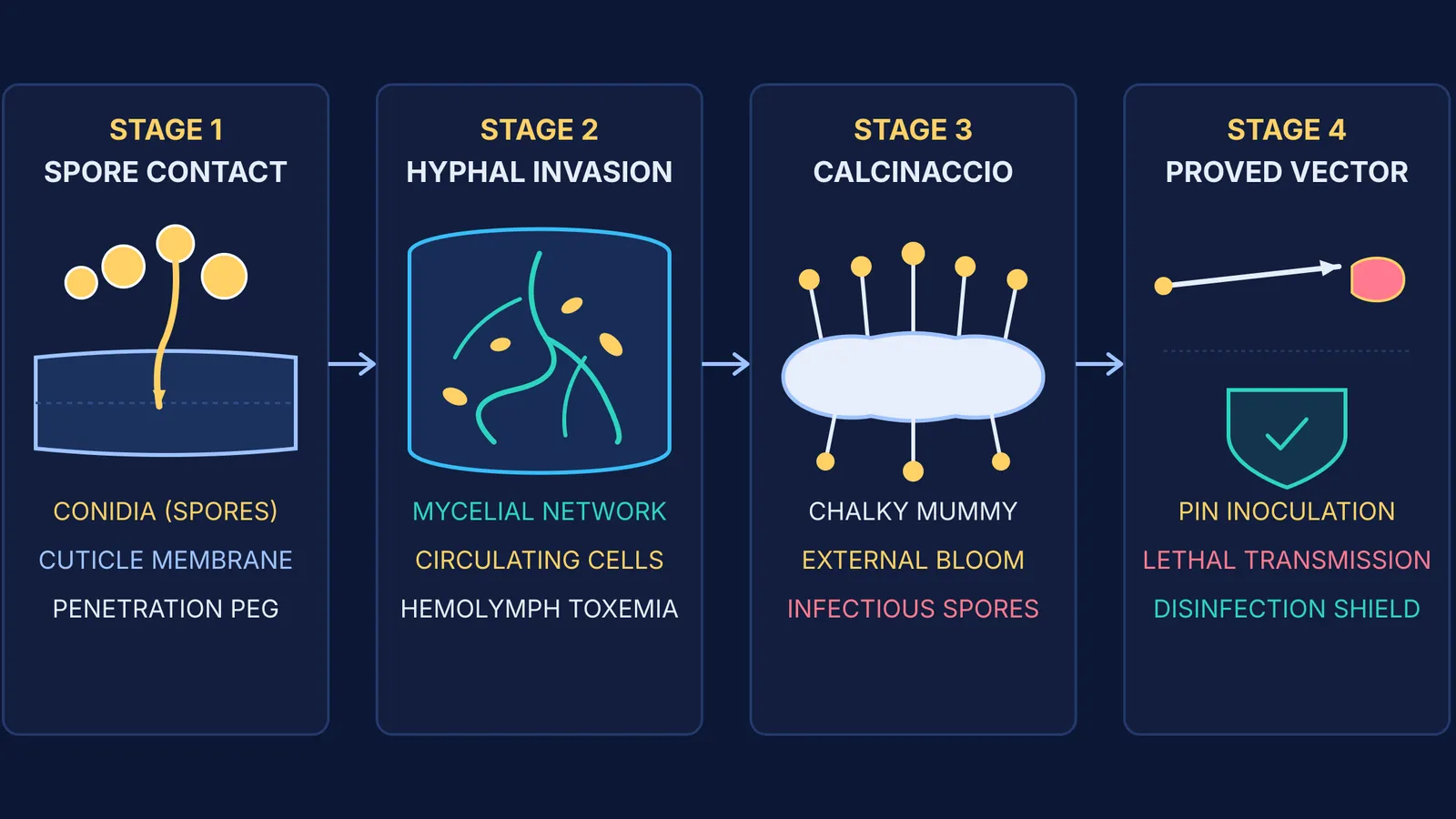
To identify what spread the contagion, Bassi examined the chalky crust under a microscope. Where contemporaries saw mineral residue, Bassi identified a living cryptogamic fungus producing microscopic seed-like globules, or conidial spores.
Bassi verified cause and effect with a controlled inoculation test:
He touched a clean pin to the white efflorescence on a dead silkworm cadaver.
He scratched the cuticle of a healthy caterpillar with the spore-coated pin.
The inoculated silkworm sickened, died within days, and sprouted identical white efflorescence.
To confirm that mechanical injury alone did not trigger death, Bassi pricked control caterpillars with sterile pins; those insects remained healthy. He then transferred the pathogen across multiple insect generations, including wild caterpillars of different moth species (Ainsworth, 1956). On August 30, 1834, Bassi demonstrated these results before a commission of nine professors at the University of Pavia, who formally verified his discovery (Porter, 1973).
How did Bassi turn laboratory tests into practical farm biosecurity?
Bassi translated his laboratory findings into practical measures to halt the disease. His protocol established four core biosecurity rules:
Early isolation: Removing and burning dead caterpillars before white spores erupted through the cuticle.
Thermal disinfection: Washing rearing shelves, baskets, and feeding tools in boiling water to kill fungal spores (Ainsworth, 1956).
Chemical cleansing: Treating contaminated trays with slaked lime (calcium hydroxide), alcohol, or nitric acid fumigation.
Rearing density limits: Increasing ventilation and spacing between caterpillars to stop cuticle-to-cuticle transmission.
These protocols rescued Italian sericulture, replacing superstition with systematic hygiene.
When you study host-pathogen interactions and fungal life cycles, seeing how spores germinate and invade host tissue helps ground the theory. The Fermi Concept Library maps every concept in biology, showing where fungal pathogens and sporulation mechanisms connect across systems. If you are working through questions on experimental controls or pathogen transmission, the Fermi Problem Library provides worked problems with a step-by-step solver that explains the reasoning rather than printing an answer.
Why did Bassi's discovery take decades to reshape human medicine?
Bassi recognized that his findings extended beyond sericulture. In his 1844 treatise, *Del contagio in generale*, he argued that human contagious diseases such as cholera, plague, and syphilis were similarly caused by living microscopic parasites (Porter, 1973).
Medical authorities initially dismissed the comparison, viewing insect fungal infections as irrelevant to human disease. Decades passed before the wider scientific community caught up. When French silkworms faced collapse in the 1860s, Louis Pasteur's work on germ theory and silkworm diseases drew directly upon Bassi's methods. Pasteur kept a portrait of Bassi in his office throughout his career. Moreover, Bassi's experimental sequence—inoculating a healthy host, reproducing symptoms, and isolating the agent—anticipated Robert Koch's postulates for identifying disease-causing pathogens by more than 40 years.
Today, *Beauveria bassiana* serves globally as an effective biological insecticide against crop pests, fulfilling the practical promise of Bassi's 1835 experiment.


