

On this page
In rural Gadchiroli, in eastern Maharashtra, hospital care for newborns was hard to reach and costly for many families. Doctors Abhay Bang and Rani Bang asked a blunt question: if the baby cannot reach the hospital, can newborn care reach the baby? Their non-profit, SEARCH, spent ten years testing the answer.
What did Abhay and Rani Bang do in Gadchiroli?
According to their 1999 paper in The Lancet03046-9), the team chose 39 intervention villages and 47 control villages, recorded every birth and death for two baseline years (1993 to 1995), and then introduced home-based newborn care only in the intervention villages.
Village health workers trained in newborn care made home visits and handled:
birth asphyxia, when a baby does not breathe properly at birth
premature birth and low birthweight
hypothermia, when a small baby gets dangerously cold
breastfeeding problems
neonatal sepsis, meaning serious infection such as septicaemia, meningitis or pneumonia, which they diagnosed and treated
Trained birth attendants helped at deliveries, and supervisors visited every fortnight.
How could a village worker tell which baby was dangerously ill? A 2005 analysis from the same trial found that health workers visited every newborn 8 times in the first 28 days. In the period before home treatment began, the presence of any 2 of 7 simple signs at once (such as reduced sucking, a weak cry or a baby cold to touch) picked out every baby who went on to die of sepsis.
How much did home-based newborn care cut infant deaths?
The 1999 Lancet paper03046-9) reported that by the third year, 93% of newborns in the intervention villages received home-based care. Compared with the control area, the neonatal mortality rate (deaths in the first 28 days per 1,000 live births) fell by a net 62.2% and the infant mortality rate by 45.7%. Deaths among babies with sepsis fell from 16.6% before treatment to 2.8% once village health workers treated them. The care cost US$5.3 per newborn.
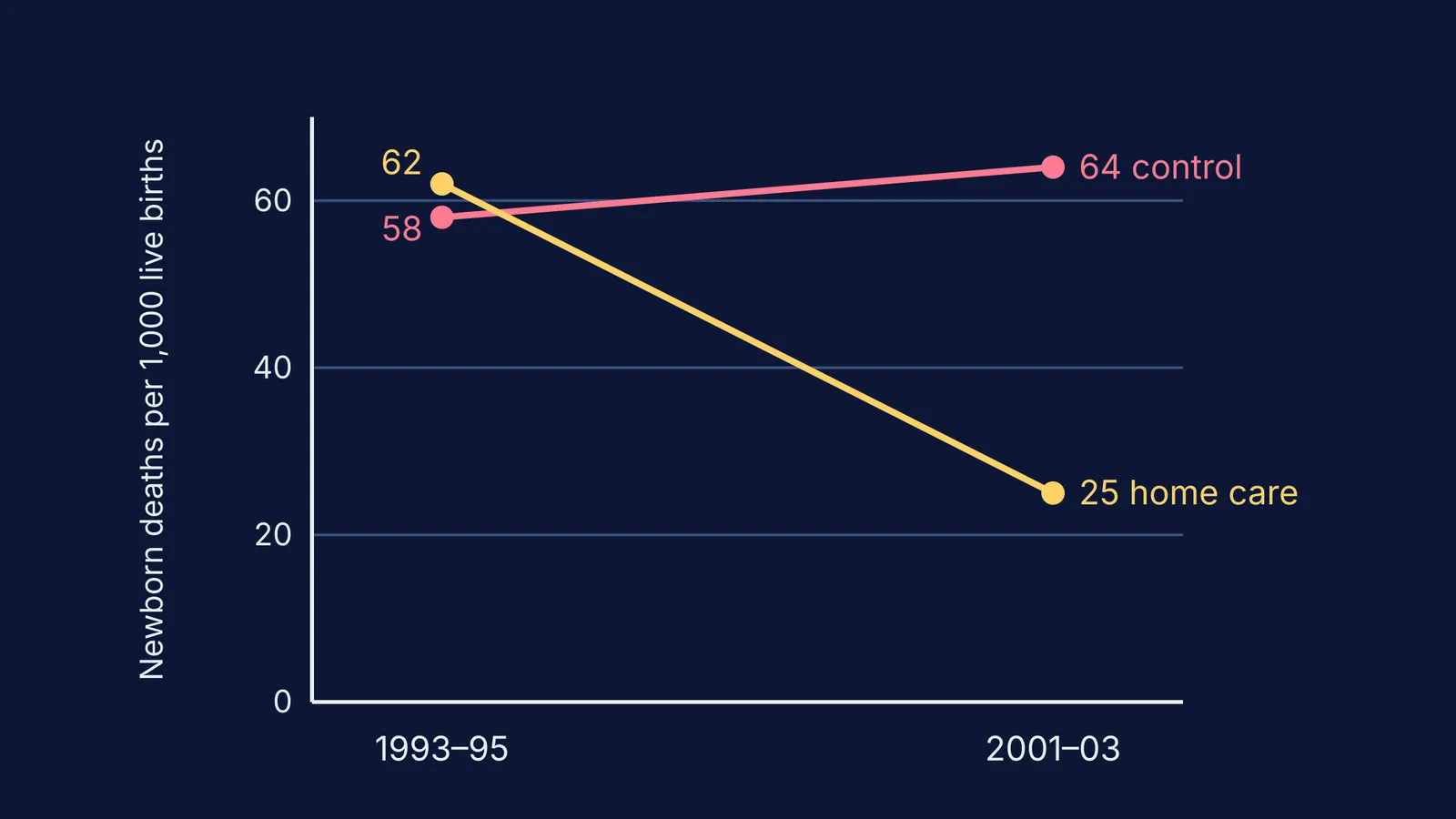
The ten-year results in the Journal of Perinatology are clearer still. In the intervention villages, the neonatal mortality rate fell from 62 per 1,000 live births in 1993 to 1995 to 25 in 2001 to 2003. In the control villages it rose from 58 to 64. Relative to control, that is a 70% reduction, and infant mortality fell by 57%. The authors credited most of the gain to managing sick babies: sepsis management (36%), supportive care of low-birthweight babies (34%) and asphyxia management (19%).
Was the Gadchiroli trial a fair test?
Villages were not assigned by lottery, so this was a controlled field trial, not a randomised one. Its safeguards were a control area, baseline years with similar death rates, and separate workers counting births and deaths. Our post on James Lind's scurvy trial explains why a comparison group matters.
The approach was later tested by randomisation. A cluster randomised trial led by the Indian Council of Medical Research in five districts found that home-based care from a dedicated newborn worker lowered the risk of neonatal death by 25%. When anganwadi workers delivered the same package, mortality was no different from control. In that trial, who delivered the care made the difference.
Worked example: where does the 70% come from?
Rebuild the headline number from the ten-year results.
Change in intervention villages: 25 minus 62 gives a fall of 37 deaths per 1,000.
Change in control villages: 64 minus 58 gives a rise of 6 deaths per 1,000.
Net effect: 37 plus 6 gives about 43 deaths per 1,000 better than the control trend. The paper reports 44; the published rates are rounded.
Divide by the starting rate of 62 and you get roughly 70%.
Subtracting the control group's change like this is called a difference-in-differences. Our post on reading Gagandeep Kang's rotavirus trial numbers walks through more of these.
If rates and denominators still feel slippery, the Fermi Concept Library covers every concept in physics, chemistry, biology, mathematics and computing, each with its own lesson.
How did the Gadchiroli model reach the rest of India?
In 2009, a WHO and UNICEF joint statement recommended home visits in a baby's first week of life, noting that home-based newborn care can prevent 30 to 60% of newborn deaths in high-mortality settings under controlled conditions.
India's Home Based Newborn Care programme was launched in 2011 and is now run under the National Health Mission. ASHAs visit on the 3rd, 7th, 14th, 21st, 28th and 42nd days after birth, with an extra visit within 24 hours for a home birth. The maternal and newborn sections of the government's Notes for ASHA Trainers are excerpted from SEARCH's manual on training ASHAs in home-based newborn care.
The lesson for future doctors and researchers: a careful count of births and deaths can shape national policy. For another Indian scientist who started from village data, read about C. Gopalan and nutrition for Indian diets.


