

On this page
Abhay Ashtekar, born in 1949 in Shirpur, Maharashtra, chose to study pure science at the Institute of Science, Bombay, over engineering. His early fascination with the fundamental laws of physics took him to the United States for his PhD and ultimately led him to tackle the biggest roadblock in modern theoretical physics: the marriage of quantum mechanics and gravity.
In November 1986, Ashtekar published "New Variables for Classical and Quantum Gravity" in Physical Review Letters. This single paper shifted how physicists looked at space and time, launching the framework that would become loop quantum gravity.
Why did Einstein's equations need new variables?
In general relativity, Albert Einstein described gravity not as a pulling force, but as the continuous curving of spacetime. The mathematics of general relativity relied on the "metric," a way of measuring distances between points on a smooth sheet.
The problem arose when physicists tried to combine this smooth metric with quantum mechanics. The other three fundamental forces of nature—electromagnetism, the strong nuclear force, and the weak nuclear force—were described using gauge theories (Yang-Mills theories). Instead of measuring distance, gauge theories track fields, like the magnetic vector potential.
When researchers tried to quantise Einstein's metric-based equations, they ended up with the Wheeler-DeWitt equation. This mathematical formula contained a non-polynomial Hamiltonian constraint that was highly difficult to solve. The math of smooth distances simply refused to speak the quantum language of fields.
What are the Ashtekar variables?
Ashtekar's insight was to rewrite general relativity so that it looked like a gauge theory. Instead of using the metric to track distances, he introduced an SU(2) connection. This new variable tracked how an object, like a quantum spinor, rotates as it is parallel-transported through space.
By changing the variable from a metric (distance) to a connection (rotation), Ashtekar simplified the Hamiltonian constraint. The highly complex non-polynomial equation became a much simpler polynomial equation.
This mathematical "Rosetta Stone" allowed physicists to finally apply the quantum techniques used in particle physics directly to gravity.
What is loop quantum gravity?
With Ashtekar's new variables in hand, physicists Lee Smolin and Carlo Rovelli were able to construct the "loop representation" of quantum gravity in the late 1980s and early 1990s.
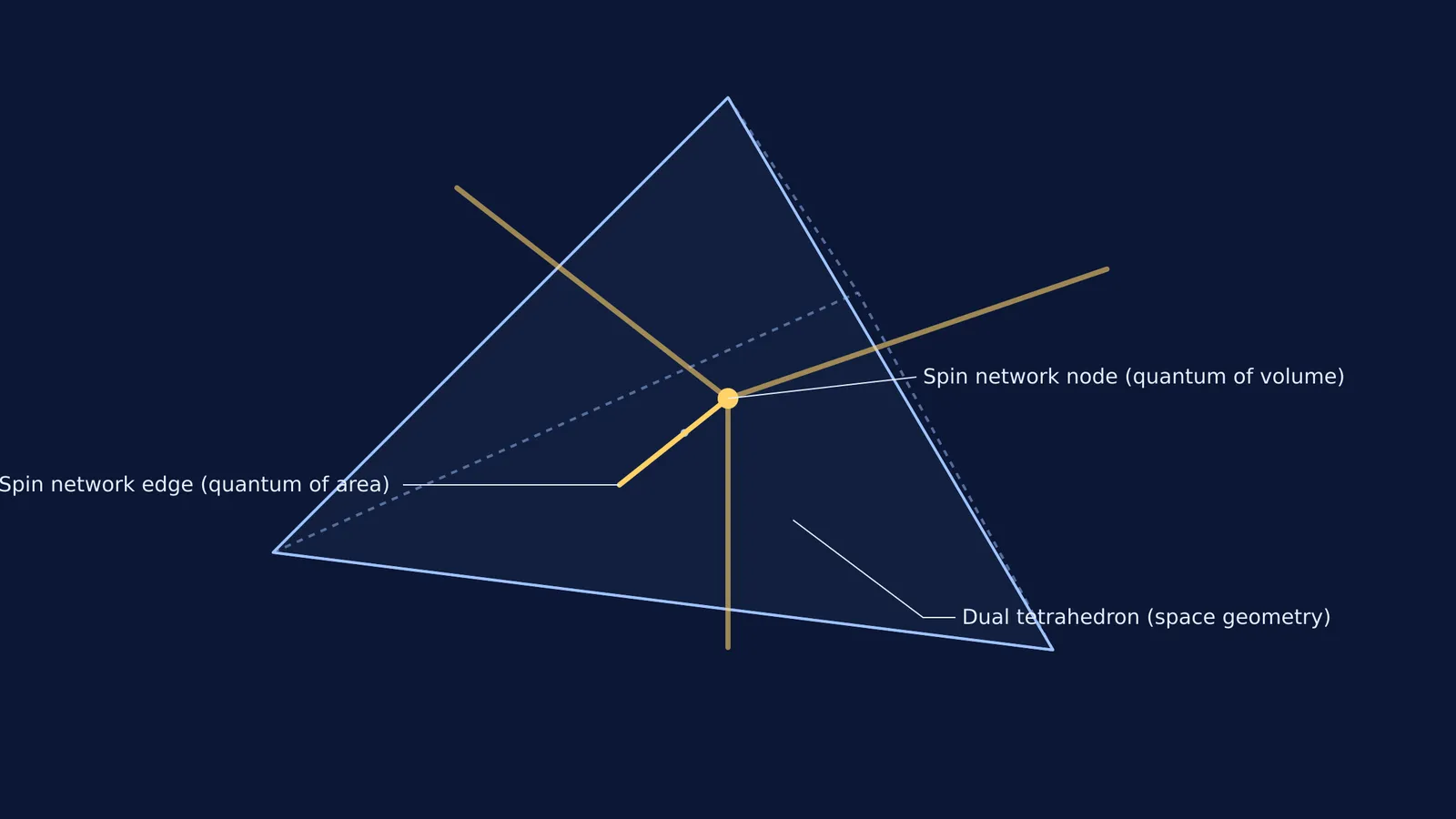
Loop quantum gravity proposes that space is not a continuous, smooth container. Instead, if you zoom in far enough—down to the Planck scale of roughly 10⁻³⁵ meters—space has an atomic structure. It is made of discrete, finite loops woven together into a spin network.
Because of this granular structure, geometric properties are quantised. Just as an electron can only exist in certain energy levels, space can only have specific, discrete areas and volumes. There is a minimum possible area, known as the area gap, and space cannot be compressed smaller than this.
How can changing the variable help your studies?
For JEE and NEET students, Ashtekar's discovery holds a powerful practical lesson: when a problem looks impossible, change the variables.
In mathematics, if an integral is blocked by complex terms, swapping the frame of reference often causes the difficulty to vanish. For example, using u-substitution with bounds turns a tricky algebraic function into a simple polynomial. Similarly, in physics, switching from Cartesian (x, y) coordinates to a polar (r, θ) grid can instantly solve a problem about circular motion. If the metric you are using is fighting you, step back and look for a connection that simplifies the equation.
If you are stuck on how to apply these techniques to your own practice, the Fermi Problem Library has worked problems with a step-by-step solver that explains the reasoning rather than printing an answer. If you still aren't sure where to begin, Fermi's AI tutor can work out what you already know and build a plan for the session, so you sit down to a clear next step. And to explore concepts like the Amal Raychaudhuri equation or the fundamentals of spacetime, the Concept Library contains every concept in physics, chemistry, biology, mathematics and computing, each with its own lesson and its place in the map.


