

On this page
Your ears stick out from the sides of your head, and that makes them highly effective biological radiators. The pinna (the visible, external part of the ear) is constructed almost entirely of flexible cartilage covered by a very thin layer of skin. Unlike your torso, thighs, or arms, the ear has almost no subcutaneous fat to act as thermal insulation.
Why do ears lose heat so fast?
Because of its thin, heavily contoured shape, the ear has an exceptionally high surface-area-to-volume ratio. There is a vast amount of surface skin exposed to the air compared to the tiny, thin volume of tissue actually holding heat.
When you step into freezing weather, your body immediately initiates vasoconstriction. This physiological response narrows the peripheral blood vessels in your extremities to keep warm blood safely near your core organs. Without a steady, robust supply of warm blood pumping through them, and completely lacking an insulating layer of fat, the temperature of your ear drops far more rapidly than the rest of your body.
Why does wind make the cold hurt more?
Still, cold air is uncomfortable, but a strong wind makes it actively painful. Your body naturally warms a thin boundary layer of air right next to your skin. In completely still air, this microscopic layer of warmth acts as a tiny, invisible buffer against the freezing environment, slowing down the rate at which heat escapes.
Wind aggressively strips this warm boundary layer away. Through the process of convective cooling, the moving air constantly replaces the slightly warmed air with fresh, freezing air, forcing your ear to lose heat much faster than it would in calm conditions at the very same temperature. This relentless, rapid drop in temperature is exactly what triggers the severe pain response.
If you want to see exactly how surface area, convection and boundary layers change cooling rates across different geometries, you can explore the interactive models in the Fermi Simulation Lab. Playing with the variables there makes the physical mathematics of heat loss much easier to picture than just reading the equations.
How do TRPM8 and TRPA1 receptors work?
The sharp ache you feel in the wind is not just a generic sense of "cold"—it is a very specific, molecular pain signal sent by your nervous system. Your sensory nerve endings contain specialised ion channels called Transient Receptor Potential (TRP) channels that fire at mathematically distinct temperature thresholds. This is very similar to how cells use highly specific membrane receptors vs intracellular receptors to detect chemical signals in the body.
Research has shown that different ion channels are responsible for handling different levels of cold exposure:
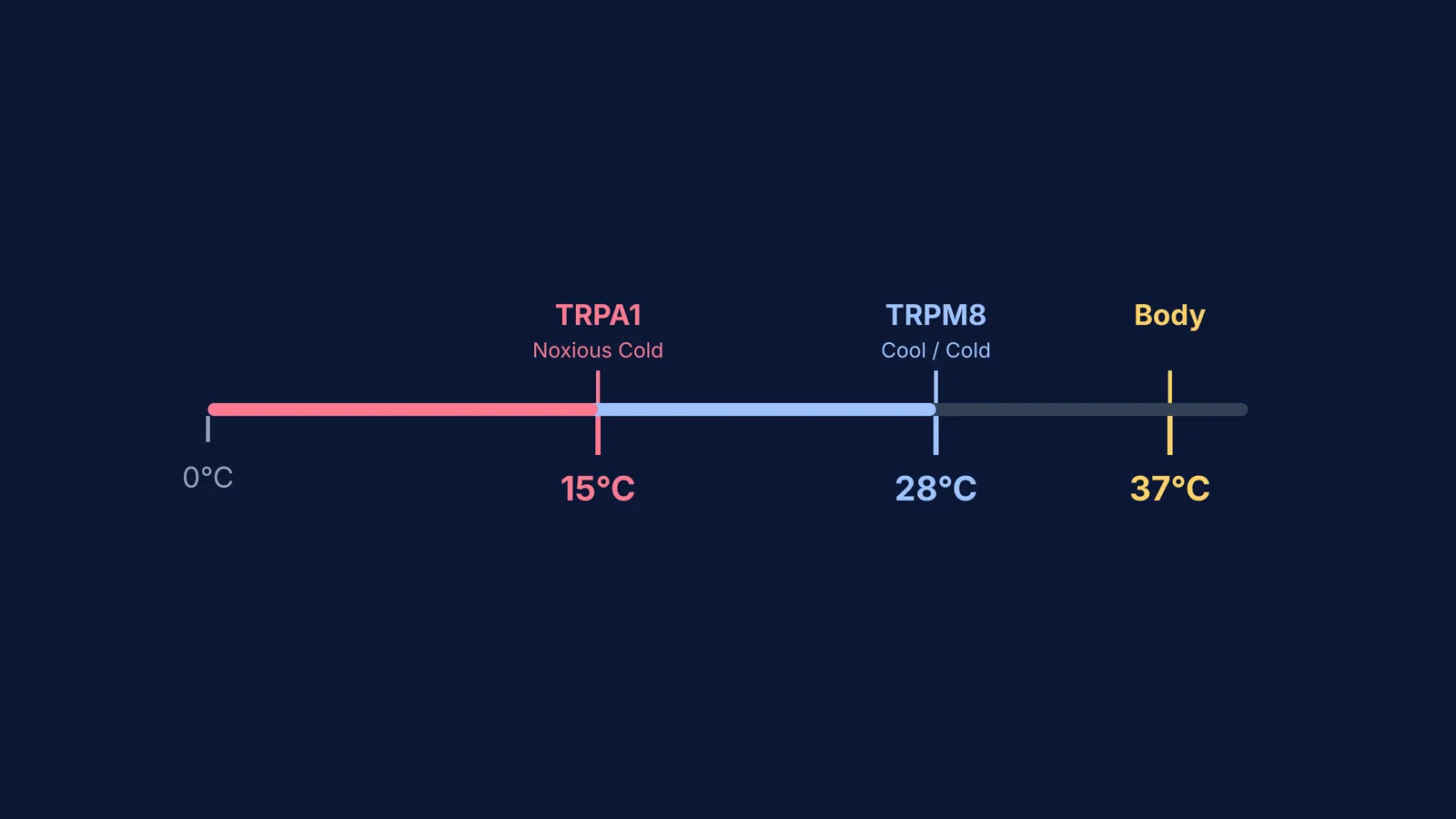
TRPM8: This is known as the "cool" sensor. It activates when the local skin temperature drops below approximately 28°C (DOI: 10.1523/JNEUROSCI.5672-12.2013). This channel gives you the initial, non-painful sensation of cold. Interestingly, TRPM8 is also triggered chemically by menthol, which is the exact reason why mint leaves a cool feeling in your mouth.
TRPA1: This channel acts as the primary nociceptor, or pain receptor, for the cold. As the tissue temperature drops further, noxious cold (which is often defined physiologically as below 15°C) triggers the TRPA1 channel into action (DOI: 10.1085/jgp.200810146). The biological job of TRPA1 is to send an urgent warning to the parts of the human brain that the peripheral tissue is at imminent risk of freezing and thermal damage.
When the wind strips away your body heat and forcibly drives your ear's skin temperature past that 15°C threshold, the TRPA1 channels fire en masse. The sensation in your ear instantly shifts from a mild cool feeling to a severe burning, stinging pain.
How can you protect your ears from the cold?
Because your ears absolutely cannot retain heat on their own, you have to provide the boundary layer manually before you step outside.
Cover the cartilage entirely: A wool or thick fleece beanie traps a substantial layer of still air directly against the skin, completely preventing convective heat loss.
Block the wind: In high winds, wearing a tightly woven, windproof shell over your ears is significantly more important than pure material thickness, as it definitively stops the moving air from stripping away the boundary layer.
Warm up slowly: If your ears are already hurting (meaning the TRPA1 channels are actively firing), applying direct, high heat from a radiator or hot water is not recommended. Cupping your ears with your warm hands or going indoors lets the constricted blood vessels slowly dilate back to normal.
Explore the Fermi Simulation Lab to see how cooling rates change with the wind.


