

On this page
Place a lit candle in a shallow water dish, cover it with an inverted glass jar, and within seconds the flame goes out as water rises up the cylinder. For decades, classroom demonstrations described in Science & Education presented this experiment as visual proof that air contains 21% oxygen. The traditional claim held that the flame consumes all the oxygen, leaving an empty volume that atmospheric pressure refills with water.
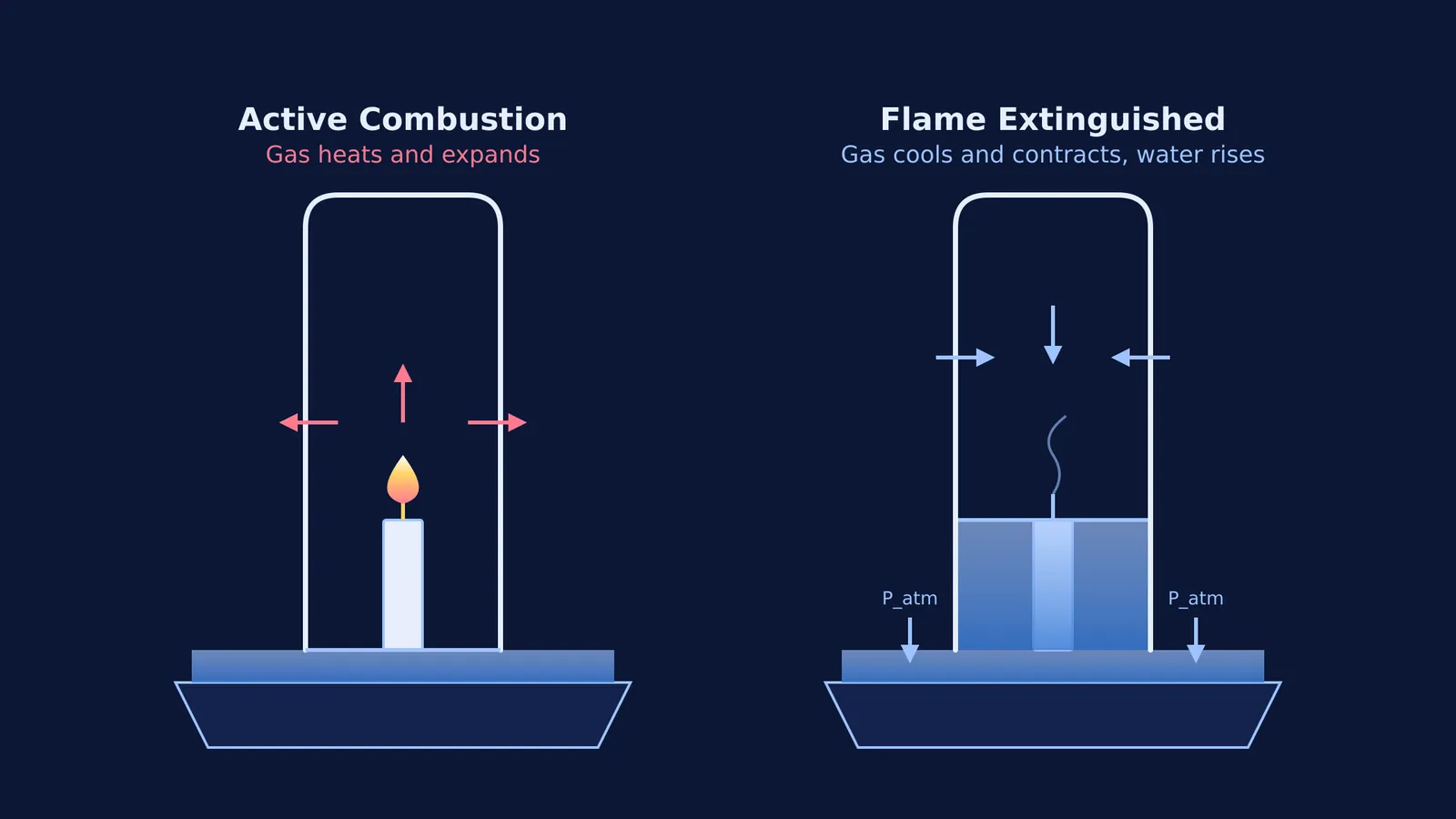
That explanation is mistaken. The water rise is driven primarily by thermal contraction and gas expansion rather than oxygen consumption. When the jar covers the flame, hot air rapidly expands, and some bubbles out beneath the rim before a water seal forms. Once the candle extinguishes, the trapped air cools back toward room temperature. As temperature drops, internal pressure plummets according to the ideal gas law, and outside atmospheric pressure pushes water upward until pressures equalize.
Why does the oxygen-consumption theory fail?
The oxygen-depletion claim fails on basic chemical stoichiometry. Paraffin wax consists of alkane hydrocarbons, approximately C₂₅H₅₂. Complete combustion follows a balanced reaction:
C₂₅H₅₂ + 38 O₂ → 25 CO₂ + 26 H₂O
For every 38 moles of oxygen gas consumed, the reaction generates 25 moles of carbon dioxide gas and 26 moles of water vapour. As noted in the Journal of Chemical Education, while water vapour condenses into liquid droplets on the glass, carbon dioxide remains a gas. Even if every molecule of oxygen were consumed, the net gas loss would be only 13 moles, or roughly 34% of the consumed oxygen volume.
Furthermore, a candle flame never uses all the oxygen in a jar. Studies in the Journal of Chemical Education confirm that candle flames extinguish when oxygen levels drop to around 10% to 15%, well above 0%. Because ambient air contains 21% oxygen, the flame burns only about 6% to 11% of the total gas volume. When multiplied by the 34% net shrinkage from stoichiometry, the chemical loss accounts for only 2% to 4% of the jar's volume. To see how fuel and air interact across different zones of a flame, see our guide on combustion and flame fundamentals.
What happens to air pressure and temperature inside the jar?
The true driver of the water rise is the ideal gas law, PV = nRT, formalized by Emile Clapeyron. Rather than a chemical vacuum, the rise follows three distinct thermal stages documented in The Physics Teacher:
Expansion and venting: As the jar lowers over the flame, air heats and expands, often bubbling out past the rim.
Burning at high temperature: While the flame is alight, elevated temperatures keep internal gas pressure high. High-speed recordings show water remains level or even depresses slightly during active burning.
Thermal contraction: The moment the flame dies, the heat source vanishes and the trapped gas cools down to room temperature.
For example, if a 500 mL cylinder's average gas temperature drops from 350 K to 295 K, Charles's law shows how the gas volume contracts:
V₂ = V₁ × (T₂ / T₁) = 500 mL × (295 K / 350 K) ≈ 421 mL
This 55 K temperature drop contracts the gas by 79 mL, producing a 15.8% water rise on its own. As verified by pressure tracking in Science & Education, hydrostatic pressure from a 5 cm water column adds only about 490 Pa, less than 0.5% of standard atmospheric pressure (101,325 Pa), so outside air pressure readily pushes water upward until equilibrium is reached. To explore how gas state variables change across thermodynamic paths, see our explainer on converting PV, PT and VT graphs.
How can you test the gas-law explanation yourself?
You can test the thermal explanation with three simple classroom checks:
Check the timing: If oxygen loss drew the water, the water level would rise steadily throughout the burn. Instead, water remains low while the flame is lit and surges upward within 1 to 2 seconds after it goes out, as detailed in The Physics Teacher.
Change the number of candles: When researchers in the Journal of Chemical Education compared one candle to four candles in identical jars, the four-candle trial pulled water dramatically higher. Because the jar contains the same 21% oxygen in both cases, the extra rise reflects greater heat and greater thermal contraction.
Heat without combustion: In another demonstration in the Journal of Chemical Education, researchers heated air inside an inverted vessel using an electric resistance coil without burning oxygen. When turned off, the cooling air drew water upward in the exact same manner.
When studying thermal and fluid dynamics, visual models help connect microscopic temperature changes to macroscopic pressure shifts. In the Simulation Lab, you can explore interactive simulations for the ideas that are easier to see than to read, adjusting temperature, volume, and moles to observe gas behavior in real time.


