

On this page
Every time you eat or drink, bacteria in the dental plaque biofilm ferment carbohydrates into organic acids, primarily lactic acid. Within minutes, plaque pH plunges from near-neutral into acidic territory. While many assume brushing is merely mechanical scrubbing to clear food debris, the primary active ingredient in modern dentifrice—fluoride—functions as a targeted chemical shield.
According to the World Health Organization, oral diseases affect nearly 3.7 billion people globally, with untreated dental caries in permanent teeth being the most common condition. The WHO recommends twice-daily brushing with toothpaste containing 1000 to 1500 ppm fluoride to prevent tooth decay. In India, under Bureau of Indian Standards IS 6356, commercial fluoridated toothpaste is formulated with up to 1000 ppm of fluoride ions. Fluoride is not a cosmetic detergent; it chemically restructures tooth enamel to resist acid.
What happens to tooth enamel when mouth pH drops?
According to dental researcher Colin Dawes, human tooth enamel is roughly 96% inorganic mineral by weight, consisting almost entirely of crystalline hydroxyapatite, Ca10(PO4)6(OH)2. Under resting oral conditions, saliva maintains a neutral pH between 6.7 and 7.3, supersaturated with calcium and phosphate ions that preserve the mineral structure.
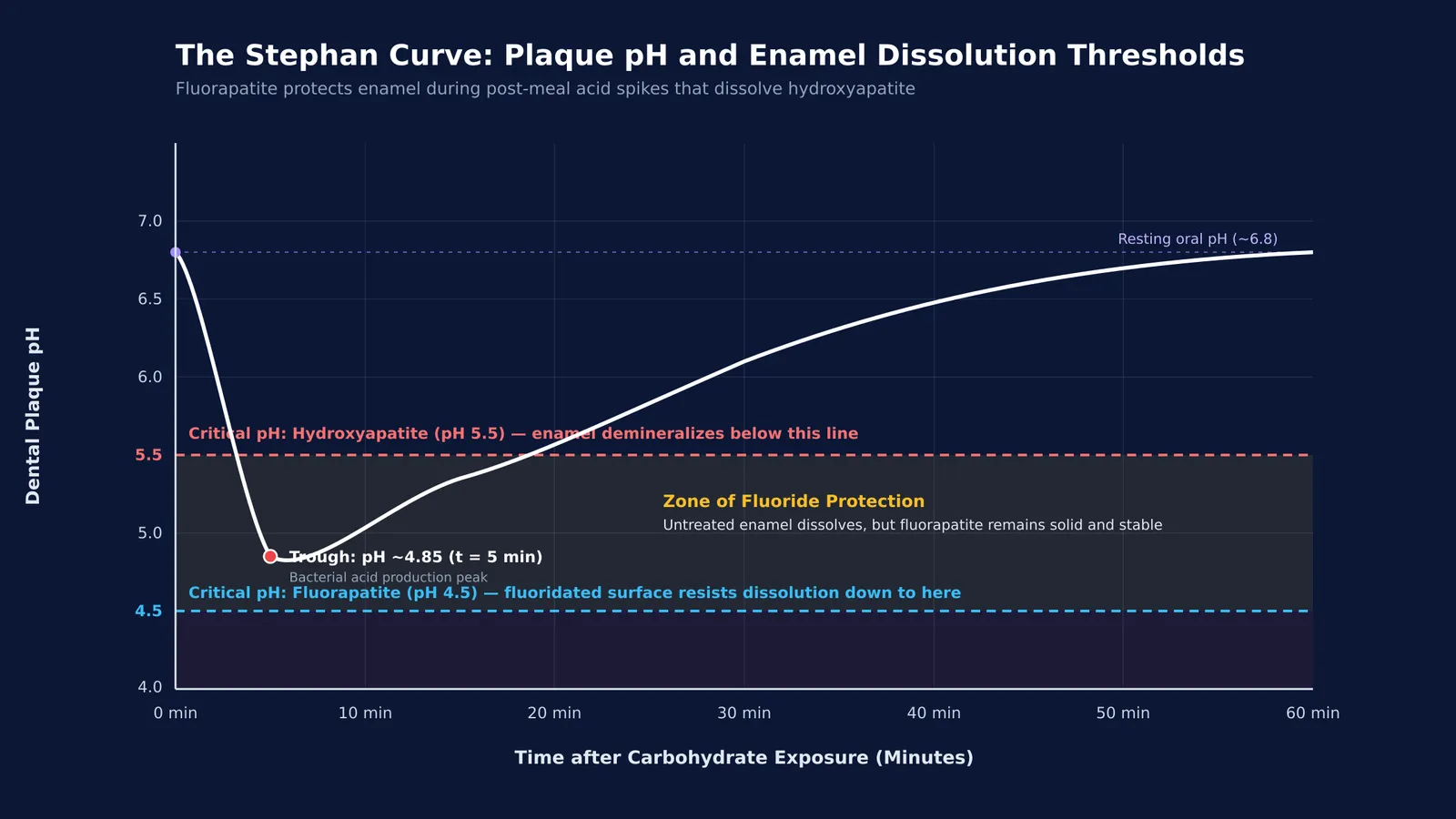
In a landmark 1944 study in the *Journal of Dental Research*, Robert M. Stephan demonstrated that rinsing with glucose causes plaque pH to plunge from 6.8 to 4.8 within 5 minutes, followed by a 40-minute salivary recovery. Enamel dissolution begins whenever plaque fluid becomes undersaturated with respect to the mineral phase.
For hydroxyapatite, this critical threshold sits at pH 5.5. When bacterial fermentation pushes oral pH below 5.5, hydrogen ions react with phosphate and hydroxyl ions in the enamel matrix:
Ca10(PO4)6(OH)2 + 8 H⁺ ⇌ 10 Ca²⁺ + 6 HPO4²⁻ + 2 H2O
By Le Chatelier's principle, this protonation removes products from the solution and shifts the dissolution equilibrium to the right, leaching calcium and phosphate into solution—a process termed demineralization. For students examining heterogeneous equilibria where solids drop out of the equilibrium expression or Søren Sørensen and why pH counts in powers of ten, enamel loss provides a concrete biological demonstration of solubility products and ionic equilibria in action.
How does fluoride convert hydroxyapatite into fluorapatite?
In *Critical Reviews in Oral Biology & Medicine*, ten Cate and Featherstone detailed how fluoride alters this equilibrium by replacing hydroxyl groups within the crystal lattice:
Ca10(PO4)6(OH)2 + 2 F⁻ ⇌ Ca10(PO4)6F2 + 2 OH⁻
This substitution yields fluorapatite, Ca10(PO4)6F2. Because fluoride ions have a slightly smaller ionic radius (133 pm) than hydroxyl ions (137 pm), they pack more tightly and symmetrically into the calcium triangles of the crystal lattice. This compact geometry produces stronger electrostatic attractions and lowers the lattice energy of the mineral.
As John D. B. Featherstone confirmed in *Community Dentistry and Oral Epidemiology*, sub-ppm concentrations of fluoride in oral fluids fundamentally alter dissolution kinetics, shifting the critical dissolution threshold of the enamel surface from pH 5.5 down to approximately pH 4.5.
Because the pH scale is logarithmic, an oral environment at pH 4.5 has 10 times the hydrogen ion concentration of one at pH 5.5. Between pH 4.5 and 5.5, pure hydroxyapatite actively dissolves, but fluorapatite remains solid and stable. Because normal post-meal acid spikes typically reach a minimum between pH 4.8 and 5.0, a fluorapatite surface does not dissolve. Furthermore, as saliva buffers plaque acid back toward neutrality, trace fluoride accelerates the precipitation of calcium and phosphate ions from saliva, rebuilding microscopic enamel defects.
Students can explore these phase changes in the Fermi Simulation Lab, testing how ion concentrations and pH alter equilibrium across mineral surfaces. The Fermi Concept Library connects these reactions to solubility products and how temperature and auto-ionization govern neutral pH.
How do oral conditions affect fluoride retention and enamel repair?
Fluorapatite forms and protects teeth only if fluoride ions remain present in oral fluids at effective levels. A 2019 Cochrane systematic review of 96 randomized controlled trials by Tanya Walsh and colleagues confirmed that toothpastes containing 1000 to 1500 ppm fluoride significantly reduce decayed, missing, and filled tooth surfaces compared to non-fluoride dentifrice.
Oral health research identifies two key biophysical factors that govern how effectively fluoride rebuilds enamel in daily life:
Salivary fluoride clearance: Rinsing vigorously with water immediately after brushing dilutes and clears dissolved fluoride ions before they can diffuse into plaque fluid. Spitting out excess foam without an immediate water rinse preserves a salivary reservoir that sustains elevated fluoride concentrations to drive remineralization over the following hour.
Salivary buffering before mechanical stress: Ingesting carbohydrates causes an immediate drop in plaque pH, temporarily softening outer enamel crystals through partial demineralization. Waiting roughly 30 minutes before brushing allows salivary bicarbonate to buffer acids back above pH 5.5, restoring mineral stability before toothbrush bristles make mechanical contact.


