

On this page
After a heavy monsoon downpour or summer thunderstorm, city skylines that were swallowed by a grey, milky murk stand out in sharp relief. Distant hills reappear, foliage looks richer, and the sky overhead turns an intense, crystalline azure.
This transformation is driven by atmospheric physics. Raindrops physically cleanse the air through below-cloud scavenging, altering how sunlight scatters between your eye and the horizon.
How does rain wash pollutants out of the air?
The lower atmosphere carries suspended solid and liquid particles called aerosols, including dust, soot, sea salt, and vehicular emissions (PM10 and PM2.5).
When rain falls from cloud base to ground, raindrops collide with suspended particles and drag them down. According to research published by Tian Luan and colleagues in the *Journal of Meteorological Research* (Luan et al., 2019), rainfall intensity governs this scavenging efficiency:
Light rain removes an average of 5.1% of PM2.5 particles.
Moderate rain removes roughly 38.5% of PM2.5 particles.
Heavy rain scrubs 50.6% of PM2.5 particles out of the air column.
For coarse dust (PM10), collection efficiency is even higher because their inertia prevents them from swerving around falling raindrops.
What is the Greenfield gap in aerosol washout?
Rain does not scavenge all particles with equal ease. In 1957, atmospheric physicist S. M. Greenfield showed that collection efficiency drops sharply for particles between 0.1 micrometres and 1.0 micrometres in diameter (Greenfield, 1957014<0115:RSORPM>2.0.CO;2)). This dip is called the Greenfield gap.
Ultrafine particles under 0.1 micrometres collide with raindrops via rapid Brownian diffusion. Large particles over 1.0 micrometres collide via inertial impaction, governed by droplet drag as examined in George Stokes and why tiny drops fall so slowly through air. Particles inside the Greenfield gap are too heavy for effective diffusion and too light for inertial capture. However, prolonged downpours eventually deplete them.
Why does removing dust turn the sky a deeper blue?
Clearing particulate matter shifts the atmosphere between two distinct optical scattering regimes:
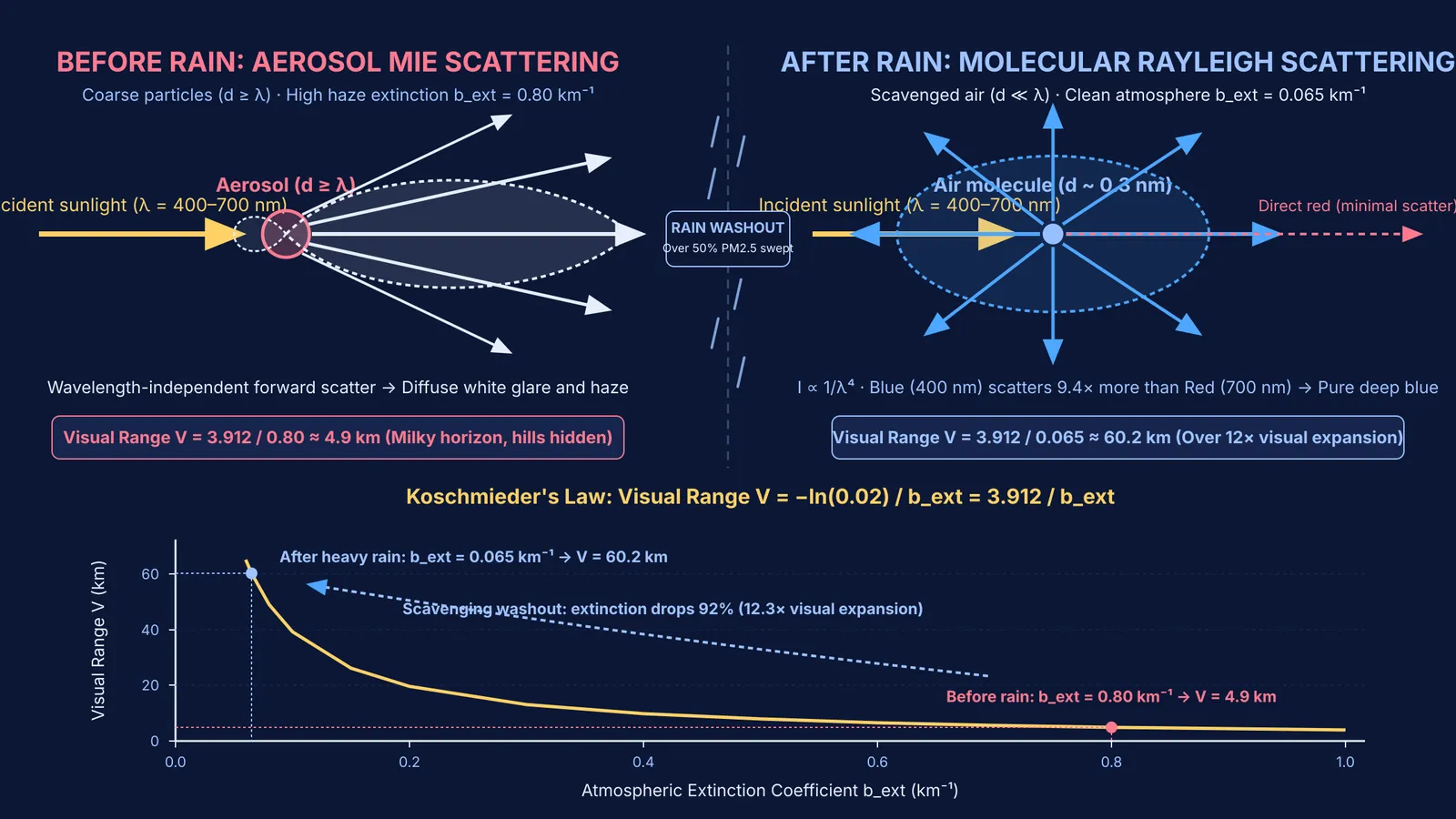
Mie scattering before rain: Aerosols comparable to or larger than visible light wavelengths (λ ≈ 400 to 700 nanometres) cause Mie scattering, formulated by Gustav Mie in 1908 (Mie, 1908). Mie scattering affects all visible colours nearly equally and scatters strongly forward. This produces a white, diffuse glare that washes out celestial colour, like colloidal scattering in John Tyndall and the light beam that shows a colloid is there.
Rayleigh scattering after rain: Once rain removes aerosols, sunlight interacts primarily with nitrogen and oxygen molecules (d < 0.5 nanometres). As derived by Lord Rayleigh in 1871 (Strutt, 1871), scattered intensity varies inversely with the fourth power of wavelength: I ∝ 1/λ⁴. Blue light (λ ≈ 400 nanometres) scatters about (700/400)⁴ ≈ 9.4 times more strongly than red light (λ ≈ 700 nanometres). With white Mie haze stripped away, pure Rayleigh blue reaches your eye with deep saturation, as outlined in scattering of light in the atmosphere and rainbow formation.
How does Koschmieder's law measure the change in visibility?
The sudden clarity of distant landmarks follows Koschmieder's law, reviewed by Helmuth Horvath in *Atmospheric Environment* (Horvath, 198190214-6)). Visual range V is the maximum distance at which a dark target is distinguishable against the horizon: V = −ln(ε) / b_ext = 3.912 / b_ext
Here, ε = 0.02 is the human eye's standard 2% contrast threshold, and b_ext is the extinction coefficient in km⁻¹.
Consider a worked comparison before and after rain:
Before rain (polluted air): High aerosol loading gives an extinction coefficient of b_ext = 0.80 km⁻¹.
V = 3.912 / 0.80 km⁻¹ ≈ 4.89 km. Hills just 5 km away disappear in the haze.
After heavy rain (scavenged air): Washout removes over 50% of PM2.5 and nearly all coarse dust, lowering extinction to b_ext = 0.065 km⁻¹.
V = 3.912 / 0.065 km⁻¹ ≈ 60.18 km.
By dropping the extinction coefficient, rain expands visual range more than 12 times.
A quick framework for predicting post-rain clarity
To gauge whether a rain shower will yield clear skies, check these three factors:
Rain intensity: Light drizzles often worsen haze because high humidity causes hygroscopic aerosols to absorb water and swell into larger light-scattering droplets. Sustained convective downpours provide the droplet density required to wash fine particles out of the air column.
Air mass movement: Clean air lasts longer when a passing weather front brings fresh winds that disperse local emissions rather than leaving stagnant air behind.
Surface drying: While damp ground suppresses ground-level dust, sunlight eventually dries road surfaces and topsoil, allowing traffic and surface winds to resuspend particulate matter within a couple of days.
For students exploring how wave optics and particle scattering interact across scales, the Fermi Simulation Lab provides interactive simulations for the ideas that are easier to see than to read. To connect these principles to wave optics and atmospheric mechanics, students can explore the Fermi Concept Library, where every concept in physics and chemistry has its own lesson and its place in the map.


