

On this page
When a full moon rises over rooftops, trees, or hills, it often looks gigantic, like an enormous glowing lantern hovering over the landscape. Step outside hours later when the Moon sits high at the zenith, and it looks strikingly smaller.
Intuition suggests that Earth's atmosphere magnifies the lunar disk. Yet when you measure the light rays entering your eye, you find one of visual science's oldest puzzles: the Moon on the horizon is optically no larger than when overhead.
Does Earth's atmosphere magnify the Moon?
A popular belief is that the thick layer of atmosphere along the horizon acts like a convex magnifying lens. Optical physics shows the exact opposite.
Atmospheric refraction bends light upward as air density changes with altitude. Because the Moon's lower limb sits in denser air than the upper limb, differential refraction lifts the bottom edge upward more than the top edge. Rather than magnifying the disk, this atmospheric gradient vertically compresses the horizon Moon into an oval.
The atmosphere does cause atmospheric scattering, stripping away shorter blue wavelengths to leave a warm red-orange hue. But as planetary data in the NASA Moon Fact Sheet confirms, atmospheric optics never inflates the Moon's physical or angular diameter.
How does the Moon's angular diameter change across the sky?
In geometry and heights and distances problems, the angular diameter θ of a sphere of diameter d at distance D is θ ≈ d / D (in radians).
The NASA Moon Fact Sheet lists the Moon's volumetric mean diameter as 3,474 km and its mean orbital distance from Earth's center as 384,400 km. This yields an angular diameter of roughly 0.009038 radians, or 0.518 degrees (31.1 arcminutes).
Now consider how distance shifts as Earth rotates. On the horizon, your distance to the Moon is roughly the center-to-center distance of 384,400 km. But at the zenith, you stand on Earth's surface, one Earth radius (6,371 km) closer to the Moon:
D_zenith = 384,400 km − 6,371 km = 378,029 km
θ_zenith ≈ 3,474 / 378,029 ≈ 0.009190 radians ≈ 0.527 degrees
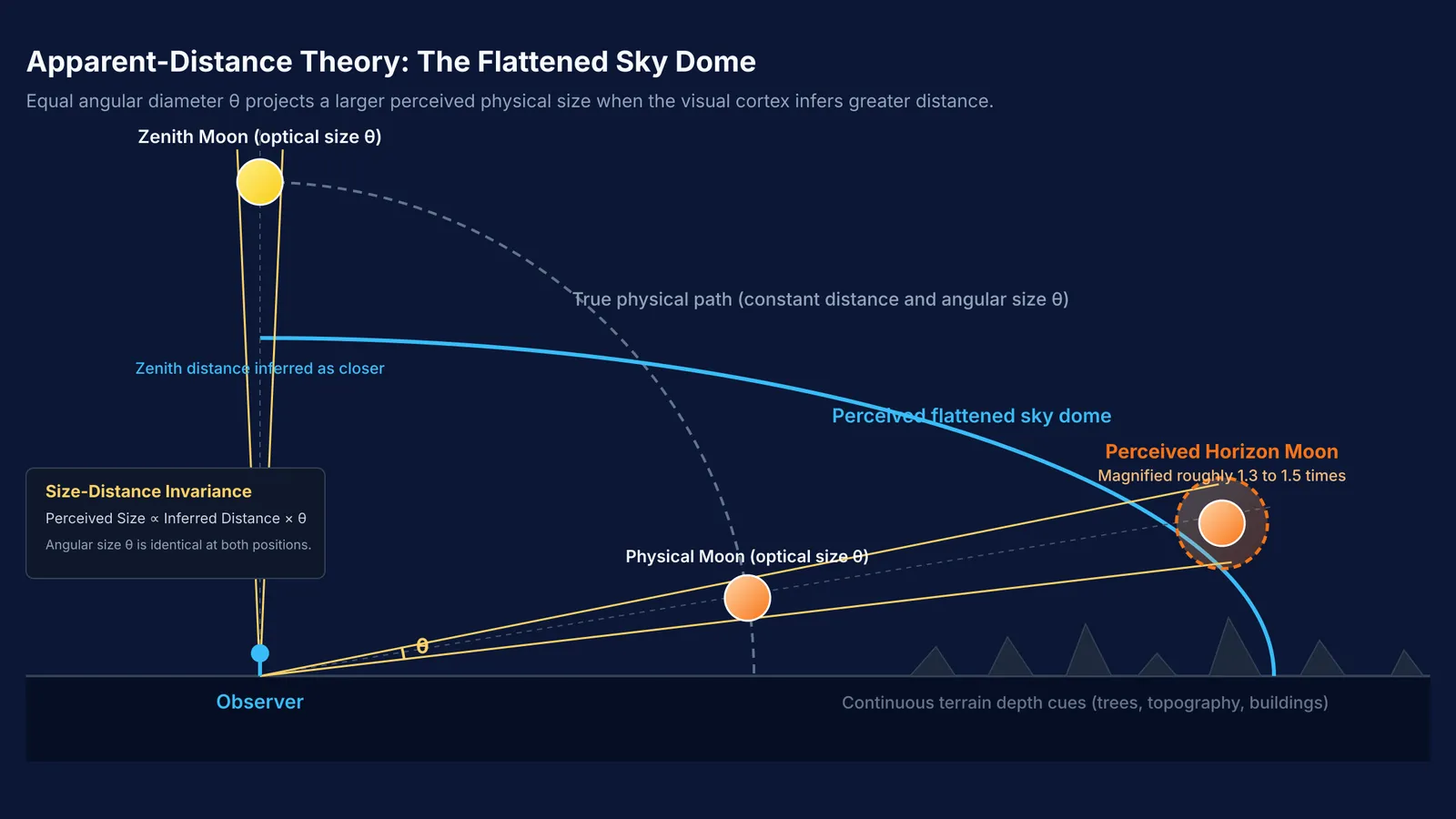
Because you stand closer to the Moon at the zenith, its retinal image is actually about 1.7% larger overhead than on the horizon. Yet human observers perceive the horizon Moon as dramatically larger.
Why does your brain scale up the horizon Moon?
The answer lies in how our visual cortex reconstructs three-dimensional space from flat retinal images.
In a classic study in *Science*, psychologists Irvin Rock and Lloyd Kaufman demonstrated that the illusion depends on ground terrain in their 1962 Moon illusion study. When terrain cues were masked, the illusion disappeared. In their 2000 PNAS paper, Lloyd Kaufman and James H. Kaufman confirmed that our perceptual system treats the horizon as significantly farther away than the zenith. Across psychophysical trials, observers judge the horizon sky as roughly 4 times farther away, scaling perceived size by a factor of 1.3 to 1.5.
This response reflects the flattened sky dome model. Because the ground provides continuous depth cues—trees, buildings, and roads—the brain infers that the horizon is far away. By the size-distance invariance principle, when two objects cast equal retinal images, the brain judges the one presumed to be farther away as physically larger.
Helen Ross and Cornelis Plug noted in *The Mystery of the Moon Illusion* that relative scale reinforces this: on the horizon, the Moon sits against tiny distant silhouettes, while overhead it floats in an empty expanse. Understanding the optics of the human eye shows how perception blends retinal input with unconscious depth assumptions.
In physics, visualizing ray paths clarifies non-intuitive spatial geometry. In the Fermi Simulation Lab, you can explore interactive simulations for ideas that are easier to see than to read, testing angles of elevation and optical paths. You can also explore optics principles in the Fermi Concept Library, which covers every concept in physics, chemistry, biology, mathematics and computing, each with its own lesson and its place in the map.
How can you test the Moon illusion yourself?
You can test and break the illusion during any clear full moon:
The paper tube test: Roll a sheet of paper into a tube framing the horizon Moon. Look through it with one eye closed to block the terrain. Without horizon depth cues, the Moon instantly shrinks.
The coin test: Hold a small coin at arm's length to cover the rising Moon. Repeat the test at the zenith: the coin covers the disk equally well, proving the optical diameter has not changed.
The smartphone photo test: Photograph the Moon at the horizon and hours later at the zenith using the same camera zoom. The Moon occupies the exact same pixel diameter in both images.
The inverted view test: Turn around, bend over, and view the horizon Moon upside down between your legs. Disrupting your vestibular orientation and landscape processing noticeably diminishes the illusion.
Separating sensory data from cognitive interpretation is central to scientific thinking. The giant Moon is an elegant reminder to test intuition against measurement.


