

On this page
If you have ever left a stainless steel pan on a hot stove empty, you likely saw a vivid rainbow of colours—yellows, blues, and purples—bloom across the metal. These heat tints might look like permanent burn marks, but they are actually an optical illusion created by chemistry and the wave nature of light.
The colours do not come from a change in the steel itself, but from a microscopic, transparent film that grows on its surface when heated.
What is the invisible shield on steel?
Stainless steel does not rust easily because it contains chromium. When exposed to the air, this chromium reacts with oxygen to form a continuous, transparent layer of chromium oxide over the metal. This passive layer acts as a seal, and is completely invisible because it is incredibly thin.
For more on how oxygen affects metals over time, you can read our guide to corrosion and rancidity in Class 10 science.
How does heat change the oxide layer?
When you heat the steel, the oxidation reaction speeds up. The ASM Handbook on Heat Treating of Irons and Steels notes that steel takes on various temper colours due to the formation of a thin oxide film.
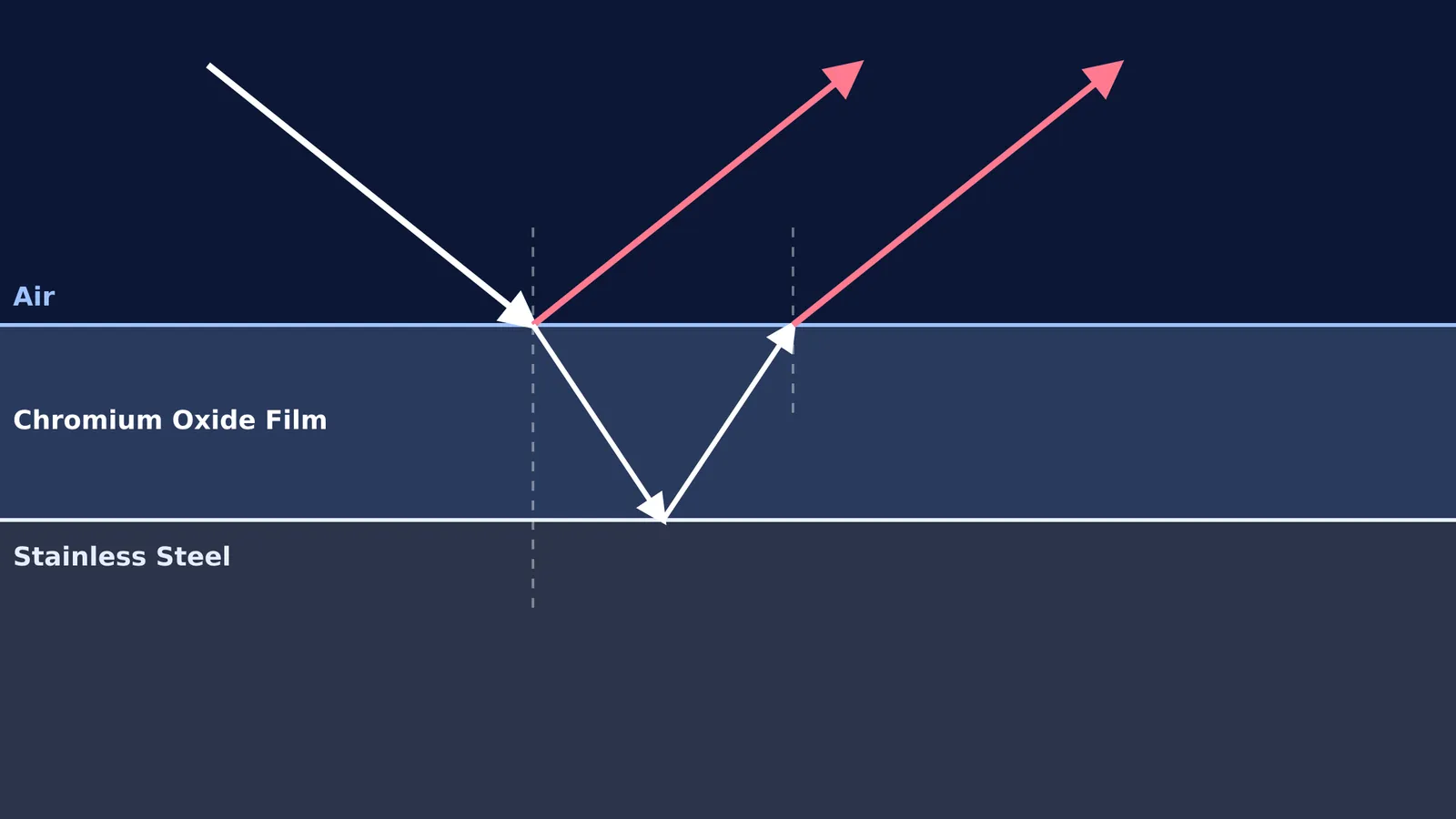
The chromium oxide layer draws more chromium from the metal below and thickens. The higher the temperature, the thicker the oxide film grows. Because the film is transparent, light passing through it splits. Some light reflects off the top surface of the oxide, where it meets the air. The rest penetrates the film and reflects off the shiny steel surface underneath.
When these two reflected light waves recombine in the air, they interfere with each other.
Why do thin films create colours?
If the oxide layer reaches a thickness that is roughly one-quarter of a specific colour's wavelength, that colour's light wave travels an extra half-wavelength by going through the film and back. The wave reflecting from the top and the wave from the bottom will be exactly out of step. They cancel each other out—a process called destructive interference.
If you remove one colour from white light, your eye sees the mix of colours that remains.
As the steel heats up and the film thickens, the cancelled wavelength shifts through the spectrum. According to the British Stainless Steel Association, this creates a predictable sequence of colours linked directly to the temperature it reached in air:
290 °C: The film cancels violet light, leaving a pale yellow.
340 °C: It cancels blue light, deepening the colour to straw yellow.
420 °C: Green is cancelled, creating a purple-brown hue.
540 °C: Red and orange are cancelled, leaving a vivid blue.
The relationship between phase difference and path difference is a core physics concept. If you want to see exactly how these waves cancel each other out, the Fermi Simulation Lab offers interactive simulations that let you watch reflected waves interfere in real time.
The problem with the rainbow
While a rainbow pan might look striking, heat tint is a warning sign in industry. Because the thickening oxide layer pulls chromium out of the metal just beneath it, it creates a chromium-depleted zone.
This zone is far less resistant to corrosion than the original stainless steel. In critical applications like food manufacturing or marine engineering, any tint darker than pale yellow means the steel is vulnerable to rusting and pitting.
How can you restore your pan?
You cannot scrub a heat tint away with regular soap because it is not a stain; you must dissolve the thickened oxide layer to expose fresh metal. Here is a practical checklist to remove it:
Wait for it to cool: Never run a very hot pan under cold water, as the thermal shock can warp the steel.
Apply a weak acid: White vinegar (acetic acid) or a paste made of water and a specialized acidic cleaner works well. The acid breaks down the excess chromium oxide.
Let it sit: Give the acid several minutes to react with the oxide layer.
Scrub with a non-abrasive pad: Use a soft sponge. Avoid steel wool, which will scratch the surface and leave iron particles behind that will rust.
Rinse and dry: Wash the pan with warm soapy water and dry it immediately to let the invisible passive layer rebuild itself naturally in the air.


