

On this page
You might stand in the supermarket aisle wondering if the brown eggs are worth the extra cost. Many people assume a brown shell means a more natural, farm-fresh, or nutritious egg, much like wholewheat bread is healthier than white bread.
In reality, the difference comes down to basic biology. Every egg starts with a white shell made of calcium carbonate. Whether it stays white or turns brown is determined entirely by the hen that laid it, and the timing of a very specific biological painting process.
Why are some eggs brown and others white?
Eggshell colour is a genetic trait tied directly to the breed of the chicken. A surprisingly reliable indicator of an egg's colour is the hen's earlobe. Generally, hens with white feathers and white earlobes, such as the White Leghorn, lack the genetic instructions to produce shell pigments, so their eggs remain white. Hens with red feathers and red earlobes, such as the Rhode Island Red or the Marans, possess a genetic pathway that produces brown pigment.
The primary pigment responsible for brown eggs is protoporphyrin IX. This compound is a precursor to heme—the same iron-containing molecule that gives red blood cells their crimson colour and carries oxygen through the body (you can read more about heme in our guide to the formed elements of blood). When protoporphyrin IX is deposited on the calcium carbonate shell, it creates a brown appearance.
Interestingly, this is different from how blue or green eggs get their colour. Breeds like the Araucana use a different pigment, biliverdin, which is integrated into the shell matrix from the very beginning of its formation. This means a blue egg is blue all the way through, whereas a brown egg's visible pigment is concentrated on the outer surface, leaving the inside of the shell white.
When does the egg get its colour?
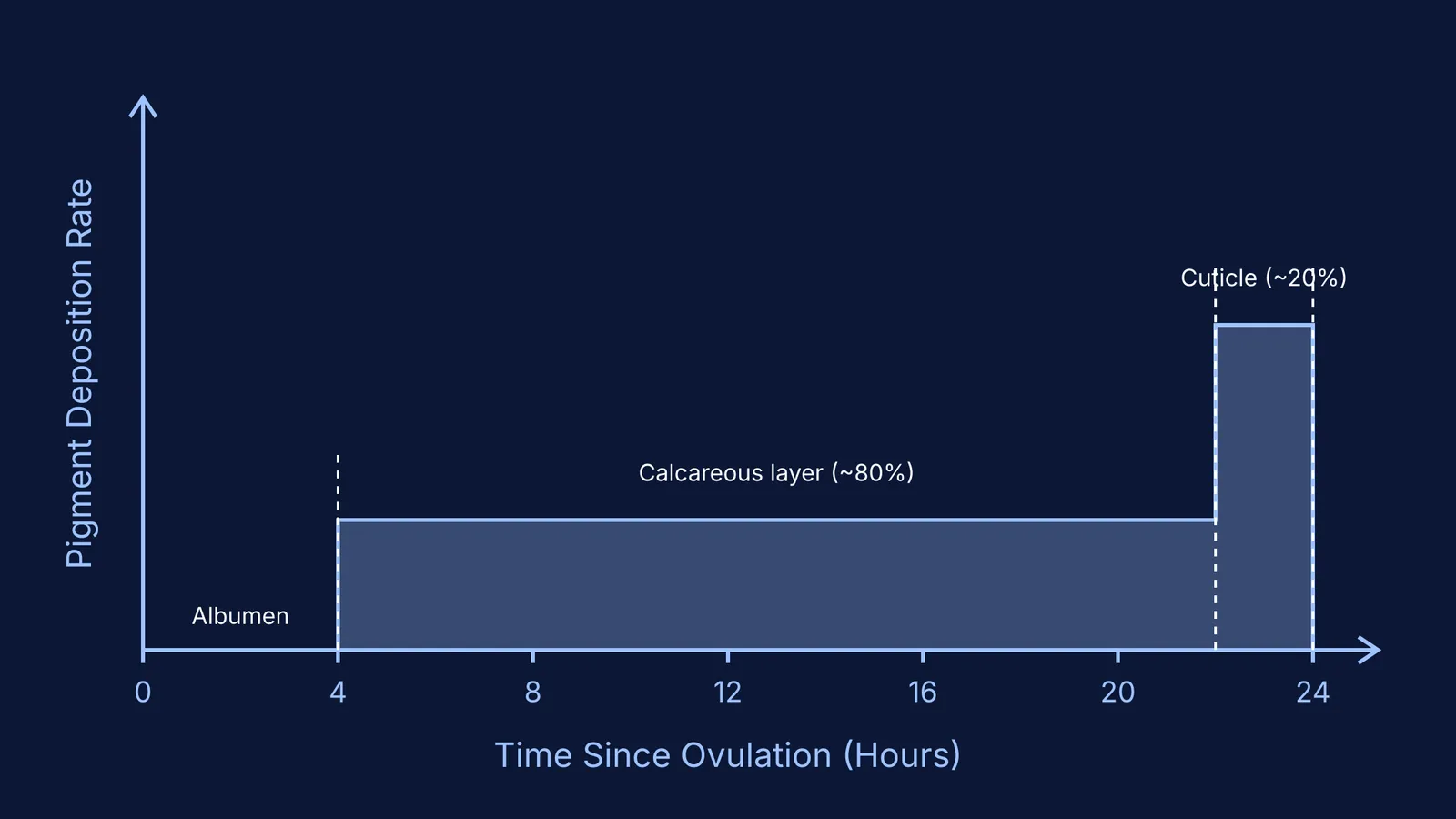
An egg takes about a day to form as it travels through the hen's reproductive tract, known as the oviduct. Most of this journey—roughly 20 hours—is spent in the shell gland, or uterus, where the hard calcium carbonate shell is gradually built layer by layer.
While some protoporphyrin IX is deposited throughout the time in the shell gland, the highest concentration is applied to the egg during the final few hours before laying.
Because this peak pigmentation happens so late in the process, it acts much like a coat of paint. Up to 20% of this pigment sits in the cuticle, also known as the "bloom." This is the very outermost protective waxy layer of the shell that seals the pores and blocks bacteria.
When studying biological pathways, reading about pigments and glands can feel abstract. The Fermi Simulation Lab has interactive simulations for the ideas that are easier to see than to read.
Are brown eggs healthier than white eggs?
Despite popular misconceptions, there is no significant nutritional difference between brown and white eggs. According to the USDA FoodData Central database, a standard large egg contains roughly 72 calories and 6.3 grams of protein, regardless of its shell colour. Both types offer the exact same levels of essential vitamins and minerals, including 186 milligrams of cholesterol, as well as choline and selenium.
The reason brown eggs often cost more at the supermarket is simply an issue of agricultural scale. The breeds of chickens that lay brown eggs, like Rhode Island Reds, tend to be physically larger than the Leghorns that lay white eggs. A larger bird requires significantly more feed and space to produce a single egg, and that extra overhead cost is passed on to the consumer.
The only factor that genuinely alters the nutritional profile of an egg inside the shell is the hen's diet. Eggs marketed as enriched with Omega-3 fatty acids or extra vitamin D come from hens fed a specially formulated diet, not from a specific shell colour. Understanding these basic principles of inheritance and biology can clarify many everyday questions—just as it helps explain Mendelian disorders.


