

On this page
Of all the formulas in trigonometry, one stands above the rest as the most useful: sin²θ + cos²θ = 1. This equation is known as the Pythagorean trigonometric identity. It lets you find the cosine of an angle if you know its sine, simplifies massive equations, and acts as the starting point for proving almost every other rule in trigonometry.
But why is it always equal to exactly 1? The answer comes straight from geometry.
Why is sin squared plus cos squared equal to 1?
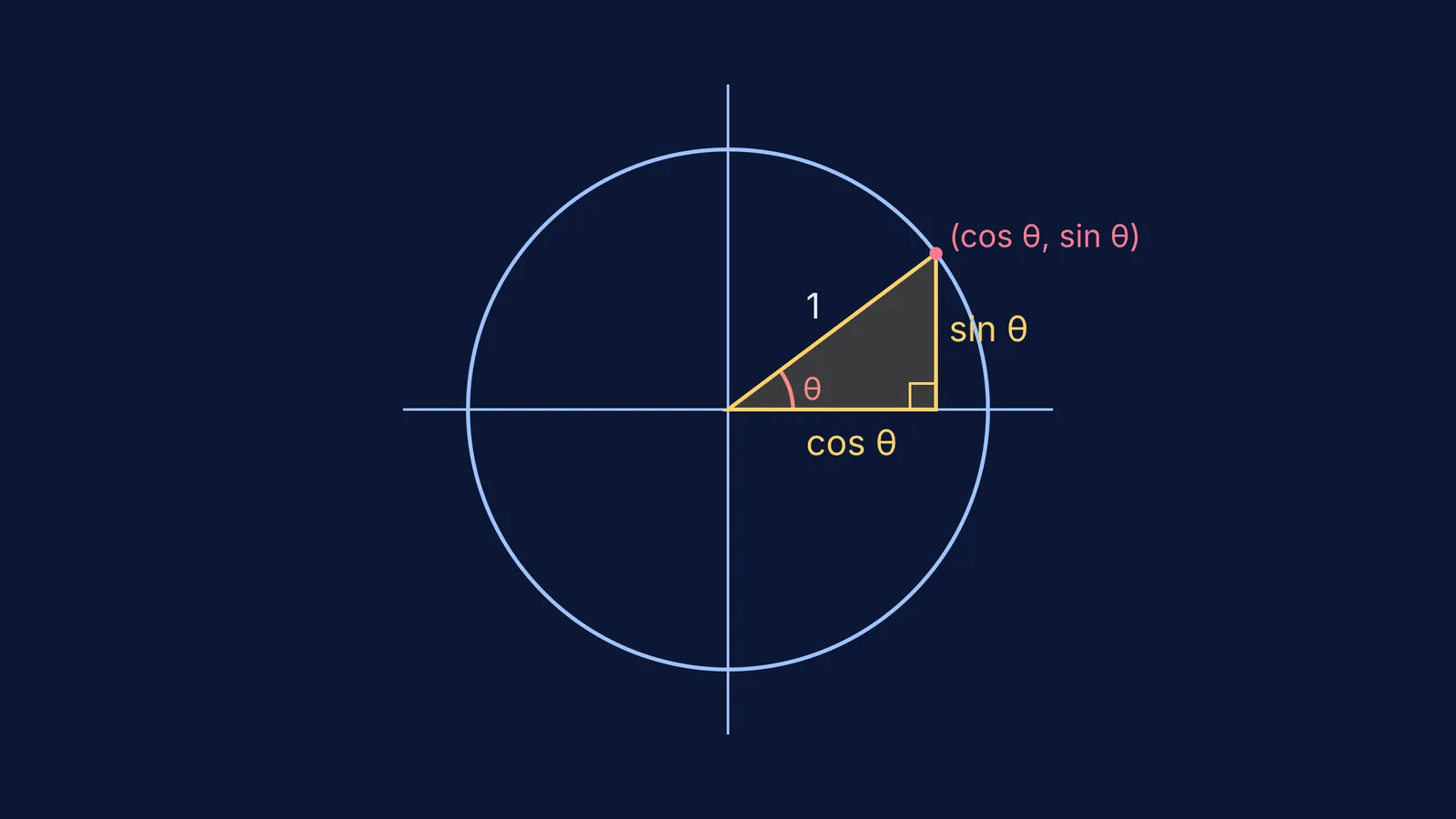
To see where this formula comes from, we draw a circle with a radius of exactly 1 unit (a "unit circle") on a coordinate graph. Then, we pick a point on that circle and draw a line from the origin (0,0) to that point.
If you drop a vertical line from that point straight down to the x-axis, you form a right-angled triangle.
The hypotenuse (the longest side) is the radius of the circle, which is exactly 1.
The horizontal base of the triangle is the x-coordinate of the point, which trigonometry defines as cos θ.
The vertical height of the triangle is the y-coordinate of the point, which is sin θ.
Now, we bring in the Pythagorean theorem, which states that for any right triangle, the square of the base plus the square of the height equals the square of the hypotenuse (a² + b² = c²). Historically, this identity is a foundational relation in trigonometry derived directly from this geometric principle, as detailed on Wikipedia. Substituting our sides into this theorem gives us the fundamental trigonometric identity: cos²θ + sin²θ = 1².
Since 1 squared is just 1, this simplifies directly to sin²θ + cos²θ = 1. The rule holds true for any angle θ, in any quadrant. Even if your angle is 150°, where the cosine is a negative number, squaring that negative number makes the result positive. The sum of the squares will always perfectly balance out to 1.
If you struggle to picture how changing the angle affects the triangle's sides, the Fermi Concept Library has a lesson for every concept in mathematics to help you build a solid visual foundation for these rules.
How do you find the secant and cosecant identities?
The Pythagorean identity is a two-for-one deal. If you can remember sin²θ + cos²θ = 1, you can generate the other two squared trigonometric identities simply by dividing.
Getting the secant identity Take the original equation and divide every term by cos²θ: (sin²θ / cos²θ) + (cos²θ / cos²θ) = 1 / cos²θ
Since sin/cos = tan and 1/cos = sec, this simplifies to: tan²θ + 1 = sec²θ
Getting the cosecant identity Take the original equation and divide every term by sin²θ: (sin²θ / sin²θ) + (cos²θ / sin²θ) = 1 / sin²θ
Since cos/sin = cot and 1/sin = csc, this simplifies to: 1 + cot²θ = csc²θ
How do you solve identity problems?
When an exam asks you to simplify a complex trigonometric fraction or prove that the left-hand side equals the right-hand side, look for squares.
Spot the squares: Any time you see a 1 next to a squared trig function (like 1 − sin²θ or sec²θ − 1), the Pythagorean identity is your tool.
Rearrange: You can shuffle the main identity to get cos²θ = 1 − sin²θ, or sin²θ = 1 − cos²θ. This allows you to swap out a messy subtraction for a single, neat term.
Substitute: Replace the complex part of the fraction with its simpler, rearranged equivalent to start cancelling terms out.
For example, if you are asked to simplify (1 − cos²θ) / (sin θ), you can substitute the top part. Because 1 − cos²θ equals sin²θ, your fraction becomes (sin²θ) / (sin θ). You can then cancel out one sine term, leaving you with just sin θ as your final, simplified answer. This strategy transforms intimidating problems into quick cancellations.
If you keep getting stuck halfway through proving an identity, it is often because you have forgotten one of these rearrangements. The Fermi Problem Library has worked problems with a step-by-step solver that explains the reasoning rather than printing an answer.
For more practice with trigonometric proofs and values, you can read our step-by-step derivations for the Exact values of sin 18° and cos 36°, derived step by step or explore Conditional identities when A + B + C = π, worked. If you are moving on to inverse functions, review [sin⁻¹(sin x) beyond [−π/2, π/2]: drawing the sawtooth graph](https://news.fermi.ai/academic-success/sin-inverse-sin-x-beyond-range).


