

On this page
The silver foil atop kaju katli and barfi is practically weightless. It clings to your fingers, vanishes on your tongue, and shatters if you breathe too hard on it. This fragile garnish, known as varq or waraq, is made of pure silver beaten down to a fraction of a micrometre.
But how does solid metal turn into a sheet thinner than paper? The answer lies in the atomic structure of silver—and the unique "flexible glue" of metallic bonding taught in Class 8 science.
How is silver varq made so thin?
To create varq, silver is hammered to a thickness of just 0.2 to 0.8 micrometres (Vark, Wikipedia). For comparison, this makes the edible foil hundreds of times thinner than a typical sheet of paper.
At this microscopic scale, the silver is safe to consume because it is biologically inert, passing through the digestive tract without being absorbed. In the European Union, edible silver is officially approved and regulated as the food additive E174 (Vark, Wikipedia). Because the silver intake from a single piece of sweet is minuscule, it passes safely through the body when pure.
How is silver varq manufactured today?
Reaching such an extreme thinness requires immense mechanical effort. Historically, artisans placed pure silver strips between layers of ox gut and pounded them with heavy mallets for hours (Vark, Wikipedia). The natural elasticity of the animal tissue prevented the expanding silver from tearing under the pressure.
However, the use of animal products made traditional varq unsuitable for many vegetarians. Today, most varq is produced using automated machines that beat the metal between specially treated paper or polyester sheets (often called "German plastic") coated with food-grade calcium powder (Vark, Wikipedia). The rhythmic impact generates heat and immense pressure, causing the silver to flow outward into a translucent film.
Why don't the metallic bonds break?
If you hit a lump of coal with a hammer, it shatters into powder. When you hit a block of silver, it simply flattens. This physical property—the ability to be beaten into thin sheets—is known as malleability.
Silver is a transition metal with extreme ductility and malleability, surpassed only by gold (Silver, Wikipedia). This is because its metallic bonds are relatively weak and lack rigid covalent character, meaning the atoms do not hold fixed, directional bonds with specific neighbours (Silver, Wikipedia).
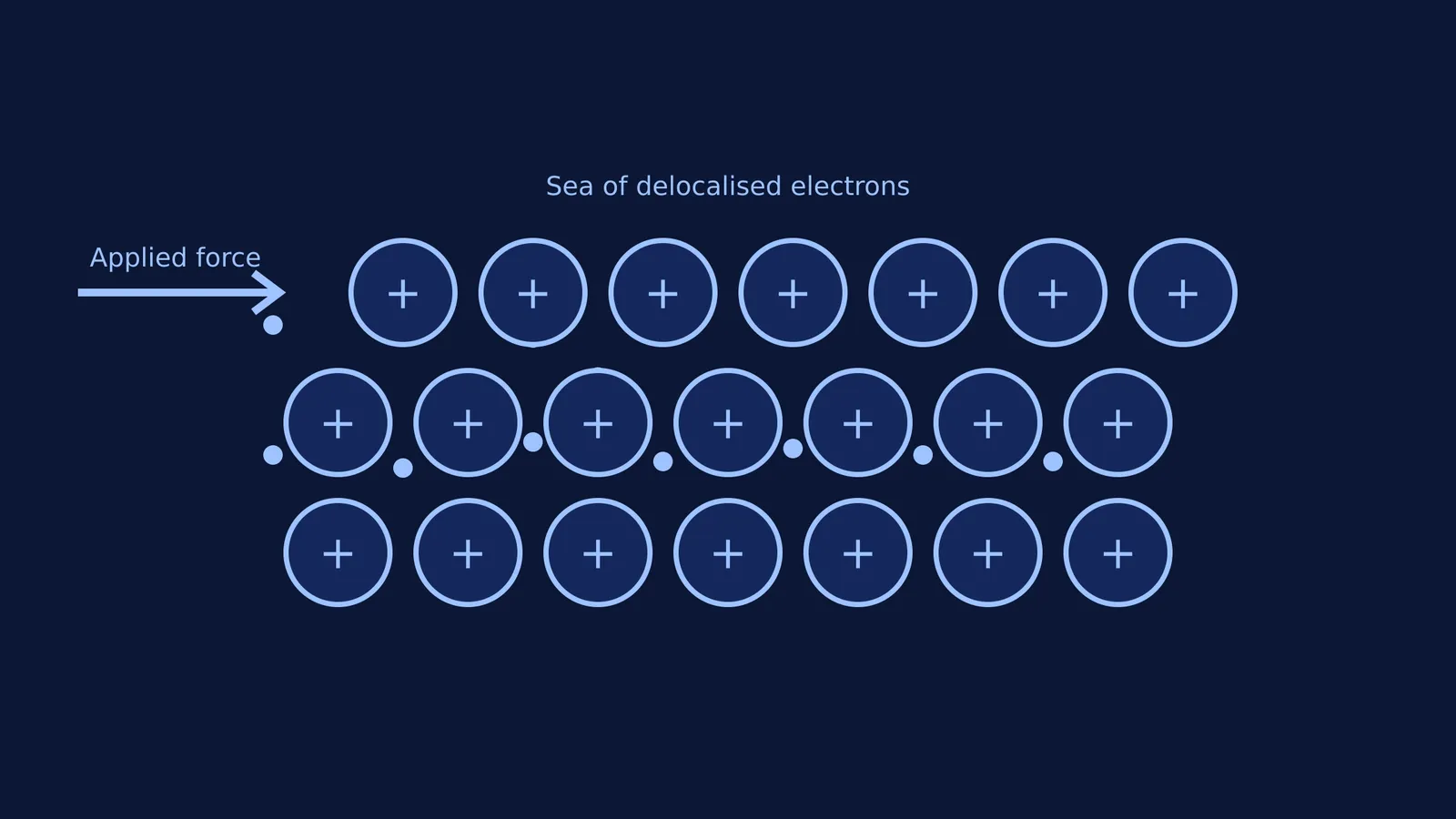
Instead, metal atoms exist as a lattice of positive ions swimming in a "sea of delocalised electrons". When a hammer strikes the silver, the force pushes a plane of atoms sideways. Because the electrons are free to move, they instantly rearrange around the shifted atoms, maintaining the electrostatic attraction. The layers slide smoothly past one another without snapping.
When a student struggles to picture how layers of atoms slide without the bond snapping, Fermi Simulation Lab lets them see the metallic lattice stretch under pressure. Rather than just reading about malleability, they can watch the electron sea re-form as the metal deforms, holding the structure together.
Testing malleability at home (Class 8 science)
The NCERT Class 8 curriculum introduces the physical properties of metals and non-metals. You can observe these differences with a simple test at home, comparing malleability and brittleness.
What you need:
A piece of aluminium foil or a thick aluminium wire
A small piece of coal or pencil lead (graphite)
A heavy object like a hammer
A hard, flat surface
The test:
Place the coal on the surface and strike it firmly. It will instantly break into smaller pieces. Non-metals are brittle because their rigid covalent bonds cannot bend.
Now, place the aluminium wire or foil on the surface and strike it. Instead of shattering, it compresses, widens, and thins out.
This simple experiment demonstrates the exact same principle that allows machines to produce silver varq. The metal's lattice yields to the pressure, while the non-metal breaks.
To explore more about how metals behave chemically, you can read our guide on Extracting metals for Class 10: roasting, calcination and reduction, or dive into Corrosion and rancidity: everyday oxidation in Class 10 science to understand why silver eventually tarnishes in the air.
Next time you see a piece of kaju katli, remember that the weightless silver coating is visible proof of metallic bonding at work.


