

On this page
If you look at an aerial photograph of the Indo-Gangetic plain or the Mississippi basin, a natural river rarely runs straight for more than a few kilometers. Perfectly straight channels carved through uniform sediment quickly deform into regular serpentine curves called meanders. Straight flow is dynamically unstable: any small deflection—such as an uneven bank or a localized eddy—forces fluid parcels into curved trajectories. As explained in our guide on non-uniform circular motion: tangential and radial acceleration, fluid negotiating a bend with radius r at velocity v undergoes lateral acceleration v²/r, directing momentum toward the outer bank.
Why do rivers flow in winding loops instead of straight lines?
Once flowing water deflects, the core of maximum velocity—the thalweg—swings toward the outer bank. This deflection spikes lateral shear stress against the bank wall. In alluvial floodplains made of loose silt and sand, this concentrated stress scours material, initiating bank erosion. Because curvature imposes centrifugal acceleration, the outward push intensifies as the bend deepens. Rather than dampening over time, the initial perturbation self-amplifies into a pronounced loop.
How does secondary helical flow drive erosion and deposition?
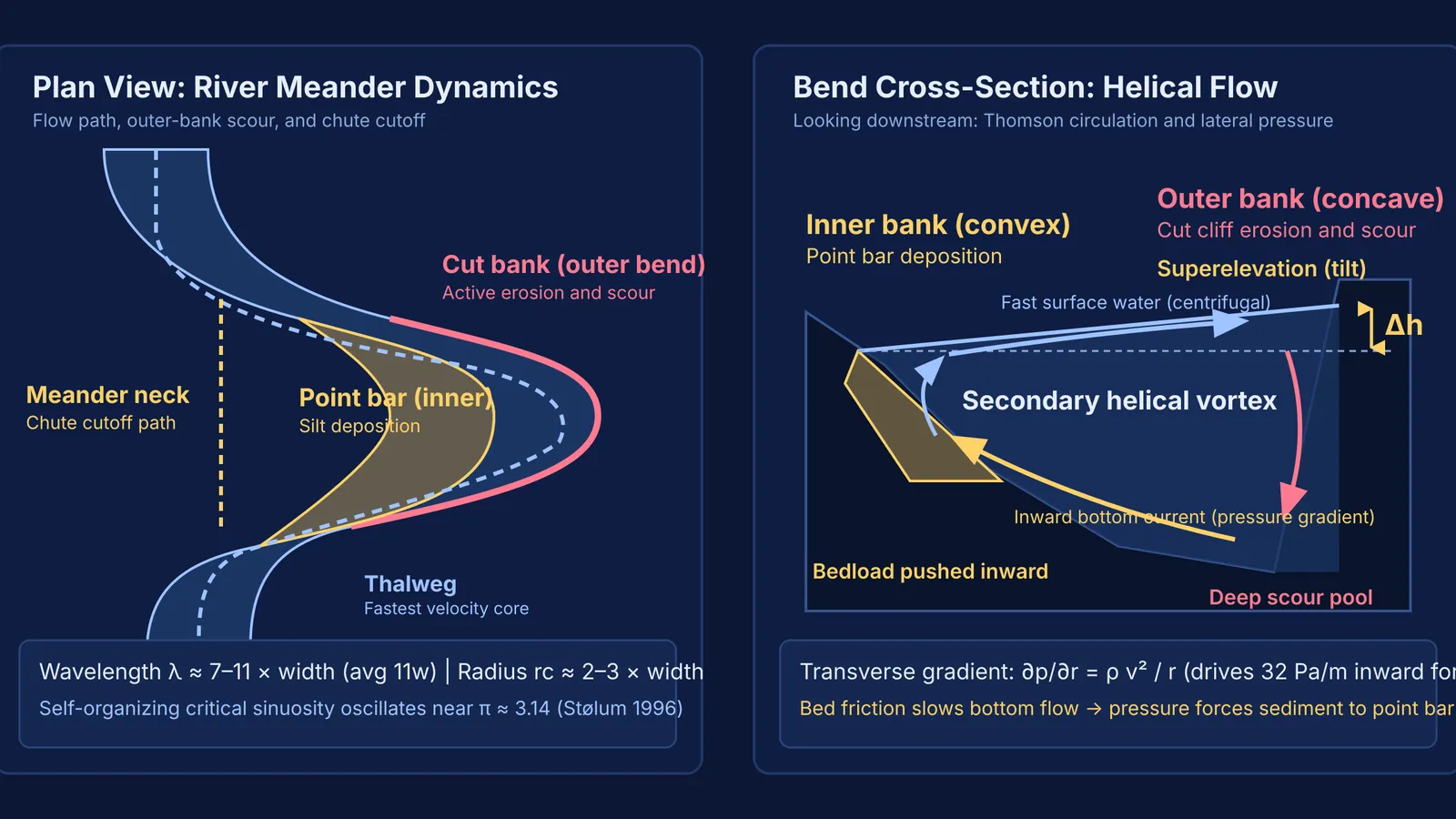
In 1876, physicist James Thomson explained the cross-stream mechanism of meanders in the Proceedings of the Royal Society of London. As water flows round a bend, centrifugal acceleration tilts the water surface upward against the outer bank. This superelevation (Δh) creates an inward hydrostatic pressure gradient throughout the depth.
Near the surface, high flow velocity balances this pressure gradient. Near the riverbed, however, boundary friction drastically slows the water, reducing its centrifugal tendency. Because the inward pressure gradient remains unchecked at the bottom, water along the bed is driven inward toward the convex bank. This establishes secondary helical flow:
Fast surface water plunges down the outer concave bank, scouring a steep cut bank.
Sluggish bottom currents carry bedload sediment inward, building a shallow point bar.
Albert Einstein analysed this cross-circulation in Die Naturwissenschaften, noting it matches how tea leaves in a stirred cup collect at the center rather than the rim. To see how pressure gradients and friction shape fluid fields, students can explore the Fermi Concept Library, which covers every concept in physics, chemistry, biology, mathematics and computing, each with its own lesson and its place in the map.
Why do meander loops grow until an oxbow lake forms?
As cut banks erode and point bars expand, meander loops grow laterally. In the Geological Society of America Bulletin71%5B769:rm%5D2.0.co;2), hydrologists Luna B. Leopold and M. Gordon Wolman showed that river meanders share universal scaling: wavelength typically measures 7 to 11 times channel width (averaging roughly 11 times width), while bend radius centers between 2 and 3 times width.
Eventually, expanding loops narrow the intervening terrain into a slender meander neck. During high-discharge floods, the river cuts directly across the neck along the steeper hydraulic gradient—a chute cutoff. Sediment then seals the abandoned loop, forming a crescent oxbow lake. In Science, geophysicist Hans-Henrik Stølum demonstrated that meanders operate as self-organized critical systems, with overall sinuosity oscillating near an average value of π (approx. 3.14).
How can students calculate superelevation and meander geometry?
Predicting river bend dynamics requires balancing centrifugal acceleration against the transverse pressure gradient. To relate channel cross-section to flow velocity, review the equation of continuity: flow speed in pipes and nozzles.
When analyzing a bend in exam problems or fieldwork, apply this 4-step framework:
Identify channel width (w) and bend radius (r) between the cut bank and point bar.
Measure surface velocity (v) entering the curve.
Compute transverse superelevation: equating lateral centrifugal force per unit mass (v²/r) to gravity along the slope (g Δh / w) gives Δh = (v² × w) / (g × r).
Calculate transverse pressure gradient ∂p/∂r = ρ v² / r, which exerts an inward force driving bedload transport toward the inner bank.
For a channel of width w = 50 m, surface velocity v = 2.0 m/s, and radius r = 125 m (matching the typical r/w = 2.5 ratio documented by Leopold and Wolman71%5B769:rm%5D2.0.co;2)), taking g = 9.8 m/s²:
Superelevation: Δh = (2.0² × 50) / (9.8 × 125) ≈ 0.163 m (16.3 cm).
Transverse pressure gradient: ∂p/∂r = (1000 kg/m³ × 2.0²) / 125 m = 32 Pa/m.
This 32 Pa/m gradient drives sluggish bedload inward to construct point bars. For students mastering multi-force mechanics in fluids, the Fermi Simulation Lab provides interactive simulations for the ideas that are easier to see than to read.


