

On this page
Driving through central Tamil Nadu or across the southern Karnataka plateau around Bengaluru and Mysuru, the earth beside the highway looks strikingly different from northern alluvial plains. The soil glows with a deep, rusty crimson. In low-lying ditches or tank beds, that same red soil fades into a warm, pale ochre.
This landscape is a core topic in CBSE Class 10 Geography. Understanding why southern soil is red, and why it turns yellow, links rock mineralogy to chemical oxidation and tropical climate patterns.
Why is the soil red in Tamil Nadu and Karnataka?
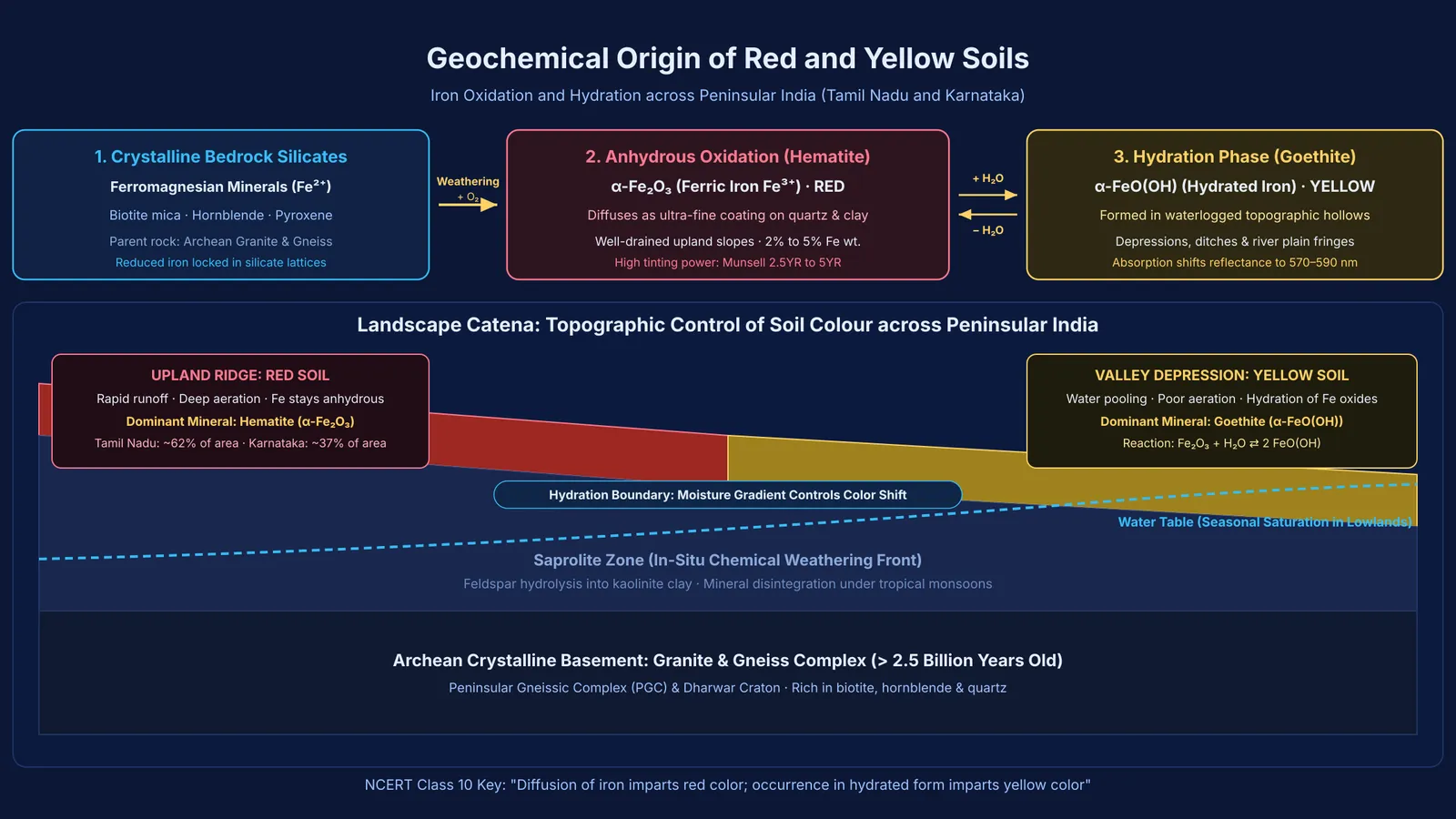
The red colour of soil in Tamil Nadu and Karnataka stems from the bedrock beneath. Most of the southern Deccan plateau rests upon the ancient Indian Shield, composed of Archean crystalline rocks like granite and gneiss. Geologists at the Geological Survey of India studying Peninsular bedrock, extending from surveys celebrated in D. N. Wadia's geological surveys of India's bedrock to modern stratigraphy, trace these crystalline basement formations back more than 2.5 billion years.
According to soil resource data from the Indian Council of Agricultural Research (ICAR), red soils dominate Tamil Nadu, covering approximately 62% of the state's total area. In Karnataka, red soils cover between 35% and 40% of the land, forming the classic red sandy loams of the southern districts.
These crystalline rocks contain ferromagnesian minerals—chiefly biotite mica and hornblende—carrying divalent iron (Fe²⁺). Over millions of years of tropical weathering, as explored through James Hutton's discoveries on deep time and rock weathering, these silicates break down. Iron oxidises into trivalent ferric iron (Fe³⁺) and diffuses as microscopic particles through the regolith. Weathering research in Gondwana Research demonstrates how ancient weathering episodes across Peninsular India concentrated iron oxides. The resulting anhydrous ferric oxide, hematite (α-Fe₂O₃), coats quartz grains and clay platelets. Even at 2% to 5% concentration by weight, hematite's strong tinting power stains the landscape rust-red.
How does iron oxide turn soil from red to yellow?
Class 10 geography textbooks group these terrains as "red and yellow soils." The shift between the two colours is governed by moisture and chemical hydration.
When hematite remains well-aerated on dry upland slopes, it stays anhydrous and bright red. But when water pools in low-lying hollows, depressions or poorly drained subsoil horizons, iron oxide reacts chemically with surrounding water molecules. Through hydration, hematite transforms into ferric oxyhydroxide, known as goethite (α-FeO(OH)):
Fe₂O₃ + H₂O ⇄ 2 FeO(OH)
While anhydrous hematite reflects red light, hydrated goethite reflects yellow and yellow-brown wavelengths. A field study on Karnataka weathering profiles in the Journal of Earth System Science confirmed that moisture availability directly controls whether iron precipitates as goethite or stays in dehydrated mineral phases. Yellow soil in Karnataka or Tamil Nadu is simply red soil that has undergone prolonged contact with water.
Where do red and yellow soils sit in the Class 10 geography syllabus?
In the official NCERT Class 10 Geography textbook (*Contemporary India - II*, Chapter 1: Resources and Development), soils are categorised into six major groups. Nationally, red and yellow soils make up roughly 18.5% of India's total geographical area, ranking second only to alluvial soils.
Examiners test three core aspects of red soils:
Origin: They develop on crystalline igneous rocks under low rainfall in the eastern and southern Deccan plateau, Odisha, Chhattisgarh and the Western Ghats piedmont zone.
Chemistry and fertility: Formed under rapid leaching and oxidation, they are naturally deficient in nitrogen, phosphorus and humus. Upland soils are coarse-grained, whereas valley loams are fine-grained and fertile.
Chemistry crossover: Silicate iron oxidation mirrors chemical principles taught in science, connecting directly to the Class 10 chemistry of oxidation and corrosion.
When students struggle to picture how rock minerals, weathering gradients and hydration states interact, interactive visual models make the mechanism click. The Fermi Simulation Lab provides interactive simulations for ideas that are easier to see than to read, helping learners visualise chemical equilibrium and mineral phase shifts in real time.
How can students master Indian soil classification for exams?
Board exams regularly challenge students to differentiate red soil from black (regur) and laterite soils. Use this four-step diagnostic framework:
Parent rock: Red soil stems from crystalline igneous rock (granite and gneiss). Black soil forms from volcanic basalt (Deccan trap). Laterite forms under intense tropical leaching.
Climatic trigger: Red soil develops in low-to-moderate rainfall zones. Laterite requires alternating high temperatures and heavy monsoon rainfall.
Colour mechanism: Red comes from iron oxide diffusion; yellow indicates hydration. Black soil owes its colour to titaniferous magnetite and organic matter.
Agricultural use: Red soil lacks nitrogen, phosphorus and humus, but responds well to irrigation and fertiliser, supporting groundnut, ragi, pulses, cotton and tobacco.
For comprehensive revision across related topics, the Fermi Concept Library contains every concept in physics, chemistry, biology, mathematics and computing, each with its own lesson and its place in the map. Connecting rock weathering to chemical oxidation transforms descriptive geography into intuitive, lasting science.


