

On this page
You step out into a downpour wearing a brand-new, 100% waterproof PVC raincoat. An hour later, no rain has leaked in, but your shirt is completely soaked. It is a common frustration for hikers, commuters and students alike. The culprit is not a tear in the fabric, but the simple physics of evaporation and condensation happening between your skin and the coat.
Why does a plastic raincoat feel sweaty inside?
When you wear a totally impermeable layer like a plastic raincoat, you create a sealed greenhouse around your body. The coat blocks liquid rain from the outside, but it also blocks water vapour from the inside.
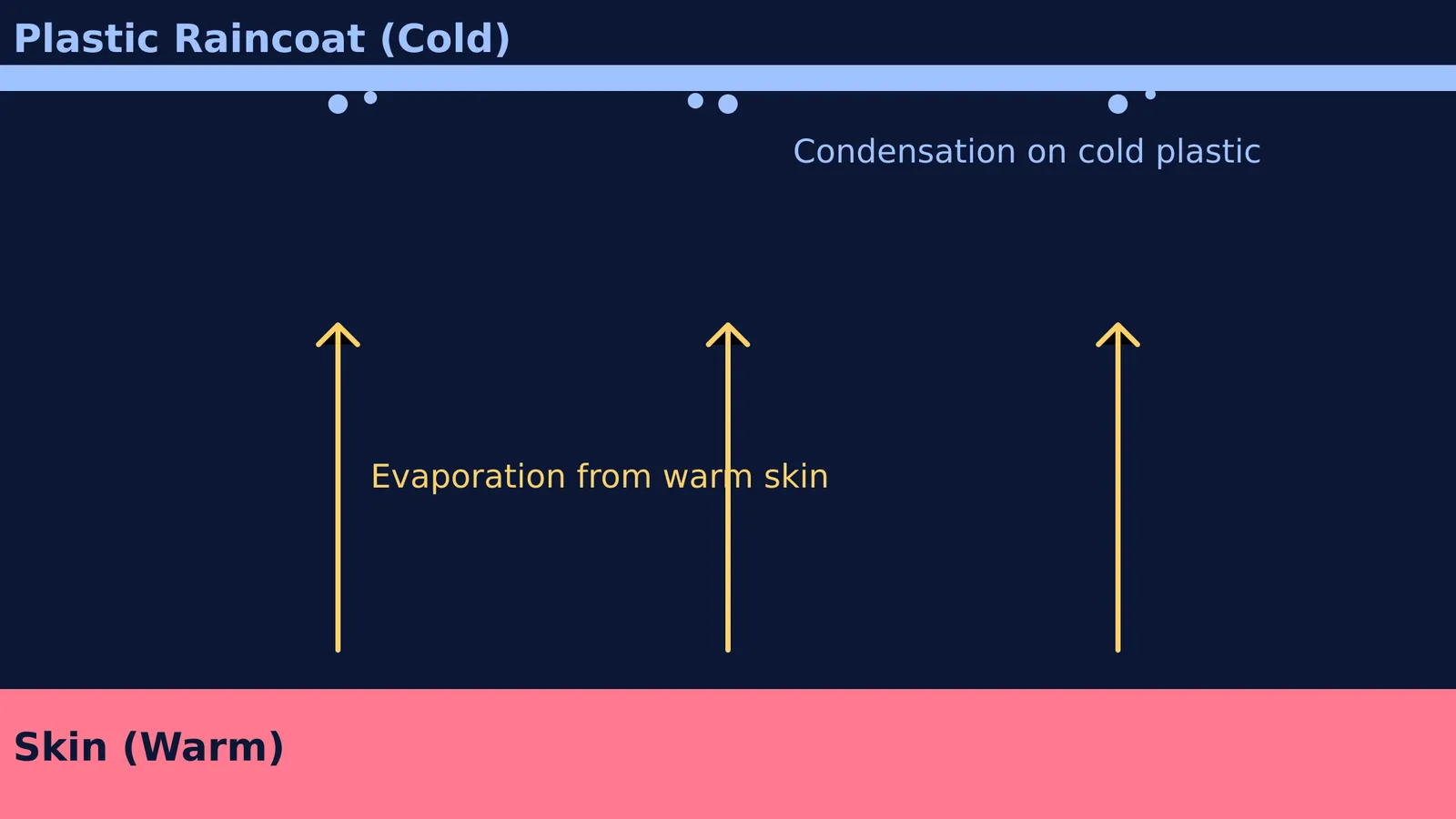
Your body acts as a continuous humidifier. The heat it produces turns moisture on your skin into water vapour. Because a PVC or plastic raincoat has a moisture vapour transmission rate of zero, the trapped air between your skin and the jacket quickly reaches 100% relative humidity. With nowhere else to go, this moisture stays on your skin. Your sweat cannot evaporate into air that is already fully saturated, making you feel sticky and uncomfortably hot.
How much water does the human body lose?
Even before you start actively sweating, your body constantly releases water. According to *Principles of Renal Physiology*, a healthy adult loses about 400 millilitres of water per day just by passive evaporation through the skin. This "insensible perspiration" means you are producing almost 17 millilitres of water every hour, even while sitting perfectly still at your desk.
When you start moving — such as walking to the bus stop or riding a bicycle — your active sweat glands switch on to regulate your core temperature. During heavy exertion, sweat rates can reach 2 to 4 litres per hour. All this liquid water needs to evaporate to cool you down effectively.
Why does condensation happen inside the coat?
Once the water turns to vapour, it needs somewhere to go. Because the outside of the raincoat is chilled by the falling rain and the cold ambient air, the inside surface of the plastic becomes much colder than your skin.
When the warm, saturated vapour hits this cold plastic surface, it loses thermal energy. It undergoes condensation, turning from a gas back into liquid droplets. These droplets collect on the inside of the coat and wipe off onto your clothes, making you feel wet from the inside out. The greater the temperature difference between your warm body and the cold rain outside, the faster this condensation occurs.
If you find it hard to picture how invisible gas molecules lose energy and clump together into liquid drops, the Fermi Simulation Lab has interactive simulations for ideas that are easier to see than to read.
How can you stop a raincoat from feeling sweaty?
To avoid soaking your clothes in your own condensation, you have to manage the physics of your coat and your layers.
Choose breathable fabrics: Look for jackets made with microporous membranes. These advanced materials have microscopic holes that are small enough to block large, cohesive liquid raindrops but large enough to let individual water vapour molecules escape into the atmosphere.
Use mechanical ventilation: If you only have a basic plastic poncho, wear it as loosely as possible. Open the zippers under the arms (often called pit zips), unzip the front slightly, and wear a cap so you can leave the hood down. This allows the saturated air to escape mechanically.
Dress in layers: Wear a moisture-wicking base layer (like polyester or merino wool) instead of cotton. Cotton absorbs and holds onto moisture, keeping it against your skin. Synthetic fabrics pull the sweat outward towards the coat so it can evaporate more efficiently.
For more on how temperature and energy affect state changes, read our guide on how matter changes states through evaporation and latent heat or explore the states of water and evaporation for Class 6.


