

On this page
Look up at a summer sky, and you will usually see brilliant white, fluffy cumulus clouds gently drifting by. But when a heavy storm rolls in, the sky turns a menacing shade of grey or even pitch black. The difference is not a change in the water itself; it is entirely a trick of light, scattering, and geometry.
Whether you are revising for a physics exam or simply wondering why the weather behaves the way it does, the colour of clouds is a perfect, everyday demonstration of optics.
Why are some clouds white?
To understand why a rain cloud is dark, you first have to know why a fair-weather cloud is white. Clouds are made of billions of microscopic water droplets or ice crystals.
According to NASA, visible light wavelengths range from roughly 380 to 700 nanometers (0.38 to 0.7 micrometers). Because cloud droplets are significantly larger than the wavelengths of the light hitting them, they trigger a phenomenon called Mie scattering.
Unlike Rayleigh scattering—which favours shorter wavelengths and gives the sky its blue colour—Mie scattering does not favour any specific colour. It scatters all wavelengths of sunlight equally. Because sunlight itself is white (a combination of all visible colours), the light scattered in all directions by the cloud droplets remains pure white. (For more on how light and water interact in the sky, read about scattering of light and how rainbows form).
Why do rain clouds look dark?
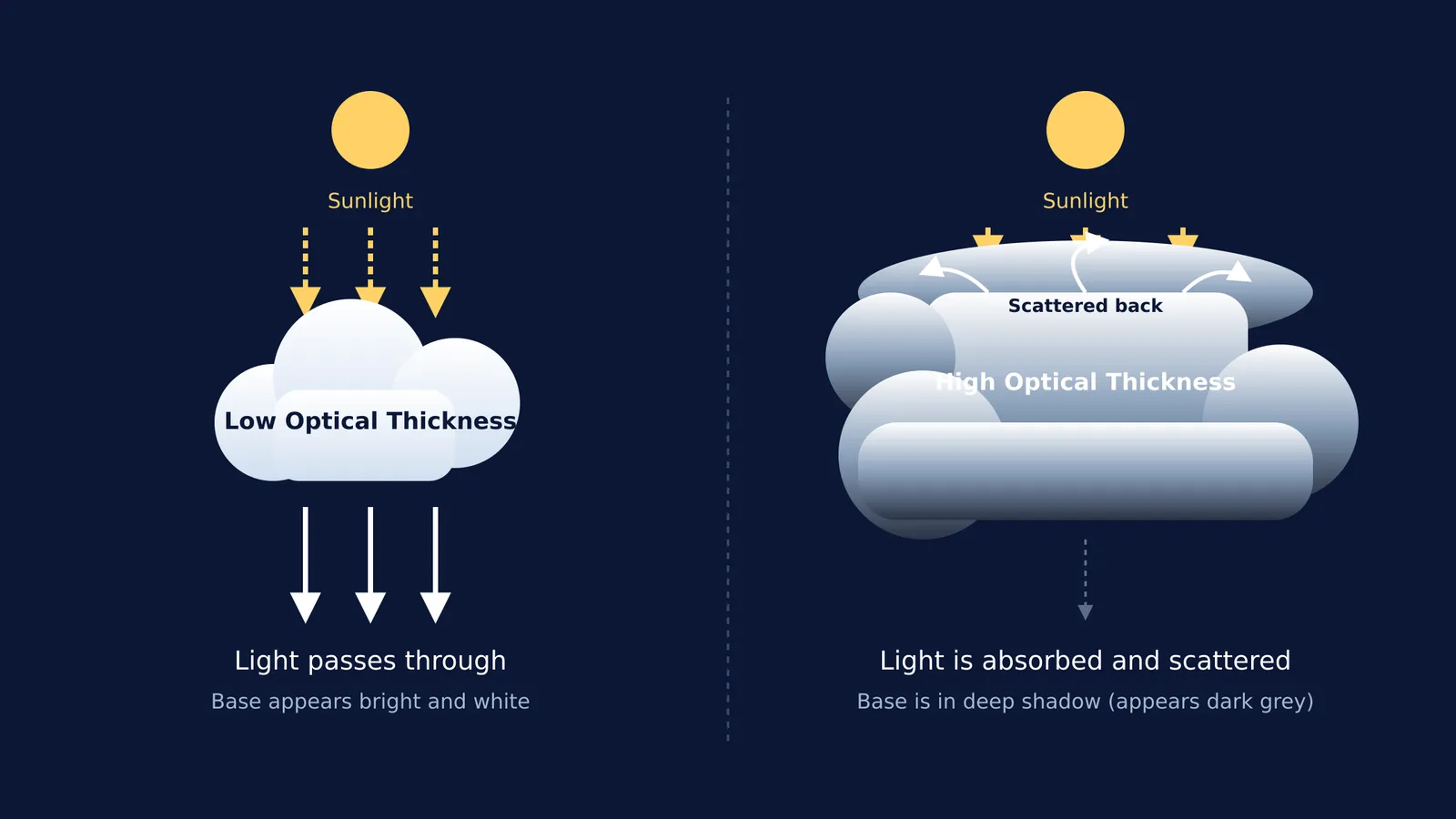
The answer lies in what meteorologists call "optical thickness" or optical depth. According to NASA's Earth Observatory, optical thickness is a measure of how much sunlight is prevented from passing directly through a cloud.
Fair-weather cumulus clouds have low optical thickness. They might only be relatively shallow from base to top. Because they are thin, a large percentage of sunlight easily penetrates them, lighting them up from within and reaching your eyes on the ground.
In contrast, rain-producing cumulonimbus clouds are towering, dense structures. According to the National Weather Service, the top of a cumulonimbus cloud can tower up to 50,000 feet or higher in severe cases.
Optical depth is essentially an accumulation effect. Each individual water droplet scatters a tiny fraction of the incoming light. In a thin cloud, there are simply not enough droplets to block the sun completely. But in a cumulonimbus cloud, the light must run a gauntlet of countless millions of droplets.
As intense sunlight hits the top of one of these massive rain clouds, the droplets scatter most of the light back up into space. This is why, if you were to fly over a violent thunderstorm in an airplane, the cloud top would still look brilliantly, blindingly white.
As the remaining light tries to travel deeper into the cloud, it is scattered and absorbed repeatedly by the dense concentration of droplets and heavy raindrops. The towering height is critical because it creates an enormous vertical column of water. Furthermore, storm clouds often contain larger raindrops and dense ice crystals, which are far more effective at absorbing the remaining light than the tiny droplets found in fair-weather clouds.
By the time that light reaches the bottom of a 50,000-foot cloud, almost no illumination is left. Grey is simply "dim white." The underside of a rain cloud looks dark because you are looking at the shadow side of a massively thick object.
How does light change when it enters a cloud?
You can think of a cloud as a giant filter for light. When you learn about basic optics and light entering glass, you see how transparent materials slow and bend light rays. A cloud, however, physically scatters the rays in millions of random directions.
If you are studying optics for an exam, predicting how light intensity drops as it passes through a dense medium is a classic problem. Instead of trying to memorise the textbook formulas blindly, you can model this kind of attenuation and light scattering in the Fermi Simulation Lab. Running an interactive simulation allows you to increase a cloud's density and watch in real-time as the light reaching the bottom drops to zero, turning your screen from white to dark grey.


