

On this page
*Cestrum nocturnum*—commonly known as raat ki rani or night-blooming jessamine—is famous for filling the evening air with a heavy, sweet perfume. While many plants open their petals to the sun, this shrub saves its energy for the dark.
The timing is not just a reaction to the sunset. It is a highly tuned biological clock designed to match the waking hours of specific insects.
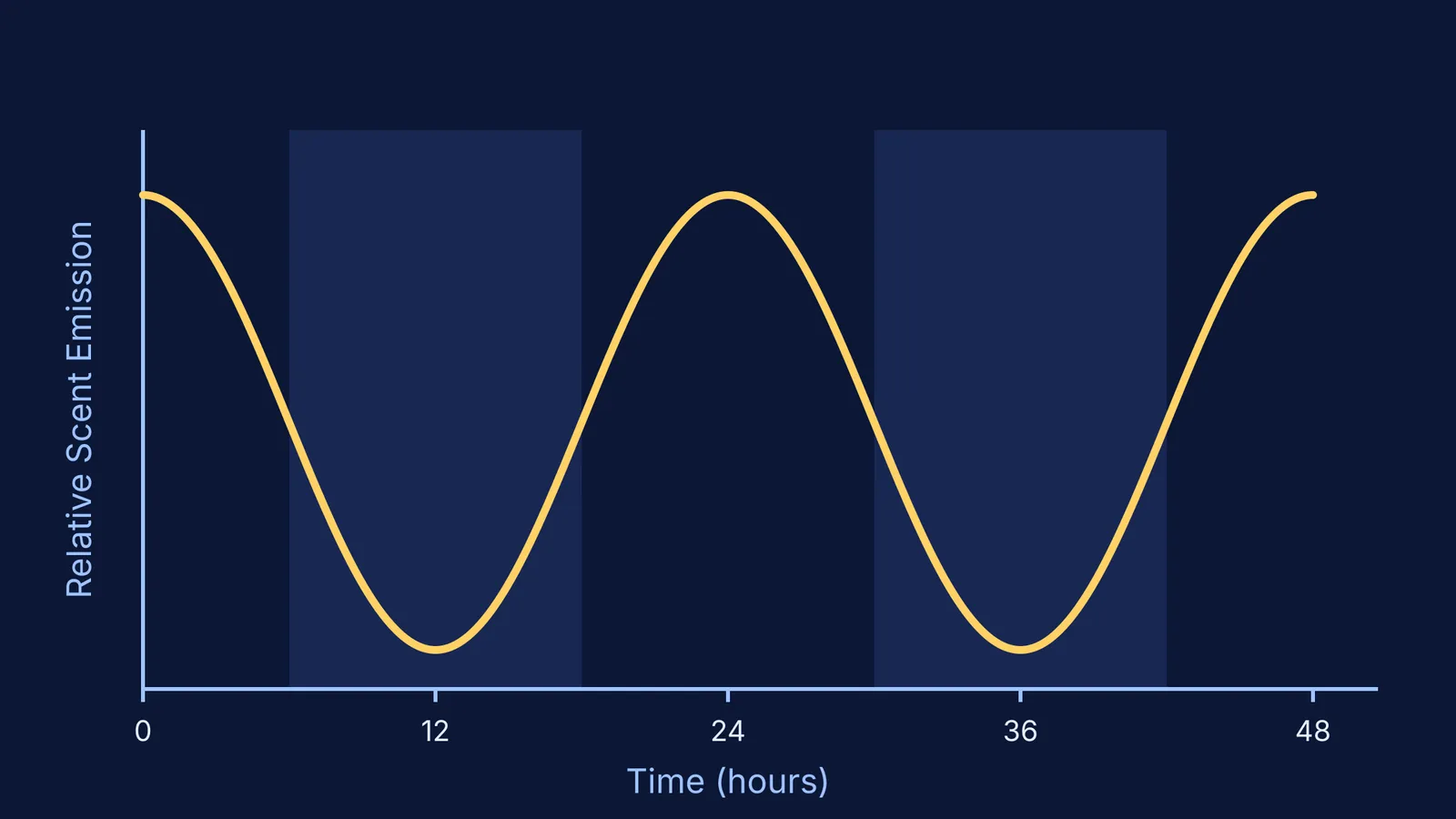
What controls the internal clock of scent emission?
It is tempting to think that the physical absence of light triggers the scent. However, researchers have shown that the plant operates on a strict internal schedule.
A study published in the *American Journal of Botany* demonstrated that the flowers of *C. nocturnum* open and close on a roughly 24-hour cyclic manner even when the plant is kept in constant light or constant darkness at a constant temperature 1. This endogenous circadian rhythm means the plant "knows" it is night regardless of the actual lighting conditions. The same study found that the controlling mechanism for this odor production is located specifically in the tips of the corolla (the petals).
If dynamic cycles like circadian rhythms are hard to picture from a textbook alone, the Fermi Simulation Lab offers interactive simulations for the ideas that are easier to see than to read.
Why does raat ki rani smell strongest at night?
Producing complex volatile compounds takes metabolic energy, so plants only release them when their target pollinators are active. For raat ki rani, those pollinators are nocturnal moths.
Research has identified that the specific floral compounds emitted by the night-blooming jessamine are highly attractive to cabbage looper moths 2. Because moths fly in the dark, they cannot rely on bright colours to find nectar. Instead, they follow invisible scent plumes through the air. By holding back its fragrance until evening, the plant ensures its chemical signals are not wasted during the day when moths are asleep.
When you are studying these mechanisms and notice a gap in your knowledge, the Fermi Concept Library contains every concept in physics, chemistry, biology, mathematics and computing, each with its own lesson and its place in the map.
What is the moth pollination syndrome?
Raat ki rani exhibits classic traits of moth pollination, known botanically as phalaenophily.
Plants that rely on moths typically share a set of adaptations. Their flowers are pale or greenish-white—like those of *C. nocturnum*—because pale colours stand out better in moonlight than deep reds or blues 3. The flowers also have long, tubular corollas. This shape restricts access to insects with a long proboscis, ensuring that only the correct moth can reach the nectar, picking up pollen in the process.
This is a prime example of how flowers recruit insects to do the mechanical work of reproduction, a process that relies heavily on how flowers avoid their own pollen to maintain genetic diversity.
How can you observe plant circadian rhythms?
If you are a student exploring biology, you can test these circadian principles in your own garden using a simple observational framework.
Isolate the variable: Observe a night-blooming plant over three days. Note the exact time the fragrance becomes noticeable. Does it shift if the day is unusually cloudy or cool?
Track the visitors: Stand near the plant at 8:00 PM and again at 10:00 PM. Count the number and types of insects you see. You will likely spot moths hovering near the tubular flowers.
Compare related species: Look at day-blooming plants in the same area. Compare their flower shapes and colours to the night-bloomers to see the physical differences in pollination syndromes.
By watching these cycles, you can see firsthand how perfectly timed chemical signals keep an ecosystem running.


