

On this page
If you mix roughly two parts cornflour (cornstarch) with one part water, you get a fluid that behaves strangely. Stir it slowly, and it flows like thick milk. Punch it, and it feels like a solid brick.
This mixture, often called oobleck, is a classic example of a non-Newtonian fluid. Unlike normal Newtonian fluids—such as water or oil—whose viscosity only changes with temperature, a non-Newtonian fluid changes its thickness depending on the physical stress applied to it. Specifically, oobleck is a shear-thickening fluid, which means it becomes thicker and more viscous when sheared or agitated. But what exactly happens at the microscopic level when your fist hits the surface? For decades, physicists debated the exact mechanism behind this sudden transformation. Now, recent research has finally provided a clear answer: it comes down to friction.
Why does oobleck become solid?
To understand why oobleck turns solid, you have to look at the microscopic starch particles suspended in the water.
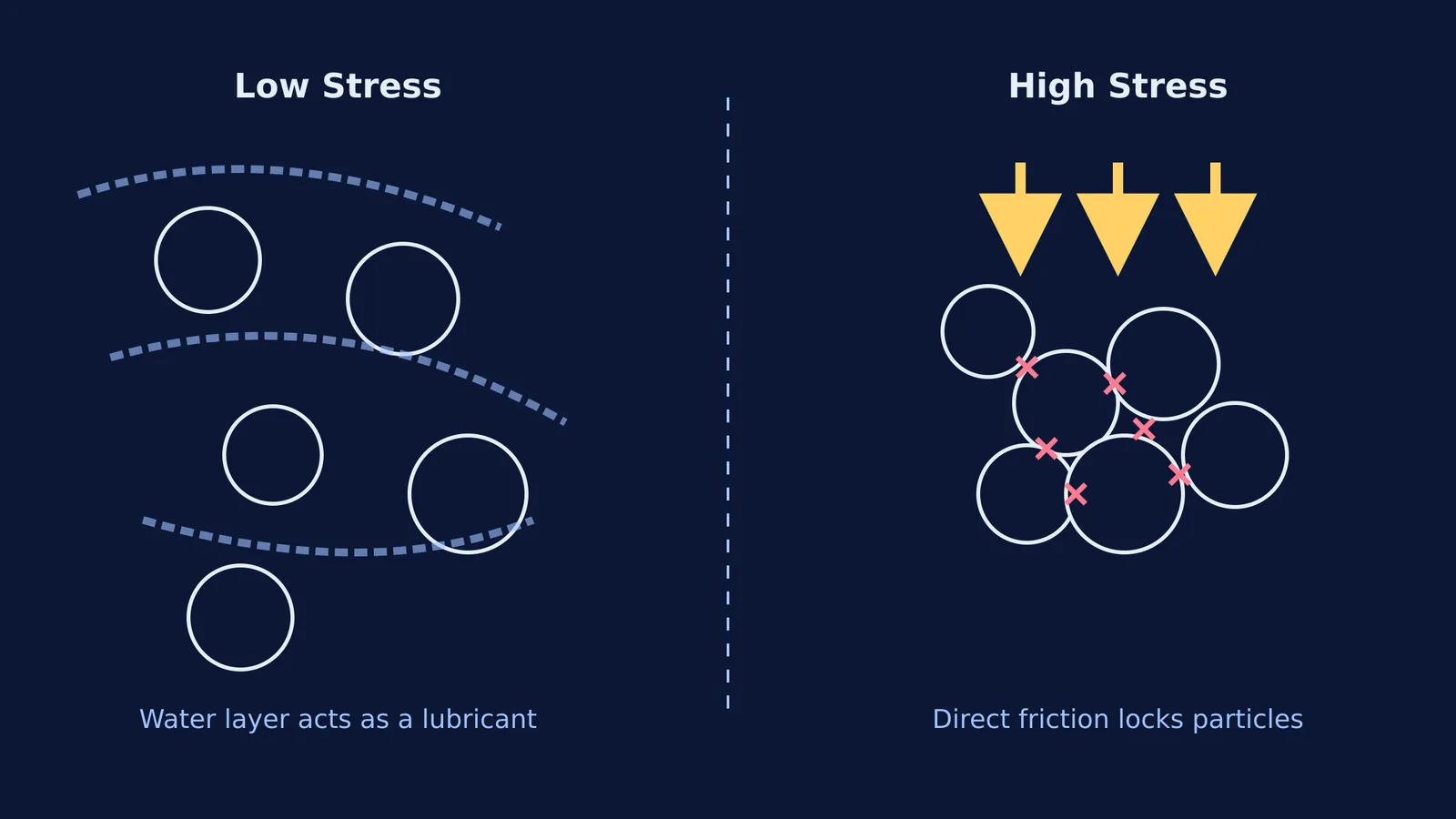
When the mixture is at rest or moving slowly, a thin layer of water coats each starch particle. This water acts as a lubricant. Because the solid particles are not physically touching, they can slide past one another easily. The mixture flows smoothly as a liquid.
When you hit the oobleck, you apply a sudden, high mechanical stress. The force pushes the particles together so quickly that the water between them is rapidly squeezed out. Without that lubricating layer, the rough surfaces of the starch particles grind directly against each other.
In 2016, researchers from the National Institute of Standards and Technology (NIST) and Georgetown University resolved a long-standing debate about this process. While older theories suggested that water resistance alone caused the particles to clump together (a theory known as the hydrocluster model), the NIST study proved that direct frictional contact between the particles is the primary force that locks the fluid into a solid-like state. Their simulations and rheological tests demonstrated that when the applied stress passes a certain threshold, the fraction of frictional contacts suddenly jumps, turning the suspension rigid.
How do we know it is friction?
Finding definitive proof of this microscopic friction was difficult because the particles are tiny and buried deep inside the opaque fluid. However, a 2023 study by scientists at the University of Chicago provided the missing direct experimental evidence.
The researchers used piezoelectric nanoparticles—tiny engineered particles that generate an electrical charge when they are physically squeezed or stressed—to investigate the mixture. When they applied mechanical force to the fluid, the piezoelectric particles produced measurable electrical signals. This allowed the scientists to effectively "hear" the exact moment the particles came into direct, frictional contact and jammed together into a rigid network.
Once the external force is removed—when you stop pushing—the particles naturally repel each other slightly. The water flows back into the microscopic gaps between them, and the solid structure quickly melts back into a flowing liquid.
How can you make oobleck at home?
Oobleck is one of the easiest and safest ways to explore non-Newtonian fluids in your own kitchen. It requires no special equipment, just two common ingredients.
Once you have mixed it, try these simple experiments:
The Slow Sink: Rest your fingers gently on the surface. They will sink to the bottom of the bowl. Now try to pull them out quickly—the fluid will grip your hand and resist your movement.
The Hammer Test: Tap the surface lightly with a spoon, then hit it hard. Notice how the resistance scales with the force you apply.
How does this help with physics exams?
Understanding the interaction between fluids and friction is a central part of learning mechanics. If you are preparing for competitive physics exams, mastering these core principles is absolutely essential. While oobleck is technically non-Newtonian, the foundational ideas of forces, pressure, and particle interactions apply across the board. You need a solid grasp of how microscopic forces scale up to cause macroscopic effects.
If you struggle to picture how forces act on fluids or objects, the Fermi Simulation Lab provides interactive simulations for the ideas that are easier to see than to read. You can change the variables and watch how the system responds in real time.
For more practice with the mathematics of forces, you can review our guide to friction problems and learn to spot common fluid mechanics mistakes.


