

On this page
When an older car or two-wheeler fails its emissions test, the culprit is rarely a single catastrophic breakdown. Instead, it is the gradual result of thousands of hours of chemistry happening inside the exhaust system. But what exactly does a PUC pollution test measure in vehicles, and why do the limits become harder to pass as a vehicle ages?
What does a PUC pollution test measure in vehicles?
In India, the Ministry of Road Transport and Highways (MoRTH) sets specific emission limits that every vehicle must meet to keep its Pollution Under Control (PUC) certificate. For petrol, compressed natural gas (CNG), and LPG vehicles, the test probe inserted into the tailpipe measures two primary gases:
Carbon Monoxide (CO): Measured as a percentage of the total exhaust volume, CO indicates how completely the engine is burning its fuel. For Bharat Stage IV (BS-IV) and BS-VI four-wheelers, the permissible limit is 0.3% CO. Older, pre-BS IV vehicles have more lenient limits of 0.5% or up to 3.0% for the oldest cars.
Hydrocarbons (HC): Measured in parts per million (ppm), these are molecules of unburned fuel that escape the engine. The limit for BS-IV and BS-VI four-wheelers is 200 ppm, while older vehicles are allowed up to 750 ppm.
For diesel vehicles, the test works differently. Instead of measuring specific invisible gases, it measures smoke density (opacity), indicating the concentration of particulate matter or soot in the exhaust. The limit for older diesel vehicles is typically 65 Hartridge Smoke Units (HSU), dropping to 50 HSU for BS-IV models.
Why do older vehicles fail their emission tests?
In a perfect theoretical engine, a hydrocarbon fuel reacts completely with oxygen to produce only carbon dioxide (CO₂) and water (H₂O). In reality, combustion is never perfect. When there is insufficient oxygen in the cylinder, the carbon cannot fully oxidise. Instead of CO₂, the reaction yields carbon monoxide. Similarly, pockets of fuel near the cooler cylinder walls may not burn at all, leaving as raw hydrocarbons.
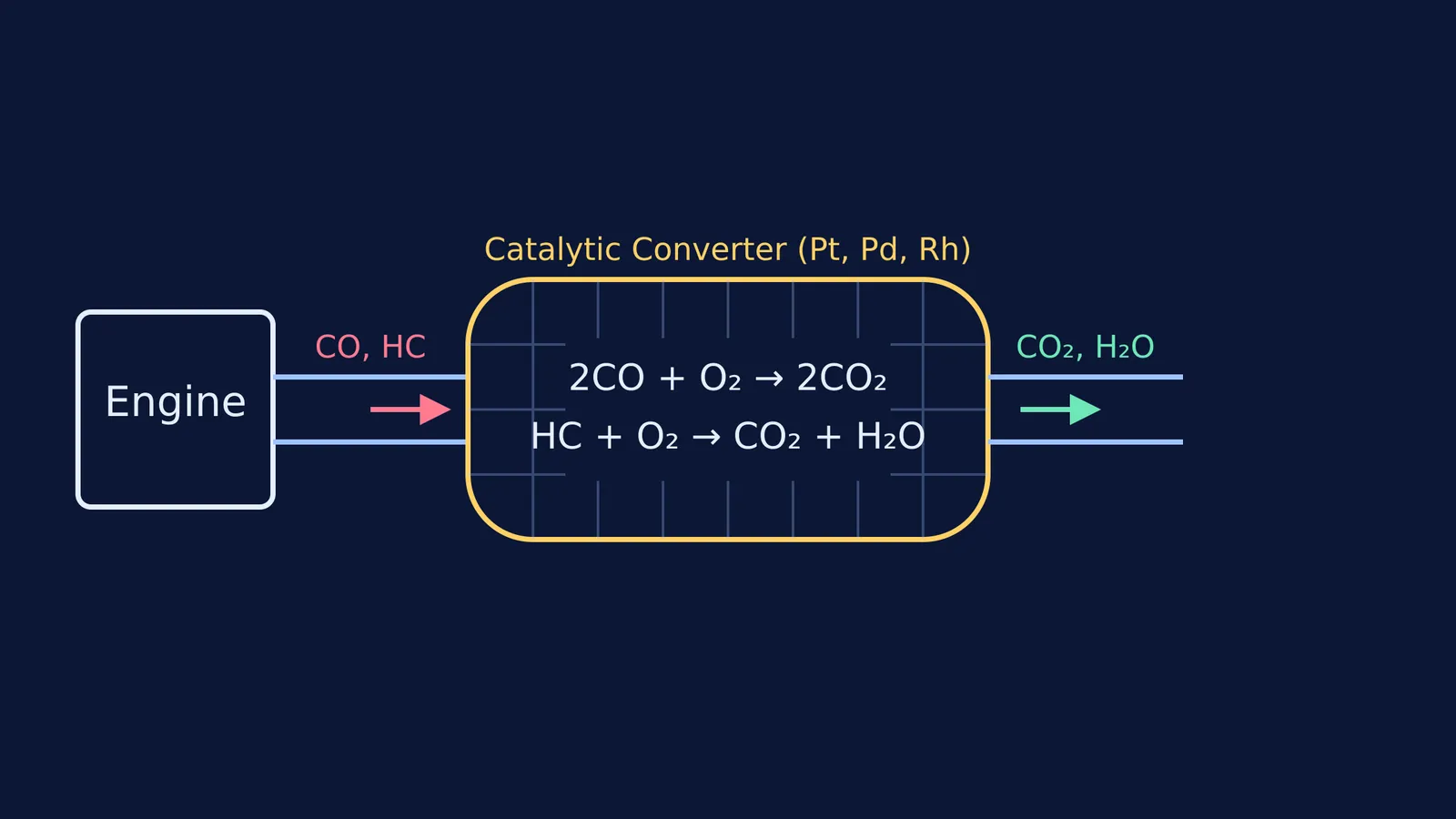
Students studying Corrosion and rancidity: everyday oxidation learn that oxidation is a ubiquitous chemical process. To stop unoxidised CO and HC from reaching the atmosphere, modern vehicles rely on a catalytic converter. This device uses precious metals—platinum, palladium, and rhodium—coated over a ceramic honeycomb to dramatically lower the activation energy required to oxidise CO into CO₂ and HC into H₂O and CO₂. The public health impact of this chemistry is massive; a landmark 2002 study published in the *Journal of the American Medical Association* (JAMA) found that the widespread use of catalytic converters led to an 81.3% decrease in unintentional motor vehicle-related CO poisoning deaths.
However, catalytic converters degrade. In older vehicles, they lose efficiency through two main mechanisms:
Thermal aging: Years of intense exhaust heat cause the microscopic precious metal particles to clump together in a process called sintering. This reduces the surface area available for gas molecules to react.
Chemical poisoning: Contaminants from engine oil and fuel gradually coat the catalyst. Just as a catalyst speeds up the Contact process for sulphuric acid in industrial chemistry, a poisoned catalyst in a car becomes inert, allowing raw CO and HC to pass straight through to the testing probe.
When you are exploring the physical chemistry of reaction rates and catalysts, interacting with models can clarify how surface area and temperature change outcomes. In the Fermi Simulation Lab, you can adjust variables like temperature and concentration to see how reaction equilibriums shift in real time.
How can you pass a PUC test with an older vehicle?
If you are taking an older vehicle for a PUC test, minor maintenance can often make the difference between a pass and a fail:
Warm up the engine: Catalytic converters do not work effectively when cold. Drive the vehicle until the engine is fully warm before reaching the testing centre so the catalyst reaches its operating temperature.
Check the spark plugs: A worn spark plug causes engine misfires, sending unburned fuel directly into the exhaust as excess hydrocarbons.
Change the oil: Dirty engine oil or worn piston rings can introduce oil into the combustion chamber, creating soot that chokes the catalytic converter.
Ensure clean air filters: A blocked air filter restricts the oxygen entering the engine, forcing a rich fuel mixture that spikes carbon monoxide levels.


