

On this page
If you have ever bought a new English willow cricket bat, you have likely spent hours tapping its face and edges with a wooden mallet. This tedious process, known as knocking in, is not just a ritual—it is a mechanical conditioning step that transforms raw wood into a tool capable of surviving a fast leather ball.
At the microscopic level, knocking in relies on the physics of stress, compression, and yield strength to protect the bat and improve its performance.
What happens to the wood when you knock it in?
English willow (*Salix alba caerulea*) is a naturally soft, porous wood. In its raw state, it contains millions of tiny, tube-like cells with empty air spaces between them. Because of this open structure, the wood has a relatively low yield point. If a hard cricket ball strikes unconditioned willow, the concentrated force exceeds what the wood can handle, causing the fibres to separate, dent, or split.
Knocking in is essentially a form of work hardening. A foundational 2005 paper in *Sports Engineering* by Sayers, Koumbarakis and Sobey showed that repeatedly striking the bat with a mallet causes these surface cells to collapse. The continuous, controlled stress crushes the open tubes into a dense, mesh-like hardened layer.
Instead of a single fibre taking the full brunt of a ball and snapping, this unified skin redistributes the impact stress across a wider area of the blade.
How deep does the hardened layer go?
Because knocking in is a surface treatment, it only changes a tiny fraction of the bat's depth. A 2021 study by researchers at the University of Cambridge, published in the *Journal of Sports Engineering and Technology*, measured exactly how much the wood compresses.
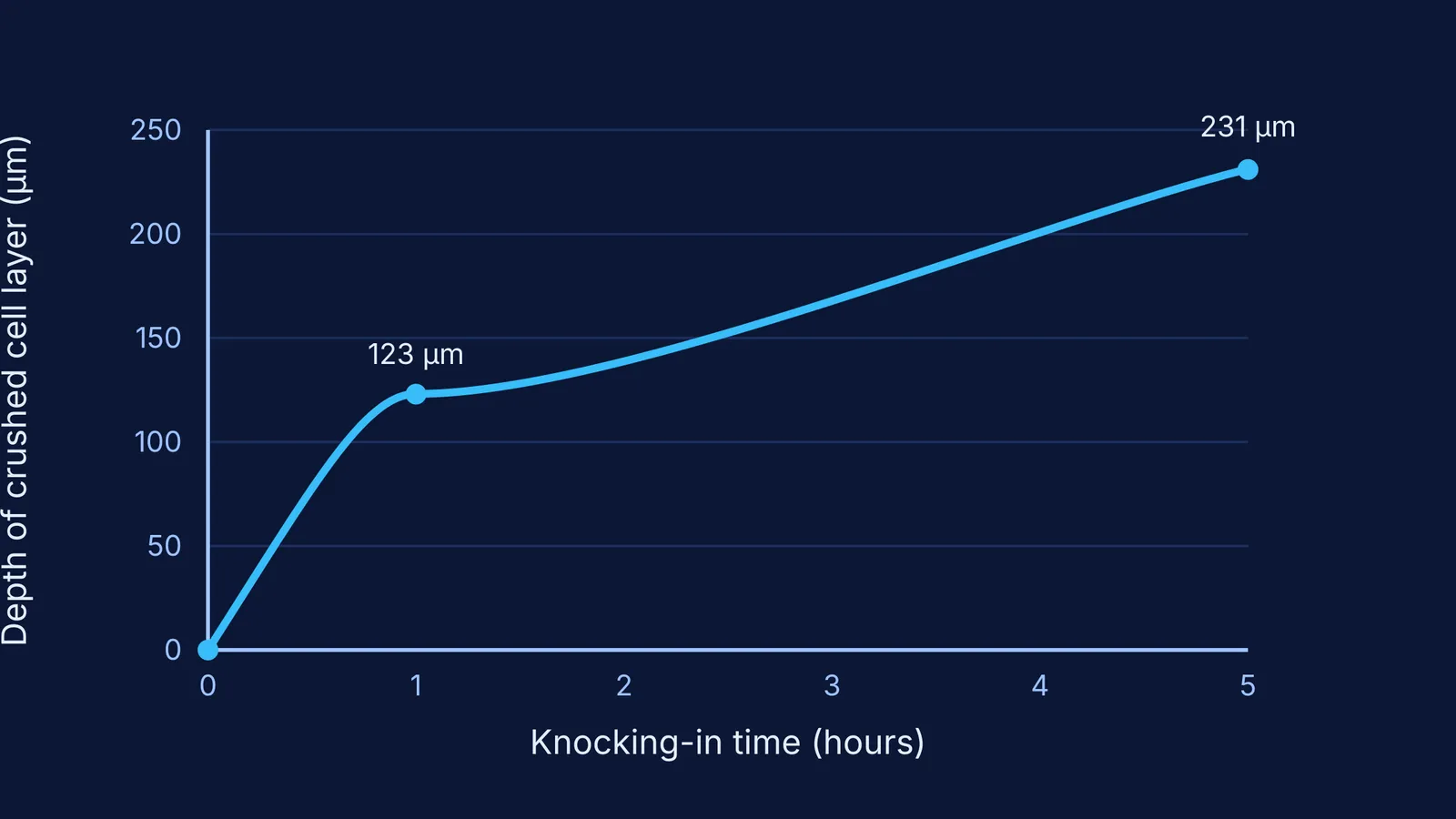
The Cambridge team found that the crushed cell layer in an English willow bat reaches approximately 123 microns (about one-tenth of a millimetre) after one hour of knocking in. After five hours of knocking, this compressed skin grows to about 231 microns deep.
Can you knock a bat in for too long?
Yes. While manufacturers heavily press the wood before selling it, they leave it slightly under-pressed so the player can finish the hardening process. However, there is a limit to how much stress the willow can take.
The Cambridge study found that for traditional willow, peak surface hardness is typically reached after about two hours of knocking in. Striking the bat for hours beyond this point can over-damage the cellular mesh, causing the fibres to weaken and the surface to lose its protective properties.
If you are exploring the mechanics of stress, strain and yield points in your physics syllabus, the Fermi Simulation Lab provides interactive simulations for the ideas that are easier to see than to read, so you can explore the physics behind the sport.
The sweet spot and the "ping"
While durability is the primary goal, knocking in also optimises the bat's elasticity. The process creates a dense surface layer with a high yield strength, while leaving the core of the bat soft and uncompressed.
When a ball hits the sweet spot, the hardened skin prevents the wood from yielding and denting, which would waste energy. Instead, the resilient surface allows the ball to rebound efficiently, while the softer wood underneath provides the lively "spring" or "ping" that transfers maximum kinetic energy back into the ball.
If you are studying the transfer of energy in collisions and materials, you can explore related mechanics in our guides to elastic potential energy in a stretched wire, worked through and oblique elastic collision of equal masses: why paths are at 90°.


