

On this page
You walk the same path every day, and suddenly a cluster of mushrooms has erupted overnight. It seems like magic, but it is a fascinating example of biological engineering. While plants and animals grow steadily by creating new cells, fungi use a completely different strategy to build their reproductive structures. They separate the slow work of cell division from the rapid phase of cell expansion.
Why do mushrooms suddenly appear after rain?
When you see a mushroom, you are only looking at the "fruit." The main body of the fungus is the mycelium, a vast underground network of thread-like hyphae. According to the USDA FoodData Central database, fresh white button mushrooms consist of 92.45% water by weight.
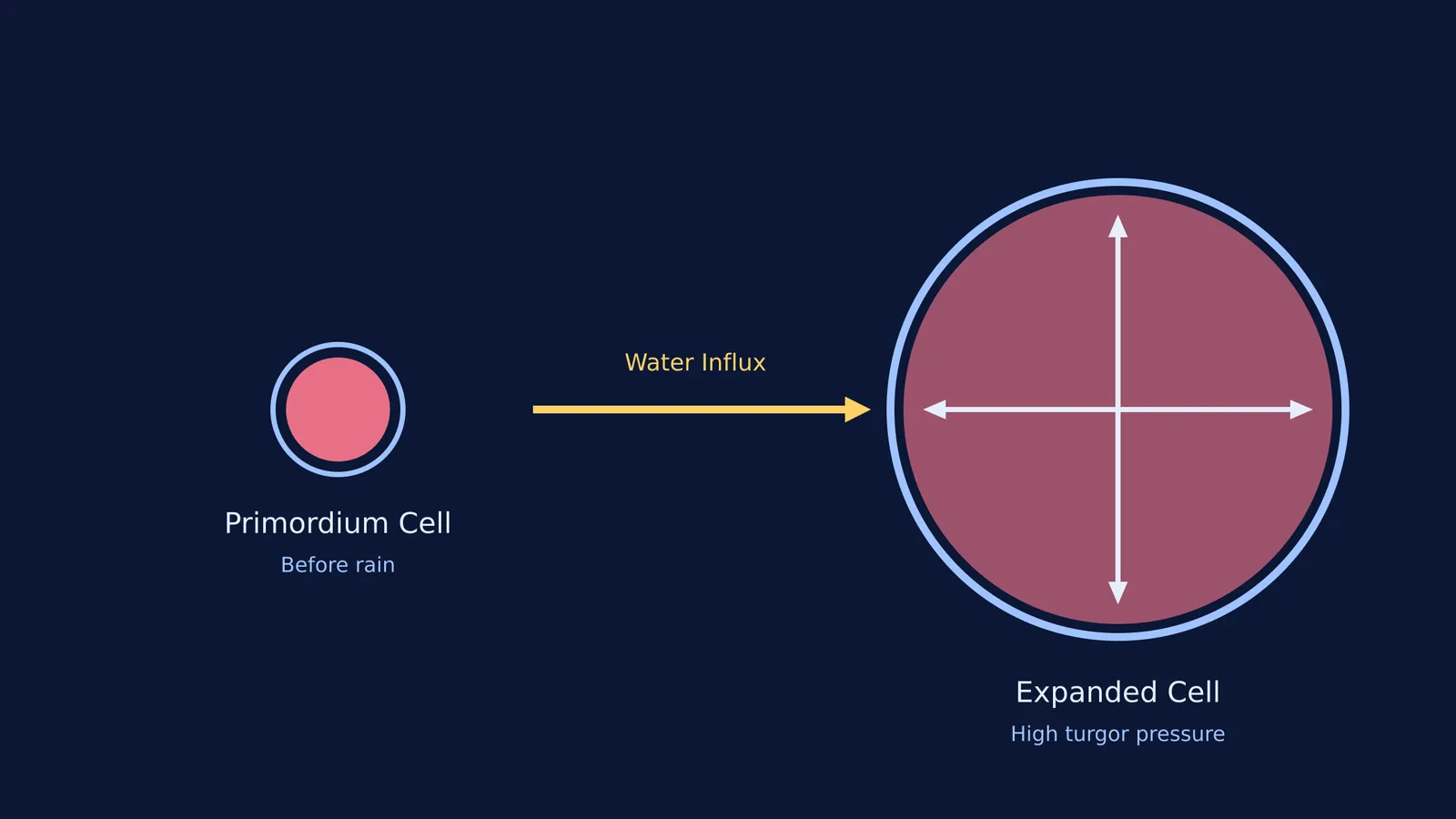
Because their volume is almost entirely water, they rely on a sudden influx of moisture to expand. During dry periods, the fungus builds a tiny, dense knot of cells called a primordium just beneath the soil surface. When it rains, these pre-formed cells absorb water rapidly, inflating like microscopic water balloons and pushing the mushroom above ground in a matter of hours. This is why a forest floor can transform from bare soil to a mushroom patch overnight.
What is the mycelial network doing underground?
For weeks or months before a rainstorm, the mycelium acts as a biological digestive engine. It secretes enzymes into the soil and decaying wood to break down complex polymers like cellulose and lignin. The network absorbs the resulting simple sugars and stores them as glycogen and lipids. It uses this gathered energy to form the primordia, which contain all the cells the final fruiting body will ever need.
This is a crucial distinction in biology. In plants, growth is typically a mix of cell division and steady expansion happening at the same time, which you might study when comparing arithmetic vs geometric growth in plants. Fungi, however, front-load the construction work. By the time rain falls, the cellular blueprint is completely finished, waiting only for the final ingredient.
How does turgor pressure drive rapid expansion?
The driving force behind this rapid growth is turgor pressure—the hydrostatic pressure generated when water flows into the fungal cells via osmosis. When heavy rain saturates the soil, the external water potential becomes much higher than the internal water potential of the fungal cells. The primordium cells contain high concentrations of solutes like mannitol and potassium ions. Water rushes in across the semi-permeable membranes to balance this osmotic gradient.
A classic botanical analysis by N. P. Money notes that turgor pressure in mycelial fungi is responsible for forcing the hyphal tips to expand and penetrate the soil. As water floods in, the rigid chitin in the cell walls temporarily softens, allowing the intense internal pressure to stretch the cells to their full size.
Visualising how osmotic gradients and internal forces stretch a cell wall can be difficult from a textbook alone. The Fermi Simulation Lab provides interactive models where you can see how changing water concentration affects turgor pressure, making these abstract biological mechanics easier to picture.
Cell division vs cell expansion: how do they differ?
For biology students (especially those preparing for NEET or school exams), confusing the mechanisms of growth is a common hurdle. Fungi and lichens operate differently from typical plants. If you are reviewing growth and movement—such as phototropism and geotropism—keep this framework in mind to avoid wrong-method mistakes.
Cell Division (Mitosis): The process of one cell splitting into two. This takes time, energy, and new genetic material. Plants use this at their meristems for steady growth over weeks or months.
Cell Expansion (Turgor-driven): The process of existing cells swelling with water. This is incredibly fast and requires only moisture and flexible cell walls. Fungi use this mechanism to send up fully formed fruiting bodies almost instantly.
The Trigger: Plants generally grow continuously as long as conditions permit. Mushrooms, on the other hand, wait for a specific environmental trigger (such as sudden rain and a drop in temperature) to rapidly deploy their pre-built cells.
When you understand the biological mechanics at play, that sudden patch of mushrooms is no longer just a surprise. It is the final, rapid phase of a long underground process, powered entirely by the physics of water and osmotic pressure.


