

On this page
When you see news footage of a smoking landfill on a hot summer day, you might assume someone dropped a lit cigarette or that a piece of glass magnified the sun's rays. But the vast majority of deep-seated landfill fires are not sparked by outside forces; they start entirely on their own. The sheer mass of the garbage acts as a massive chemical reactor, breaking down waste and hoarding the heat until it spontaneously ignites.
Here is how biology and chemistry combine to turn a pile of everyday trash into a spontaneous, self-sustaining fire. The process involves a cascade of distinct phases where microorganisms and reactive chemicals build off one another to reach explosive temperatures.
How does decomposition generate heat?
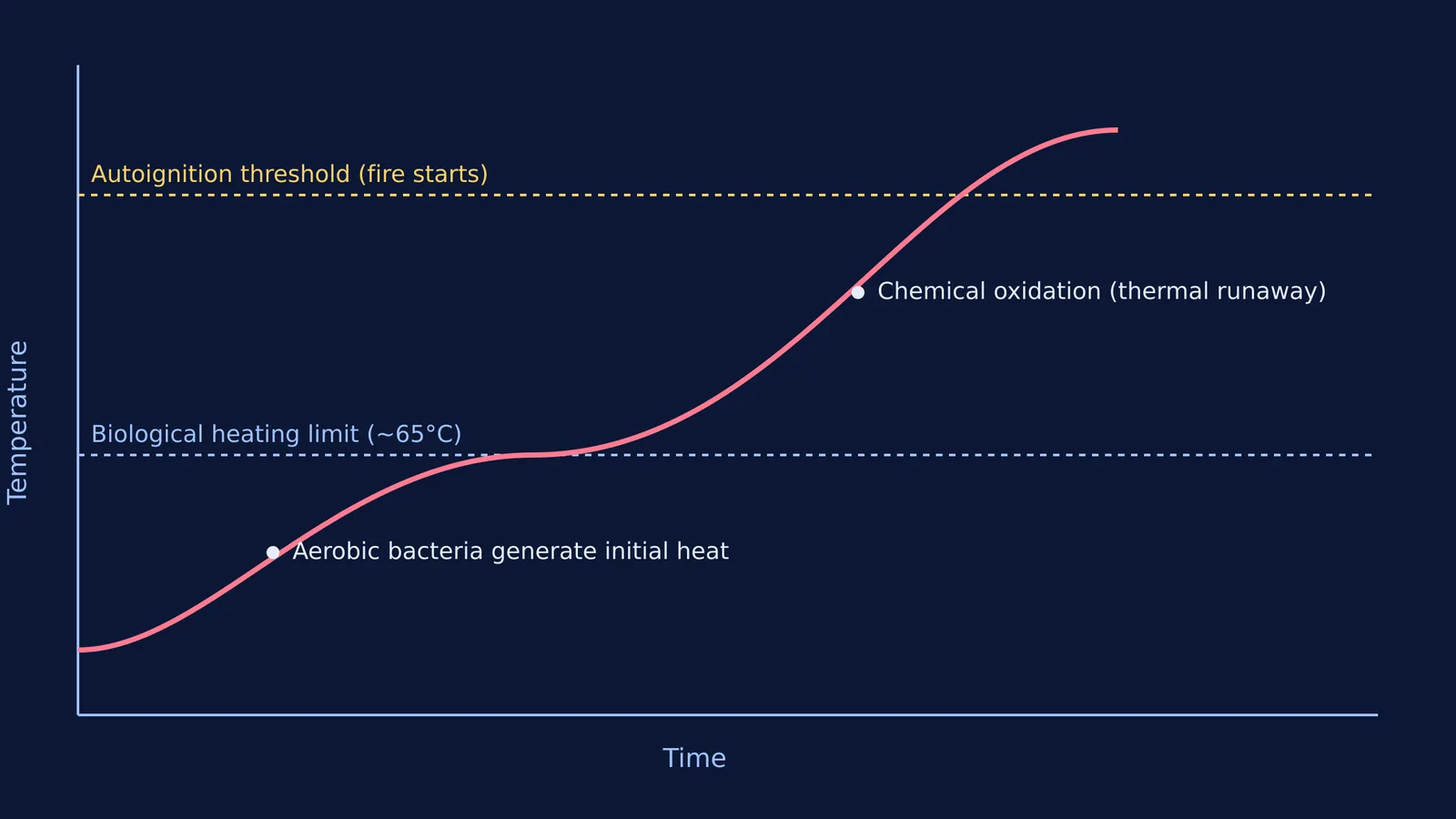
When food scraps, yard trimmings and paper are first buried in a municipal landfill, oxygen is still present in the air pockets between the rubbish. Aerobic bacteria immediately begin to digest this organic matter. This biological decomposition process is highly exothermic, meaning it releases a significant amount of heat into its surroundings. As these microbes multiply and feed, the temperature steadily rises.
In a 2010 study published in *Waste Management*, researchers showed that this initial biological self-heating can easily raise the temperature inside the pile to up to 65 °C (DOI: 10.1016/j.wasman.2010.01.006). At these elevated temperatures, the bacteria begin to die off or retreat into dormancy, meaning the biological heating phase has a natural ceiling. However, because the active hot spot is covered by millions of tonnes of insulating waste, the heat generated during this first phase cannot escape.
This principle is identical to the mechanics of calorimetry and heat transfer, where an insulated boundary prevents thermal energy from bleeding into the surrounding environment. In a landfill, the thick layers of compacted garbage act as the perfect insulator, effectively locking the thermal energy deep underground and preparing the site for the next phase.
What pushes the pile to catch fire?
Once the temperature crosses roughly 65 °C (DOI: 10.1016/j.wasman.2010.01.006), a second, more dangerous phase begins: chemical oxidation. Materials like plastics, rubber and organic acids begin to chemically react with whatever trace oxygen remains. Unlike biological heating, this phase is governed by thermal runaway.
As researchers noted in a 2022 study, paper, cardboard and leaves are particularly susceptible components that drastically shorten the time it takes for a pile to ignite (DOI: 10.1016/j.wasman.2021.11.044). The chemical reactions accelerate rapidly, effectively doubling in speed for every small bump in temperature. The heat from these reactions feeds back into the system, driving the temperature higher in a self-sustaining loop.
If you are studying thermodynamics and want to see how these exponential curves work, the Fermi Simulation Lab lets you adjust variables and watch a reaction run out of control in real time.
Where does the methane come from?
Deep inside the landfill, oxygen eventually runs out entirely. Here, anaerobic bacteria take over the digestion process. Unlike their aerobic counterparts, these microbes thrive in oxygen-free environments. They break down the remaining organic matter through a complex, multi-step process known as methanogenesis.
As a byproduct of this anaerobic digestion, the bacteria produce landfill gas. The US Environmental Protection Agency notes that this gas is composed of roughly 50 percent methane and 50 percent carbon dioxide (EPA). Because methane is lighter than air, it naturally migrates upward through the layers of garbage, often accumulating in pockets near the hotter, oxygen-deprived zones.
Methane is a highly potent fuel that becomes explosive when its concentration in the air reaches 5% to 15% (NOAA CAMEO Chemicals). While pure methane requires a remarkably high autoignition temperature of 540 °C (1004 °F) to catch fire on its own, the surrounding paper and reactive chemicals ignite at much lower temperatures. When the paper and cardboard spark from the chemical oxidation phase, they act as a pilot light for the trapped methane gas, resulting in a large underground combustion event.
Understanding the mechanics of combustion and flame zones helps explain why these subsurface fires are so devastating. Instead of a rapid, open blaze, they form deep-seated, smouldering fires. They can burn underground for months, fed by a continuous supply of methane and insulated by the trash, before smoke ever breaches the surface.
A checklist for thermal runaway
If you need to break down the stages of spontaneous combustion for a chemistry exam, follow this sequence of events:
Biological heating: Aerobic bacteria digest fresh waste, raising the temperature to roughly 65 °C.
Insulation: The massive bulk of the landfill traps the thermal energy, preventing it from dissipating.
Chemical oxidation: The elevated heat triggers non-biological chemical reactions, creating a state of thermal runaway.
Fuel accumulation: Anaerobic bacteria produce highly flammable methane in the oxygen-deprived lower layers.
Ignition: The internal heat crosses the autoignition threshold of paper or surrounding waste, which then lights the accumulated methane.
Next time you read about a landfill fire, you will know the heat did not just come from the sun. The chemistry of decomposition built the fire from the inside out. If you are preparing for exams and need to break down the mechanics of exothermic reactions step by step, the Fermi Problem Library explains the reasoning behind each formula.


