

On this page
When you step out of scorching afternoon heat under an umbrella, direct sunlight stops hitting your skin, but the air still feels hot. Beneath a leafy tree, the temperature drops noticeably within seconds. Both cast shade, yet your body experiences two completely different thermal environments.
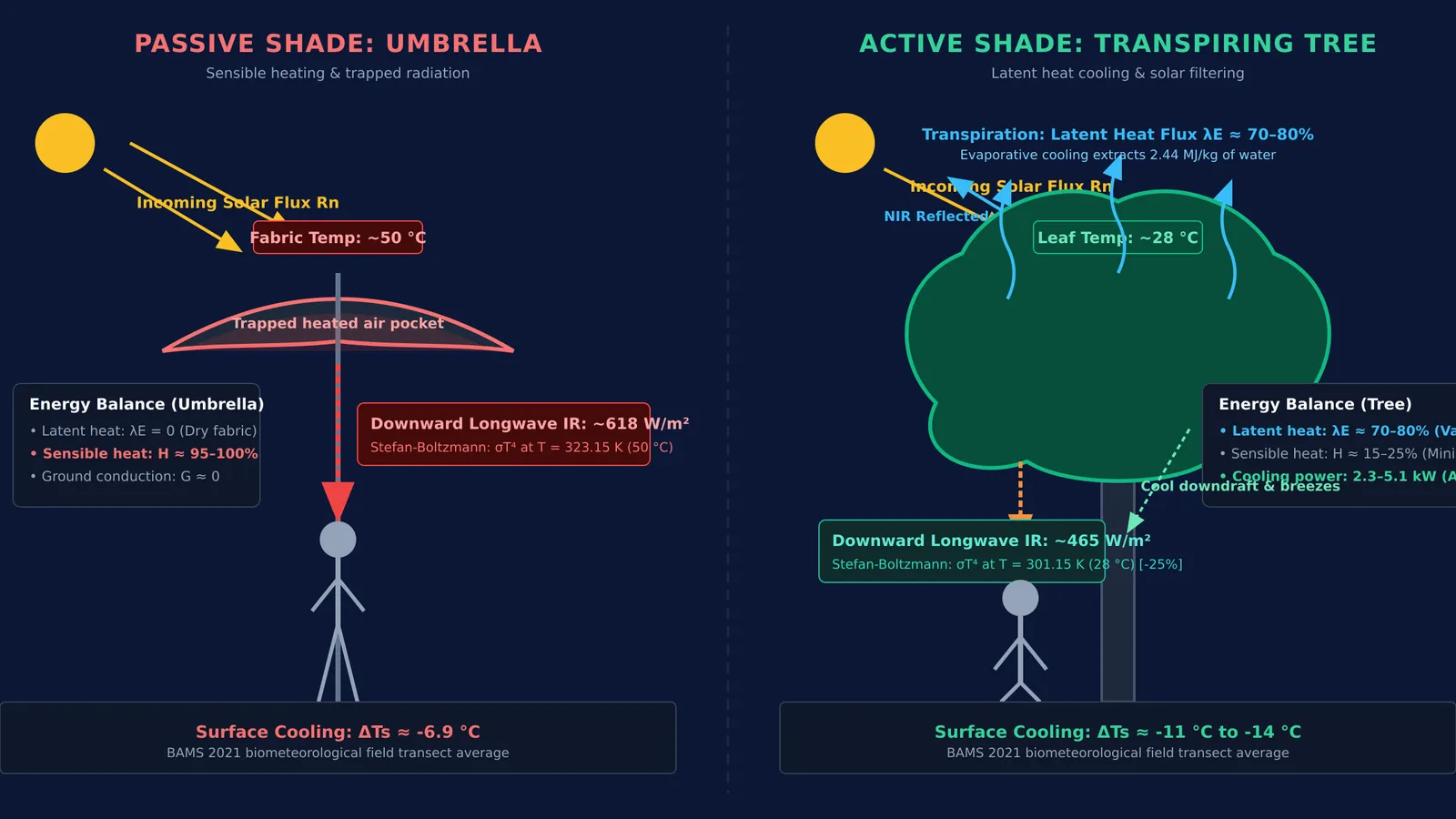
The difference lies in how matter handles absorbed solar energy. An umbrella is a passive barrier: it blocks visible sunlight, but cannot evaporate water. In the *Bulletin of the American Meteorological Society*, researchers found that personal umbrellas reduce surface temperatures by an average of only 6.9 °C, while tree canopies lower ground temperatures by 11 °C to 14 °C. Across outdoor shade environments, mean radiant temperature varied by up to 50 °C. The umbrella stops direct rays, but radiates heat downward right onto you.
A tree canopy is an active evaporative cooler. Instead of converting absorbed sunlight entirely into sensible heat, leaves partition incoming energy into evaporating water through transpiration. In our guide to Stephen Hales and the first measurements of transpiration, we explored how botanists first quantified this massive water flow.
How does transpiration convert heat into water vapour?
In plant physiology, transpiration is the loss of water vapour through stomata. According to NCERT Class 11 Biology curriculum guidelines, transpirational cooling lowers leaf surfaces by 10 °C to 15 °C below ambient air during daylight hours. What makes transpiration so effective is latent heat. As explained in our guide to evaporation and latent heat, evaporating water requires breaking intermolecular hydrogen bonds without raising temperature.
At 25 °C, water has a specific latent heat of vaporization of approximately 2.44 × 10⁶ J/kg, documented by the National Institute of Standards and Technology. Every kilogram of water evaporated through stomata extracts 2.44 megajoules of thermal energy from leaf tissues and surrounding air, converting sensible heat into latent heat.
Field measurements in *Agricultural and Forest Meteorology* showed that a single mature small-leaved lime (*Tilia cordata*) tree delivers up to 2.3 kW of peak transpirational cooling power through sap flow. Furthermore, research in *Agricultural and Forest Meteorology* demonstrated that urban tree species with high stomatal conductance transpire up to 4 times more water than drought-sparing trees, producing substantially greater human thermal comfort.
How do you calculate the cooling power of transpiration?
To see why this biological mechanism dwarfs artificial shade, consider the canopy energy balance equation from microclimatology in *Agricultural and Forest Meteorology*:
R_n = H + λE + G
Here, R_n is net solar radiation, H is sensible heat flux (warming air), λE is latent heat flux (consumed by evaporation), and G is ground conduction.
Dry umbrella: Dry fabric has zero latent heat flux (λE = 0). With negligible conduction, net absorbed solar radiation dissipates almost entirely as sensible heat H and downward thermal radiation, heating the fabric and air below.
Living tree canopy: For well-watered leaves, 70% to 80% of net radiation is channeled into latent heat flux λE. If a tree transpires 60 kg of water across an 8-hour afternoon, energy consumed is:
Q = 60 kg × 2.44 × 10⁶ J/kg = 1.464 × 10⁸ J Dividing by 28,800 seconds (8 hours) yields a continuous cooling rate: Power = 1.464 × 10⁸ J / 28,800 s ≈ 5.1 kW.
Domestic comparison: A 1.5-ton air conditioner produces roughly 5.2 kW of cooling capacity. The tree's transpiration matches an air conditioner at full power, absorbing heat directly from the surrounding air.
Interactive simulations for the ideas that are easier to see than to read, including energy balance and latent heat partitioning, can be explored directly in the Fermi Simulation Lab.
Why do leaves re-radiate less thermal infrared than fabric?
Air temperature is only one component of heat stress. Human thermal comfort depends heavily on mean radiant temperature—the total radiant heat arriving at your skin from surrounding surfaces.
Every warm surface emits longwave infrared radiation according to the Stefan-Boltzmann law (scaling with T⁴), as explored in our guide to thermal radiation and Stefan's law. A dark umbrella canopy exposed to midday sun reaches 50 °C (323.15 K), as documented in *Bulletin of the American Meteorological Society*, emitting roughly 618 W/m² of thermal radiation straight down onto you.
A transpiring leaf typically remains near 28 °C (301.15 K), consistent with measurements in *Agricultural and Forest Meteorology*. At 28 °C, emitted thermal radiation drops to approximately 465 W/m²—a 25% reduction compared to hot fabric. Moreover, leaf spongy mesophyll reflects 40% to 50% of near-infrared radiation (700 nm to 1100 nm), scattering heat before it is absorbed.
For students connecting the latent heat numericals of physics with plant physiology in biology, the Fermi Problem Library has worked problems with a step-by-step solver that explains the reasoning rather than printing an answer.
How does canopy architecture prevent stagnant heat traps?
An umbrella's curved dome creates an aerodynamic heat trap: warm air rises by buoyancy and collects in the apex, leaving you directly under trapped, heated air.
A tree canopy operates with an open, multi-layered architecture:
Porous structure: Foliage gaps allow breezes to penetrate, continuously flushing away warm air.
Cool downdrafts: Transpiration-cooled air becomes denser, encouraging gentle descending micro-drafts beneath the canopy.
Extended shade footprint: As research in the *Bulletin of the American Meteorological Society* showed, an umbrella leaves nearby unshaded ground baking at 50 °C or higher, radiating lateral heat at your body; a tree shades dozens of square metres, suppressing ground heat emission.
Resting under a banyan, neem, or gulmohar tree on a hot afternoon lets you experience evolutionary thermodynamics in action: evaporative chilling, selective solar filtering, and natural convective airflow working together.


