On this page
When a heavy rainstorm rolls in, you often feel a sudden, sharp chill just before the first drops hit. And even after the sun comes back out, the air and the ground stay noticeably cooler.
This drop in temperature is driven by two physical processes: cold downdrafts from the storm clouds above, and evaporative cooling at the surface. Here is how heat and air movement work together to bring the temperature down.
Why does a storm bring a cold breeze?
Thunderstorms form as warm, moist air rises. But once the rain starts to fall, it drags the surrounding air downward, creating a column of rapidly sinking air known as a downdraft.
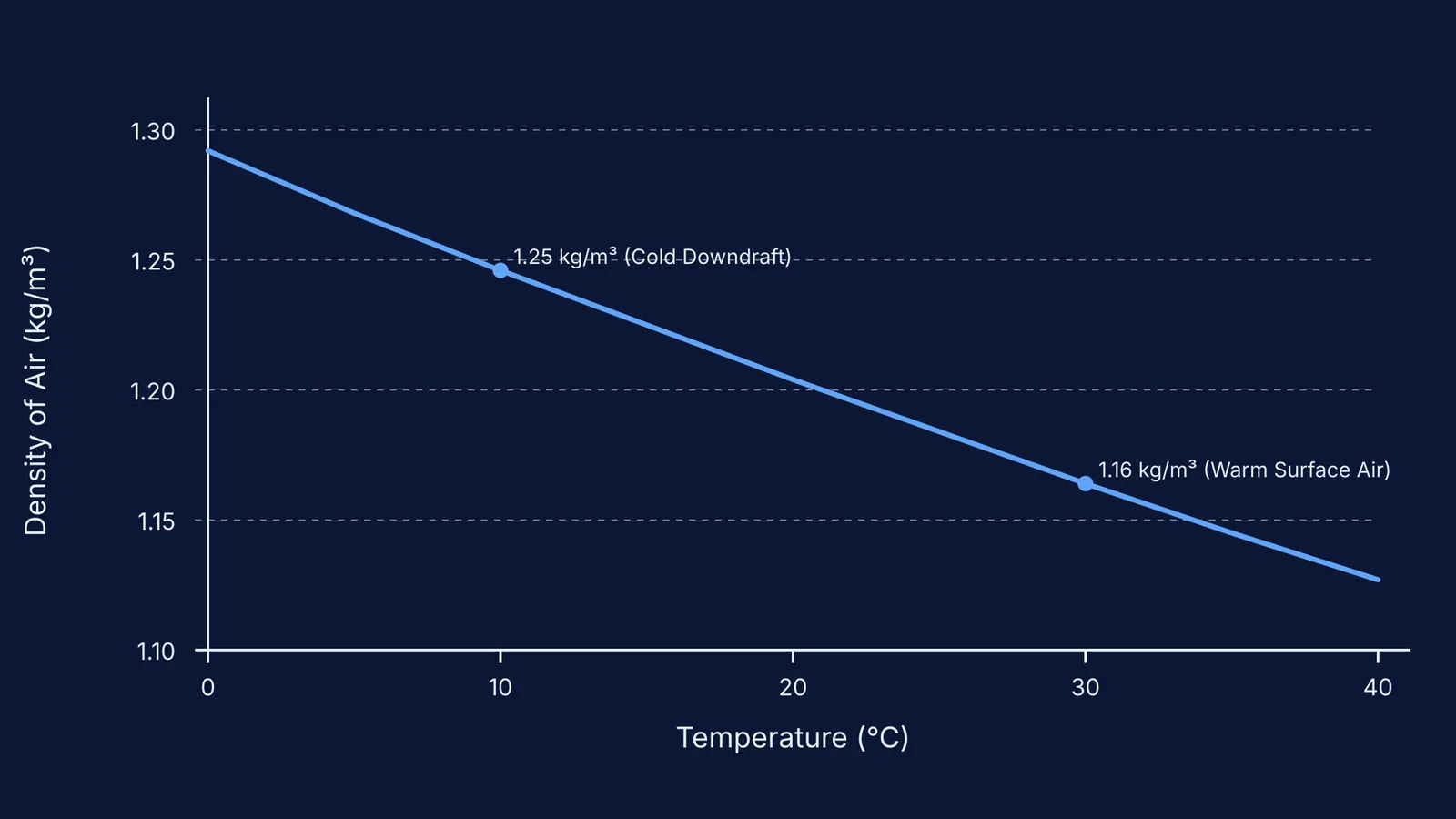
According to the National Weather Service, these downdrafts are driven by precipitation drag and evaporative cooling. As raindrops fall through the drier air below the cloud base, some of them evaporate. This evaporation cools the air, making it denser and heavier than the surrounding atmosphere. This heavy, cold air plunges to the ground—sometimes at speeds exceeding 100 mph (160 km/h).
When this column of cold air hits the ground, it spreads out in all directions. This creates a "gust front," which you feel as a sudden blast of cool, gusty wind just before the rain arrives.
To visualize how temperature and density create these moving currents of air, you can explore interactive models in the Fermi Simulation Lab.
Why does the ground stay cool after it rains?
Even after the storm passes and the downdrafts stop, the air remains cool. This happens because the ground, trees, and buildings are wet, and that water immediately begins to evaporate.
Evaporation is an endothermic process, meaning it requires heat to turn liquid water into a gas. The amount of heat required is called the latent heat of vaporization (L_v). According to OpenStax Physics, the latent heat of vaporization of water at 37 °C is approximately 2430 kJ/kg. This means that for every kilogram of rainwater that evaporates, the water must pull 2430 kilojoules of heat energy from the surrounding air and surfaces.
Because the water "steals" this thermal energy from the environment to change its state, the temperature of the ground and the immediate air drops. This is the exact same physics that explains why you feel cold when stepping out of a swimming pool, or why sweating cools down the human body.
What happens when the humidity rises?
While evaporative cooling lowers the air temperature, it also adds water vapour to the air, raising the relative humidity.
If the air is very dry before the storm, the evaporation of rainwater will cause a dramatic and lasting drop in temperature. However, if the sun comes out immediately after the rain, the combination of the remaining heat and the newly added moisture can make the air feel heavy and "muggy." The physical temperature is lower than it was before the storm, but your body struggles to evaporate its own sweat into the humid air, making it feel uncomfortable.
A quick thermodynamics checklist for your exams
When tackling problems on phase changes, thermodynamics, and weather in your physics or chemistry exams, use this three-step check:
Identify the temperature: The latent heat of vaporization is not a single fixed number. It takes *more* energy to evaporate water at body or room temperature (2430 kJ/kg) than it does at the boiling point (2256 kJ/kg, as per OpenStax Physics) because the molecules start with less kinetic energy.
Check the signs: Evaporation is endothermic. Heat (Q) absorbed by the water is positive, while the temperature change (ΔT) of the surrounding air is negative.
Connect density to movement: Cold air is denser than warm air. Always point your convection arrows (like a thunderstorm downdraft) downward for cooler, denser fluids.
Next time you step outside after a storm and feel the chill, you are directly experiencing the transfer of latent heat and the massive convection currents of the atmosphere.