

On this page
A brand-new iron tawa is a bare, reactive piece of metal. If you cook on it, food will stick, and if you leave it wet, it will rust almost immediately. To turn it into a non-stick, durable cooking surface, you have to season it.
But seasoning is not just wiping a bit of oil on the metal. It is a precise, two-part chemical transformation involving extreme heat, metal, and fat that creates a protective shell. Here is the science of what happens when you bake a layer of oil onto a tawa.
Why does an iron tawa need seasoning with oil?
At a microscopic level, the surface of cast iron or rolled iron is porous and uneven. These microscopic craters grab onto the proteins in your food, causing them to stick. Worse, this naked iron is highly vulnerable to everyday oxidation in Class 10 science.
Seasoning with oil solves both problems by filling in those microscopic valleys and laying down a slick, permanent barrier. But this barrier is not liquid oil—it is a solid polymer. The process of heating the oil past its smoke point (around 260°C or 500°F, according to a chemical analysis by Sheryl Canter) changes its chemical structure entirely.
The chemistry of polymerisation
When a thin layer of oil on an iron tawa is exposed to high heat and oxygen, the fatty acids in the oil undergo a chemical reaction called radical polymerisation.
The intense heat causes the fat molecules to break down and release free radicals. The iron of the tawa acts as a catalyst for this process. These free radicals then attack the double bonds in the oil's fatty acids, forcing the individual molecules to cross-link with each other. They snap together to form massive, interconnected chains called polymers.
The result is a tough, plastic-like film that bonds directly into the pores of the iron. Because it is chemically bonded, it does not wipe off when you wash the pan.
Which oils are best for seasoning?
Not all oils polymerise equally well. The ideal oils for creating a hard, glass-like finish are those high in polyunsaturated fats, known as "drying oils."
Flaxseed oil is widely considered the gold standard for seasoning because it contains 57% alpha-linolenic acid (ALA) (Canter, 2010), an omega-3 fatty acid. These polyunsaturated fats have multiple double bonds—reactive sites where cross-linking occurs easily. When baked, flaxseed oil polymerises faster and harder than saturated fats like lard or coconut oil, which lack the double bonds necessary for extensive cross-linking.
How does the coating prevent rust?
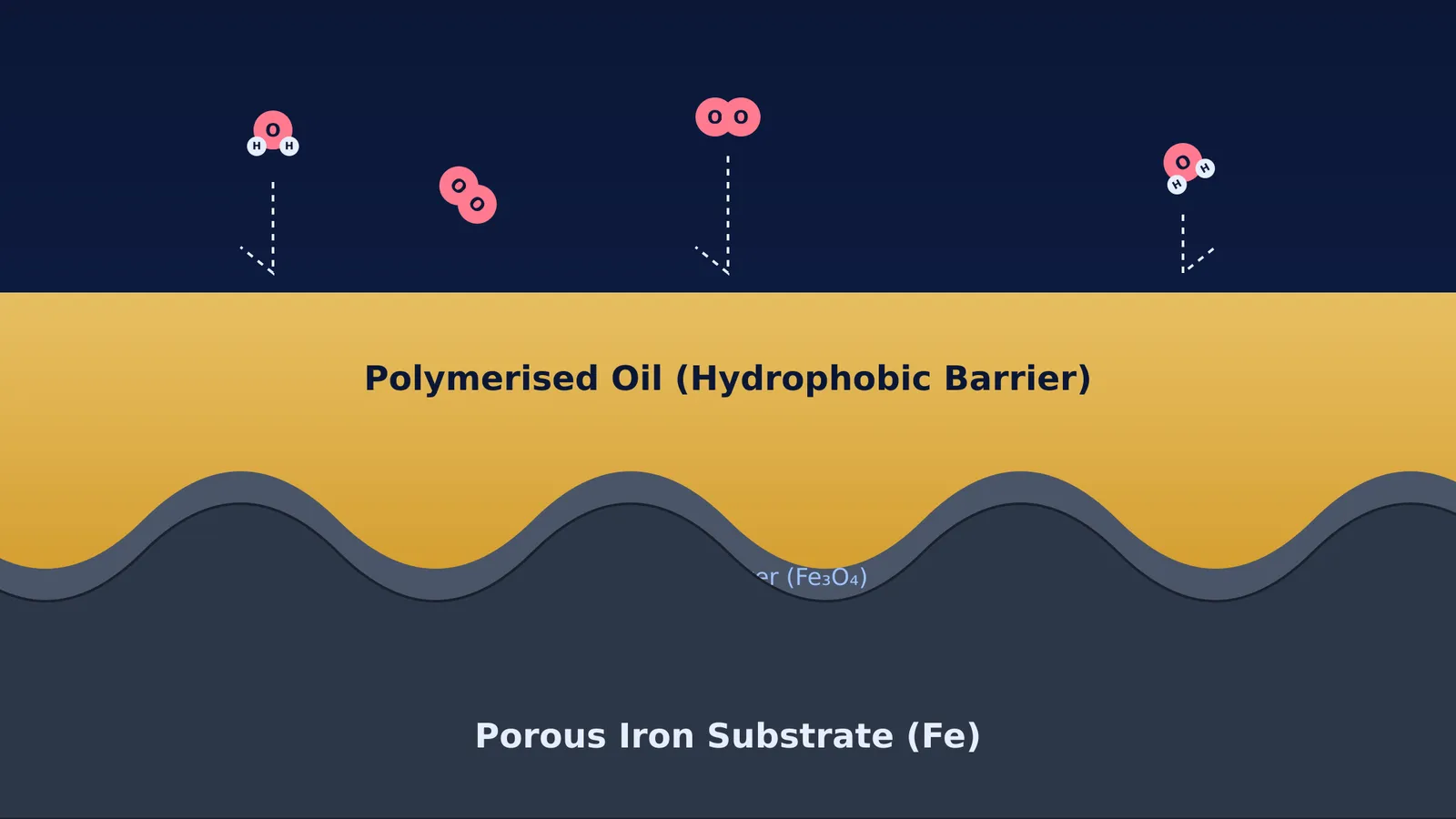
Rust requires two things to form: iron and water (specifically, moisture and oxygen). If you remove either from the equation, rust cannot occur. To understand why iron rusts and how to stop it, look at the barrier created by the polymerised oil.
The newly formed polymer layer is highly hydrophobic (water-repelling). By sealing the iron's pores completely, it acts as physical armour. Water and oxygen cannot pass through this plastic-like matrix to reach the raw iron underneath, meaning the oxidation reaction never begins.
If you find these chemical interactions difficult to visualise, interactive models can help. In the Fermi Simulation Lab, you can interact with simulations of molecular structures to master ideas that are easier to see than to read.
The role of magnetite (Fe₃O₄)
In addition to the polymerised oil, the process of heating the tawa repeatedly changes the surface of the iron itself. A 2020 study in the journal *Nano Materials Science* examined the nanoscience behind traditional seasoning.
The researchers discovered that repeated heating of oil on an iron pan creates microscopic nanoballs of Fe₃O₄ (magnetite) on the surface. This dark layer of magnetite acts alongside the polymerised oil to provide "conditional hydrophobicity," meaning it repels water efficiently while cooking, creating a non-stick effect. You can explore oxidation numbers from structure: Fe3O4 to see how this stable black oxide differs chemically from the destructive red iron oxide (Fe₂O₃) we know as rust. The magnetite anchors the oil polymer and offers a second line of defence against rust.


