

On this page
In many Indian homes, making idlis is a daily routine that doubles as a masterclass in biochemistry. You grind rice and black gram (urad dal), leave it on the kitchen counter, and wake up to a bowl of airy, frothy batter.
But what actually causes this dramatic physical transformation? Unlike bread, idli batter does not rely on added commercial yeast. The secret lies in a wild, invisible ecosystem that springs to life while you sleep.
Where do the microbes come from?
In Class 8 science, students learn about microorganisms and how they are ubiquitous in our environment. When you make idli, the necessary bacteria are already hitching a ride on the surface of the raw black gram.
As soon as the lentils are soaked and ground, these dormant microbes wake up. They are predominantly lactic acid bacteria (LAB). Early in the process, a diverse set of environmental microbes competes for the easily accessible sugars in the rice and lentils. However, as the bacteria metabolise these sugars and the environment becomes slightly acidic, only the hardiest lactic acid-producing strains survive to dominate the mixture.
Why does idli batter rise when left overnight?
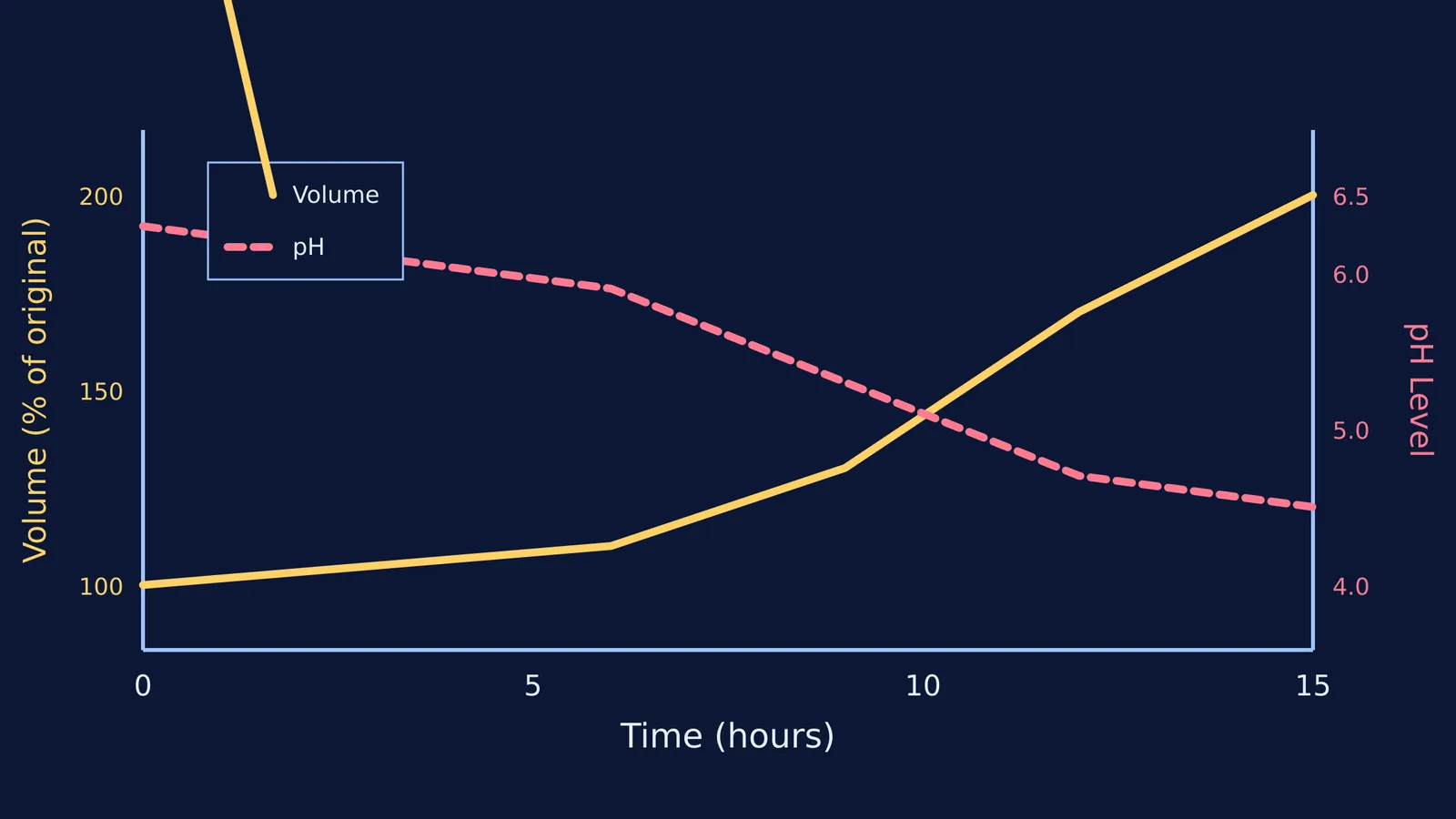
Idli batter rises because natural lactic acid bacteria consume simple sugars and release carbon dioxide gas as a metabolic byproduct. A 2019 study published in *Applied and Environmental Microbiology* mapped the bacterial populations and found that strains from the genus *Weissella* act as the primary engines of this process, doubling the batter's volume over 15 hours (doi:10.1128/AEM.00368-19).
Historically, science textbooks often credited a different bacterium, *Leuconostoc mesenteroides*, for this leavening action. However, modern genetic sequencing reveals that *Weissella* species are the true workhorses during the peak fermentation window. These heterofermentative bacteria use a specific chemical route—the hexose monophosphate pathway—to break down carbohydrates. This pathway inherently produces both lactic acid and carbon dioxide.
The mucilaginous proteins found naturally in the black gram act like a sticky, elastic net, trapping these tiny carbon dioxide bubbles. This trapped gas aerates the batter, physically pushing it upward in the container. When the batter is subsequently steamed, the heat sets this protein structure, which is why idlis turn out spongy and porous rather than dense and flat.
How do pH and density change?
As the *Weissella* bacteria multiply and work through the starch, the physical and chemical properties of the batter shift dramatically. Over the standard 15-hour fermentation window, the pH of the batter drops steeply from a near-neutral 6.3 to an acidic 4.5 (doi:10.1128/AEM.00368-19).
At the same time, the bulk density plummets because the heavy liquid matrix is now filled with thousands of microscopic pockets of gas. The microbes have effectively predigested the complex starches, a process distinct from how respiration acts as an amphibolic pathway in humans, but equally vital for breaking down raw nutrients into accessible forms. This predigestion makes the final food much easier for our own bodies to absorb, significantly improving the bioavailability of essential vitamins and minerals.
If you are studying for exams and find it hard to picture how molecular gas bubbles become trapped within a three-dimensional network of plant proteins, the Fermi Simulation Lab provides interactive models that make these microscopic physical changes easier to see.
How can you test fermentation variables at home?
Biological processes are incredibly sensitive to their environment, which explains why idli batter behaves differently during a cold winter night compared to a humid summer evening. You can treat your kitchen as an active learning space by changing one variable at a time, keeping a log of the results:
Temperature: Lactic acid fermentation thrives in a warm environment. Try splitting a fresh batch of batter into two identical bowls. Keep one inside a slightly warm, turned-off oven and place the other on a cool countertop. Measure the height difference with a ruler the next morning to calculate the rate of volume expansion.
Ingredient ratio: The standard household ratio uses a larger proportion of rice to urad dal. Because the black gram provides both the initial bacteria and the essential trapping proteins, a batter with too little dal will fail to retain the carbon dioxide. Conversely, using too much dal makes the batter overly dense. Testing small batches with altered ratios helps identify the structural limits of the protein net.
Salt timing: Some cooks stir in non-iodised salt before fermentation, while others wait until just before steaming. Adding salt early can intentionally slow down wild yeasts and overly fast-acting bacteria, giving the *Weissella* a controlled, steady environment to work in.
This kind of practical observation bridges the gap between rote textbook definitions—like memorising the misfits of five-kingdom biology—and real-world science. Approaching everyday phenomena with a scientific mindset turns passive eating into active learning. The next time you sit down to breakfast, you will know exactly how billions of microscopic workers collaborated to make your meal possible.


