

On this page
Why do ice skaters glide so effortlessly while maintaining enough grip to launch into spinning jumps? The secret is in the blade, which is typically just a few millimetres wide. By shrinking the contact area beneath their feet, skaters manipulate pressure and friction to control their movement.
How does a tiny area create high pressure?
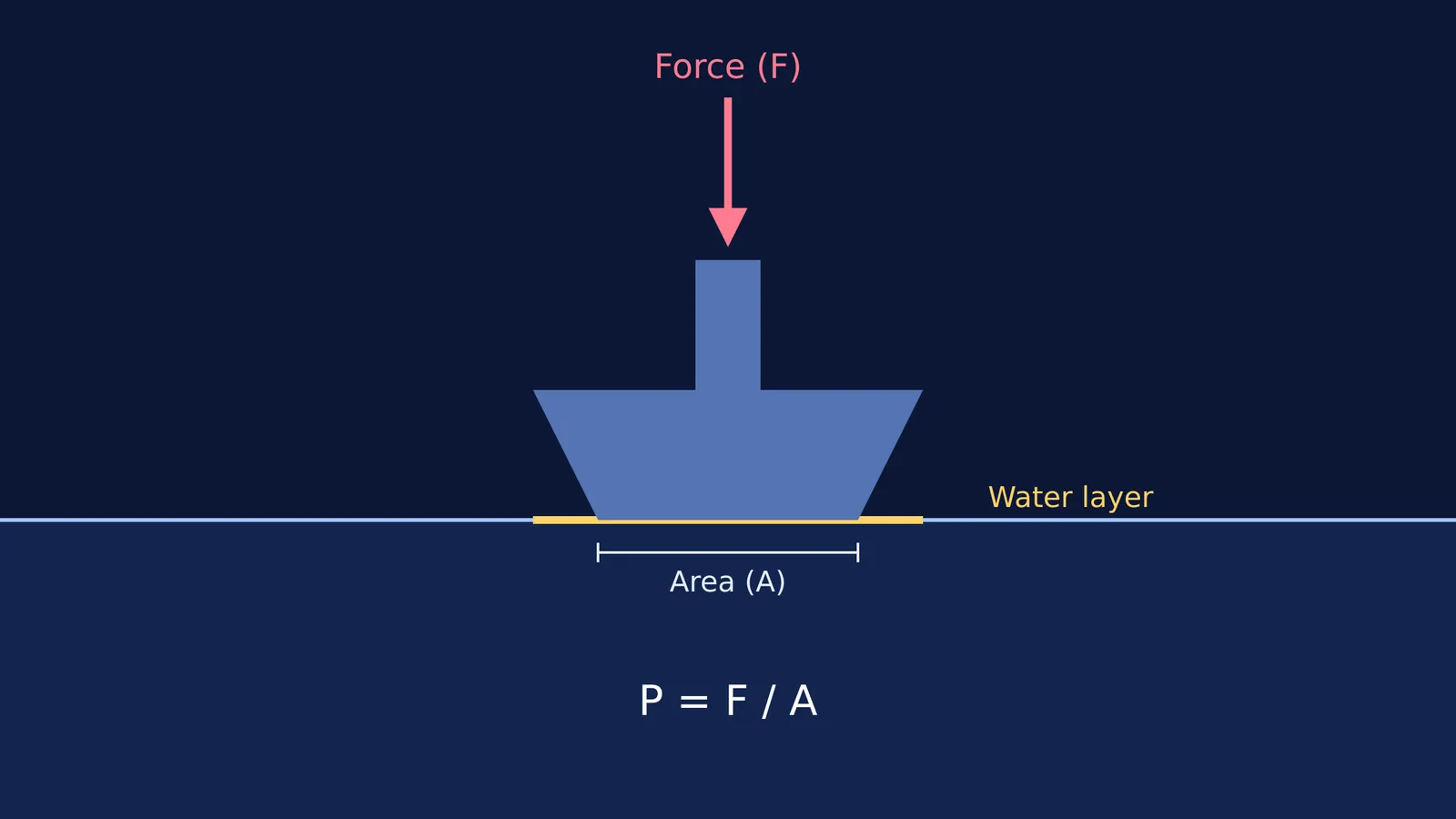
In physics, pressure is the force applied perpendicular to a surface, divided by the area over which it is distributed (P = F / A). If you stand on the ice in flat shoes, your weight is spread over a large area, resulting in low pressure.
When you put on ice skates, your entire weight is concentrated onto the microscopic edge of two thin metal blades. Because the area (A) is so small, the resulting pressure (P) becomes enormous. This high pressure allows the sharp steel edge to bite physically into the solid ice, providing the lateral grip a skater needs to push forward, carve a tight turn, or land a jump without slipping sideways. If you are studying how to calculate these forces, you can explore force and pressure in Class 8 to see how contact area changes the result.
Why does the old "pressure melting" theory fail?
For over a century, textbooks taught that this immense pressure was also the sole reason skates could glide. This 19th-century hypothesis, known as pressure melting, argued that the high pressure from the blade lowered the freezing point of the ice directly beneath it, squeezing out a lubricating layer of liquid water.
However, the math does not hold up to real-world conditions. According to a comprehensive Wikipedia review of the physical mechanics of skating, the pressure melting theory cannot account for skating at temperatures lower than −3.5 °C. Because figure skaters and hockey players frequently compete on ice much colder than that, pressure alone cannot explain the glide.
Why is friction the real secret to gliding?
Modern physics reveals that the smooth glide relies on two different mechanisms working together: a pre-existing surface layer and frictional heating.
First, ice is inherently slippery. Research summarized on Wikipedia shows that ice possesses a "quasi-fluid" or water-like layer at its surface. The molecules in this layer are 100,000 times more mobile than those deep inside the solid ice, though they remain 25 times less mobile than bulk liquid water. This slippery layer exists even in extreme cold; at −157 °C, it is exactly one molecule thick, and it grows thicker as the temperature rises.
Second, as the skater begins to move, the sharp edges plough through the ice. This creates viscous frictional heating. The kinetic energy of the moving blade is converted into heat, which actively melts a macroscopic layer of water beneath the skate. This friction-induced melt is what truly lubricates a fast-moving skater. Interestingly, as velocity increases, this water layer lifts the skate, causing the physical "ploughing friction" to decrease. According to Wikipedia's summary of skating physics, this efficiency allows speed skaters to reach velocities exceeding 90 km/h.
For students exploring how friction can be both a hindrance and a necessity, mastering the balance of these forces is key. The Fermi Concept Library can help you explore how friction acts across different surfaces. You can also read more about friction in Class 8: why it helps, and how we reduce it to understand these everyday mechanics.
By combining the grip of high pressure with the lubricating heat of friction, the narrow skate blade turns a block of solid ice into the perfect high-speed track.


