

On this page
The story of the Mpemba effect starts with a persistent student in a Tanzanian classroom. In 1963, Erasto Mpemba was making ice cream for a school project. Running out of time, he put his boiling hot milk and sugar mixture straight into the freezer alongside the cooler mixtures of his classmates. To everyone's surprise, his hot mixture froze first.
Mpemba's teachers initially dismissed his claim, assuming he had made a mistake. However, he remained curious and eventually posed the question to Dr Denis Osborne, a visiting physics professor. Osborne was intrigued and tested it in a laboratory, finding that boiling water indeed froze faster than water at room temperature. The two published their findings in a 1969 paper in *Physics Education*.
The idea that hot water can freeze faster than cold water became known as the Mpemba effect. It continues to spark debate among physicists because it is notoriously difficult to reproduce reliably. The phenomenon is not a single, simple trick of thermodynamics, but rather a combination of several mechanisms competing at once. So, what causes it?
What drives the Mpemba effect?
When you place a container of hot water in a freezer, it loses heat through several pathways that do not apply equally to cold water.
First, hot water evaporates much faster than cold water. Evaporation removes mass, meaning there is simply less water left in the container to cool and freeze. As water turns to vapour, it also takes away a massive amount of latent heat, cooling the remaining liquid even faster. However, precise measurements over the decades have shown that evaporation only accounts for a small fraction of the total cooling difference.
Convection is another major factor. Hot water develops strong circulation currents because the colder water at the edges of the container becomes dense and sinks, while the hotter water in the centre rises. These constant currents keep the surface temperature higher for longer, accelerating the heat lost to the surrounding freezing air.
If you struggle to picture how convection currents and heat loss work across different temperature ranges, the Fermi Simulation Lab provides interactive simulations for the ideas that are easier to see than to read.
Finally, dissolved gases play a role. Heating water to a boil drives out dissolved air. Water with less dissolved gas has different properties, which directly affects how ice crystals begin to form. This leads to the most compelling explanation for the effect.
Why does supercooling matter?
While evaporation and convection help hot water catch up in the cooling race, they rarely explain how it actually turns into solid ice *first*. The true deciding factor almost always comes down to supercooling.
Water rarely turns to ice exactly at 0 °C in real-world conditions. Instead, it supercools—remaining a liquid well below its freezing point—until an impurity, a rough edge, or a gas bubble acts as a nucleation site to kickstart the formation of ice crystals. In 2011, physicist James Brownridge demonstrated that the Mpemba effect relies heavily on these nucleation points (Brownridge, 2011).
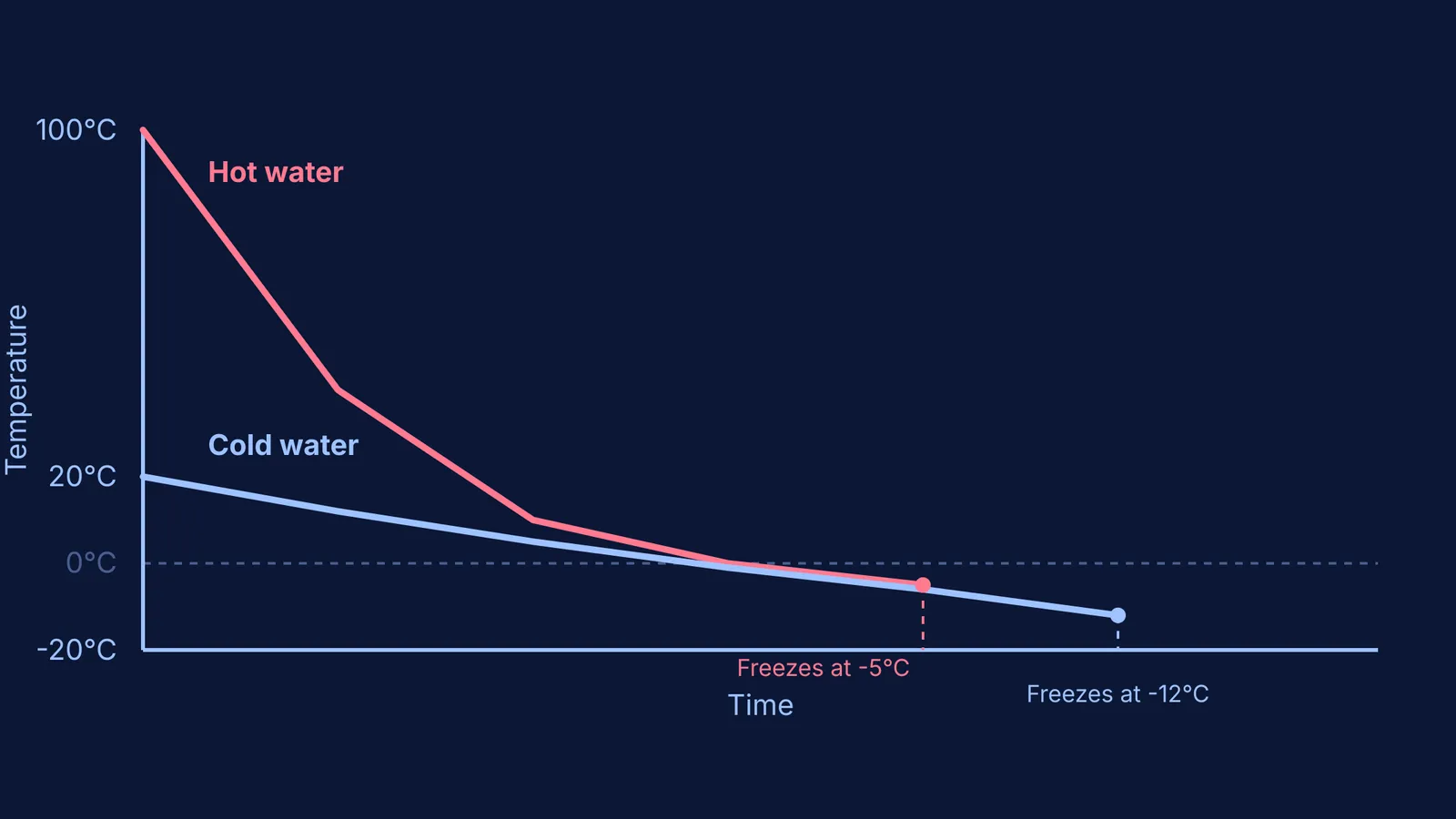
Brownridge found that heating water can expel gases and alter the distribution of impurities, which changes the exact temperature at which the water will spontaneously freeze. In his experiments, a sample of hot water might supercool to −5 °C before snapping into solid ice. A colder sample of the identical water, still retaining its original dissolved gases, might supercool much further, dropping to −12 °C before finally freezing.
If you plot the temperatures, the cold water reaches 0 °C first, but it stays liquid. The hot water reaches its warmer freezing point of −5 °C and turns to ice, winning the race. The effect is not about the rate of cooling; it is about the threshold for freezing.
Can you test the Mpemba effect at home?
You can reproduce Mpemba's classic observation in your own freezer, but it requires careful controls to isolate the variables.
Take two identical small containers, such as paper cups or silicone baking moulds.
Measure exactly 50 ml of cold tap water (around 20 °C) into the first cup.
Measure exactly 50 ml of recently boiled water (around 80 °C) into the second cup.
Place both cups on a piece of thick cardboard in your freezer. The cardboard stops the hot cup from melting the frost on the shelf and gaining an unfair advantage through better thermal conduction.
Check the cups every 10 minutes to see which one develops a solid layer of ice first.
Whether you are studying the time for ice to form on a pond or calculating heat in isobaric and isochoric processes, the Mpemba effect is a reminder that simple questions in physics often have complex, multi-layered answers.


