

On this page
Why are honeybee numbers falling across the world?
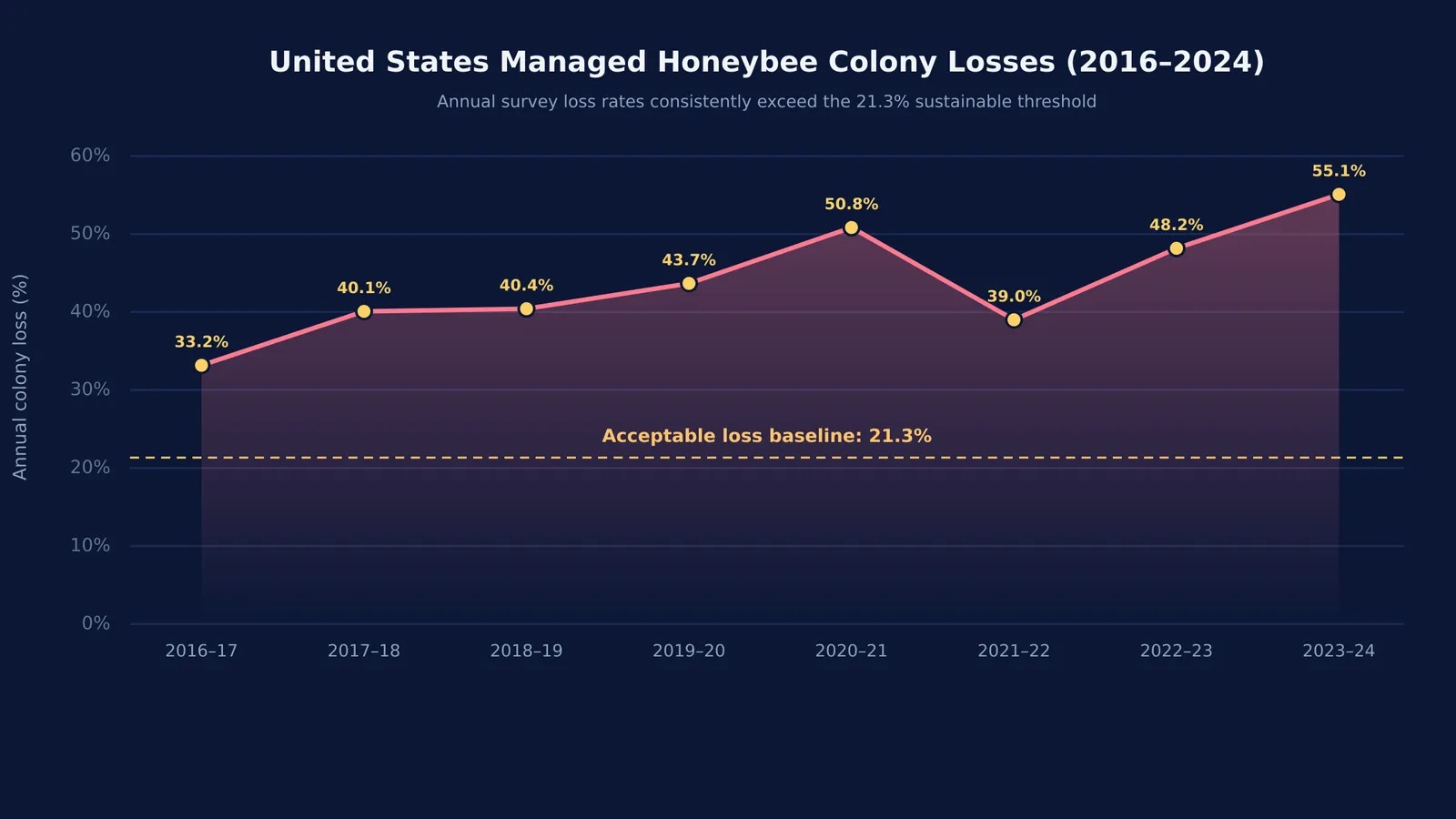
Beekeepers have reported heavy losses over the last two decades, but the nature of this decline is often misunderstood. Managed colonies are not vanishing into extinction; rather, individual hives fail at rates far exceeding historical norms. In a survey published in the Journal of Apicultural Research, Dan Aurell and colleagues reported that United States beekeepers lost 50.8% of their managed colonies in 2020–21 and 39.0% in 2021–22. Although beekeepers consider a 21% loss rate sustainable, annual mortality has repeatedly exceeded 40% across recent survey cycles.
To replace dead hives, apiarists continuously split surviving colonies and rear new queens. This keeps overall hive counts relatively steady, but it masks severe underlying physiological damage. The European honeybee (*Apis mellifera*), along with Indian species such as *Apis cerana indica*, *Apis dorsata*, and *Apis florea*, faces multiple colliding stressors that prevent worker bees from surviving winter or completing foraging flights.
How do Varroa mites and viruses dismantle a hive?
The main biological driver is *Varroa destructor*, an invasive parasitic mite. Entomologists long believed the mite consumed bee hemolymph, the insect equivalent of blood. But in the Proceedings of the National Academy of Sciences, Samuel D. Ramsey and colleagues proved that Varroa feeds primarily on fat body tissue. The fat body acts like a liver, producing vitellogenin storage proteins, regulating hormones, and detoxifying pesticides. Deprived of fat body tissue, developing bees emerge stunted and immunocompromised.
Mites also serve as a lethal viral vector. Stephen J. Martin and colleagues demonstrated in Science that Varroa infestation drives Deformed Wing Virus (DWV) from a rare, low-level infection into a dominant, highly virulent pathogen circulating at titers a million times higher. Infected bees emerge with ruined wings and damaged flight musculature, unable to forage.
Chemical exposure accelerates this decline. As explored in our guide on how pesticides accumulate through biological magnification, agricultural chemicals accumulate in beneficial insects. In a multi-country field study in Science, B. A. Woodcock and co-authors found that field-realistic neonicotinoid seed treatments reduced overwinter colony survival and queen production across the United Kingdom and Hungary. Neonicotinoids block nicotinic acetylcholine receptors, impairing memory and navigation so foragers cannot find their way home.
What happens to crops when pollinator populations drop?
Honeybee declines directly threaten human nutrition. A global evaluation by Alexandra-Maria Klein and colleagues in the Proceedings of the Royal Society B showed that 87 of the world's 115 leading food crops depend on animal pollinators for fruit, vegetable, or seed set. While staple grains like wheat and rice self-pollinate or depend on wind, insect-pollinated crops supply crucial micronutrients including vitamins A and C, iron, and essential lipids.
According to the IPBES assessment on pollinators, more than 75% of global food crop types rely on animal pollination, accounting for 235 billion to 577 billion US dollars in annual crop value. In India, field studies by the Indian Council of Agricultural Research AICRP on Honey Bees and Pollinators show that managed bee pollination can boost mustard seed yields by up to 43% and raise apple fruit set from around 10% to over 33%. The floral recruitment mechanisms behind these visits build on Christian Konrad Sprengel's studies on flower recruitment and the evolution of outbreeding devices that encourage cross-pollination.
How can students analyze colony stress in ecosystems?
Ecology questions often ask you to trace why complex systems collapse. Rather than treating bee decline as a single problem, examine it through a four-stage interaction model:
Primary organ destruction: *Varroa destructor* consumes fat body tissue, draining vitellogenin reserves.
Viral amplification: Mite punctures inject Deformed Wing Virus directly into the hemolymph, bypassing normal gut filters.
Neurotoxic disorientation: Sub-lethal neonicotinoid doses disrupt neural signaling in the bee brain, scrambling navigation and communication.
Nutritional deficits: Monoculture agriculture replaces diverse wild flora with single-crop blooms, causing seasonal nutritional deficits.
When dynamic feedback loops in ecological food webs feel abstract on the page, the Fermi Simulation Lab offers interactive simulations for ideas easier to see than read, letting you adjust parameters like pollinator mortality or floral density to watch how population dynamics shift. To strengthen your grasp on related concepts in floral reproduction and ecosystem dynamics, the Fermi Concept Library covers every concept in physics, chemistry, biology, mathematics and computing, each with its own lesson and its place in the map.


