

On this page
Why does gold jewellery stay shiny for years?
In Indian households, gold jewellery passes across generations without losing its characteristic yellow glow. While an iron nail left outside turns reddish-brown within days and polished copper tarnishes green, gold necklaces and bangles remain bright even after decades of daily wear.
Gold preserves its shine because it sits at the very bottom of the metal reactivity series outlined in NCERT Science. As covered in our Class 10 metals and non-metals guide, metals differ in their tendency to lose valence electrons. Highly active elements like sodium react violently with water, but gold (Au) holds its electrons so tightly that it resists reaction with oxygen, moisture, and sweat.
Why does iron rust while gold never corrodes?
To understand why gold stays shiny, you need to separate rusting from general corrosion. As detailed in our guide to corrosion as an electrochemical process, rusting applies only to iron and steel. Iron reacts with air and water to form porous hydrated iron(III) oxide (Fe₂O₃·xH₂O), which flakes away and exposes fresh metal to further attack.
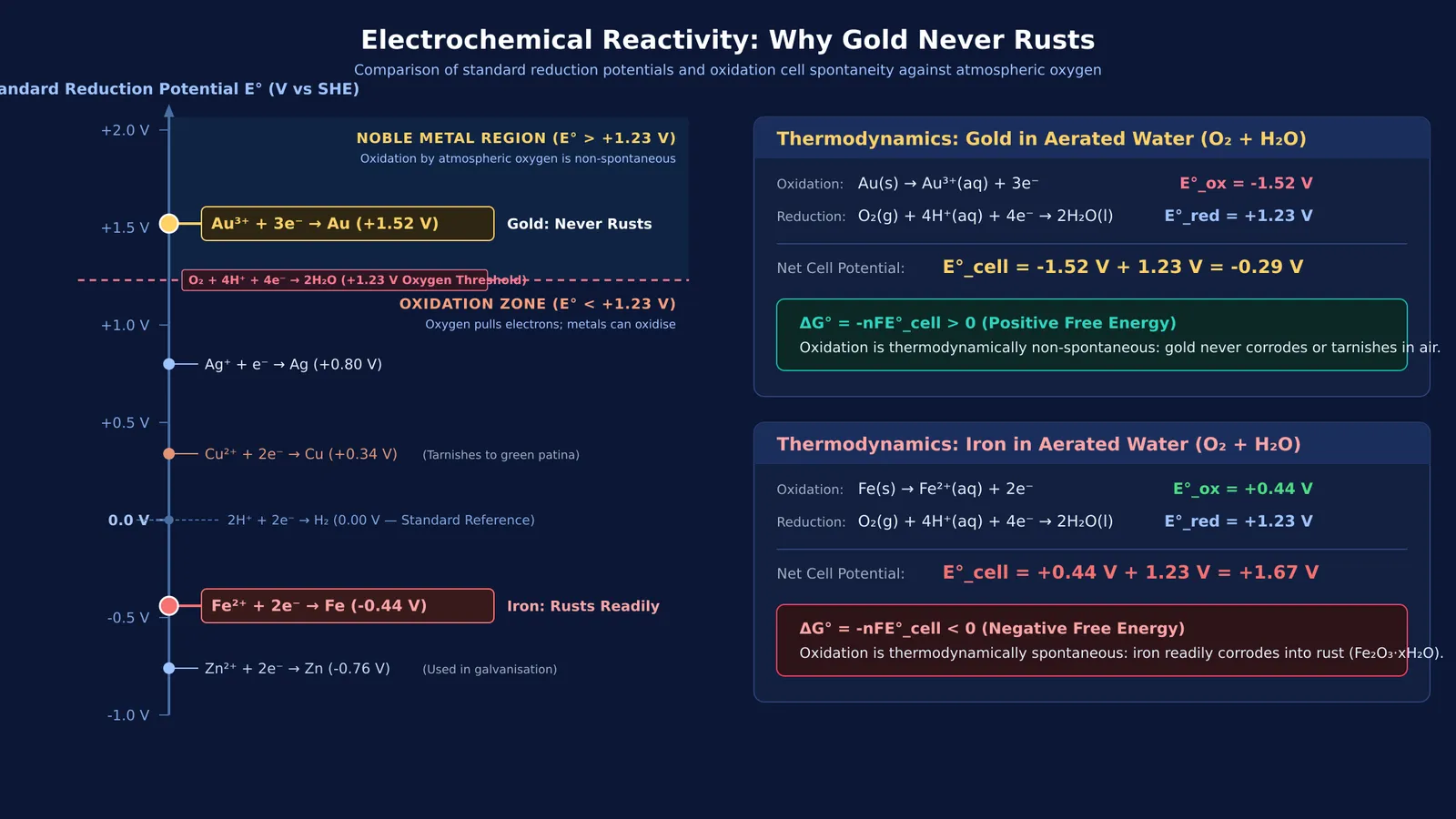
Gold does not corrode because its oxidation is thermodynamically non-spontaneous. Standard reduction potential tables from Chemistry LibreTexts measure a species' affinity for electrons:
Au³⁺(aq) + 3e⁻ → Au(s), E° = +1.52 V
For atmospheric oxygen dissolved in water, the reduction half-reaction has a standard potential of +1.23 V:
O₂(g) + 4H⁺(aq) + 4e⁻ → 2H₂O(l), E° = +1.23 V
Here is the worked comparison showing why iron rusts while gold remains intact:
Iron oxidation: Solid iron oxidises readily (Fe → Fe²⁺ + 2e⁻, E°_ox = +0.44 V). Paired with oxygen reduction (+1.23 V), the cell potential is E°_cell = +0.44 V + 1.23 V = +1.67 V. Because E°_cell is positive, the Gibbs free energy change (ΔG° = -nFE°_cell) is negative, driving spontaneous rusting.
Gold oxidation: Gold would need to oxidise (Au → Au³⁺ + 3e⁻, E°_ox = -1.52 V). Paired with oxygen reduction, the net potential is E°_cell = -1.52 V + 1.23 V = -0.29 V. Because E°_cell is negative, ΔG° is positive. Atmospheric oxygen cannot pull electrons from gold.
What makes gold chemically unreactive at the atomic level?
Gold's exceptional stability stems from Albert Einstein's special theory of relativity.
With atomic number 79, gold's nucleus carries a heavy positive charge. Inner 1s electrons travel at roughly 58% of the speed of light, causing relativistic mass increase. As calculated by chemist Pekka Pyykkö in Angewandte Chemie, this contracts and stabilises the spherical 6s electron shell, pulling valence electrons closer to the nucleus.
This contraction gives gold a high first ionisation energy of 890.1 kJ/mol. Neither pure oxygen nor ordinary acids can dislodge these electrons. Gold dissolves only in aqua regia, a 3:1 mixture of concentrated hydrochloric and nitric acids that forms soluble [AuCl₄]⁻ ions.
Can 22-karat gold jewellery ever tarnish in daily use?
Pure 24-karat gold (99.9% purity) is too malleable for daily jewellery. In India, hallmark jewellery complies with Bureau of Indian Standards specifications: 22-karat (22K916) items contain 91.6% pure gold and 8.4% alloying metals like copper or silver to provide mechanical strength.
The gold atoms never react, but exposed copper atoms on the surface can react with airborne sulfur compounds or sweat acids. As explored in why cheap jewellery turns your skin green, this forms a faint microscopic film of copper sulfide. A gentle wash in warm soapy water removes this superficial residue without altering the gold underneath.
How can students master the reactivity series for exams?
For board exams and entrance tests like JEE Main and NEET-UG, use this 4-step diagnostic checklist to solve reactivity and electrochemical questions:
Compare against hydrogen: Reference tables in Chemistry LibreTexts set hydrogen at 0.00 V. Metals above hydrogen release H₂ gas from dilute acids; metals below it (copper, silver, gold) never do.
Check displacement rules: A more reactive metal displaces a lower metal from its aqueous salt solution. Zinc displaces copper, but gold cannot displace iron.
Link reactivity to extraction: Reactive metals at the top require electrolytic reduction, while unreactive metals like gold occur in nature as native free elements.
Verify cell spontaneity: A redox process occurs spontaneously only when E°_cell = E°_cathode - E°_anode > 0.
For concepts that are easier to see than to read, the Fermi Simulation Lab provides interactive simulations to observe electron transfer and cell potentials. To map related topics, the Fermi Concept Library covers every concept in chemistry with its place in the concept map, while the Fermi Problem Library offers worked problems with a step-by-step solver that explains the reasoning rather than printing an answer.


