

On this page
Taking off an artificial ring or bracelet often reveals an unmistakable green band across your skin. While discoloured skin can look alarming, this mark is neither an infection nor a toxic hazard. Instead, it is an everyday example of electrochemical corrosion occurring at the boundary between base metal, perspiration, and ambient air.
Why does artificial jewellery turn skin green?
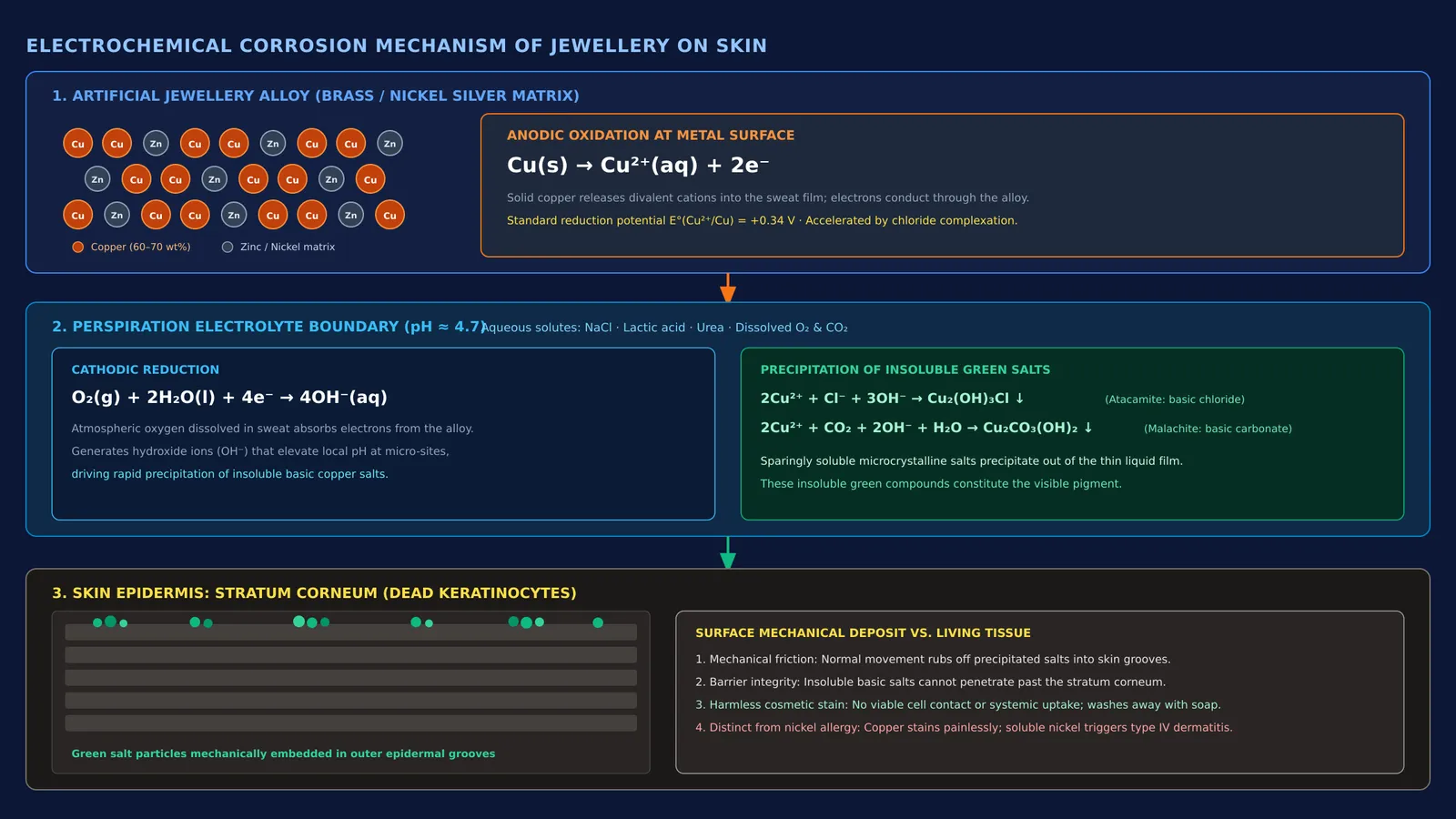
The reaction begins with perspiration, which acts as an aqueous electrolyte. Skin surface pH averages approximately 4.7 due to lactic acid and fatty acids, as shown in a 330-subject study by Lambers and colleagues in the International Journal of Cosmetic Science. Sweat also delivers dissolved sodium chloride and moisture to the metal surface.
In this mildly acidic, saline film, metallic copper establishes microscopic electrochemical cells. Solid copper undergoes anodic oxidation, releasing ions into the liquid layer:
Cu(s) → Cu²⁺(aq) + 2e⁻
Simultaneously, dissolved atmospheric oxygen undergoes cathodic reduction:
O₂(g) + 2H₂O(l) + 4e⁻ → 4OH⁻(aq)
Dissolved copper cations react with hydroxide, chloride, and carbon dioxide in the sweat film. Surface analysis of copper alloys in synthetic sweat by Colin and co-authors in Corrosion Science00141-3) confirmed that copper precipitates as basic copper chloride, Cu₂(OH)₃Cl (atacamite), alongside copper(I) oxide; ambient carbon dioxide also forms basic copper carbonate, Cu₂CO₃(OH)₂ (malachite). Because these green salts are sparingly soluble in water, mechanical friction from normal movement rubs them off, embedding the microcrystals into the stratum corneum.
To see how galvanic microcells and redox potentials drive real reactions, the Fermi Simulation Lab provides interactive simulations for the ideas that are easier to see than to read.
Which alloy metals cause the green discoloration?
Affordable fashion jewellery is rarely made from pure precious metals. In an elemental analysis of 956 fashion jewellery components, Hamann and colleagues in Contact Dermatitis identified copper, zinc, and nickel as the primary base metals. To keep manufacturing costs low, makers typically cast items from copper-rich alloys:
Yellow brass: Containing 60% to 70% copper and 30% to 40% zinc, brass is the most common base alloy in fashion jewellery.
German silver (nickel silver): This alloy contains roughly 50% to 60% copper, 10% to 20% nickel, and 20% to 30% zinc, but no elemental silver.
Flash-plated metals: Inexpensive pieces often carry a decorative gold or silver plate thinner than 0.5 micrometres. Regular friction wears away this micro-layer, exposing the copper core to sweat.
Copper has a standard reduction potential of +0.34 V for the Cu²⁺/Cu couple, placing it below hydrogen in the reactivity series. As explained in our guide to metals and non-metals in Class 10, copper does not displace hydrogen from non-oxidizing acids. However, in the presence of oxygen and chloride ligands, its oxidation becomes spontaneous. The wider principles behind this metal oxidation are explored in our guides to corrosion and rancidity in Class 10 science and the electrochemical mechanism of corrosion.
Is green skin dangerous or a metal allergy?
Although green marks look striking, they are purely superficial cosmetic stains. In an assessment of copper hypersensitivity, Hostynek and Maibach in Dermatologic Therapy showed that copper has exceptionally low sensitization potential in predictive assays, finding that verified allergic contact dermatitis from copper jewellery is exceedingly rare.
Instead, true jewellery allergies are almost always triggered by nickel. In a five-nation study of 3,119 individuals, Diepgen and colleagues in the British Journal of Dermatology documented an age-standardized contact allergy prevalence of 14.5% for nickel. While insoluble copper salts simply rest on dead keratin cells, soluble nickel ions penetrate the barrier and provoke a type IV delayed hypersensitivity response. Persistent itching, redness, swelling, or rash indicate a nickel allergy rather than harmless copper staining.
How can you prevent artificial jewellery from turning your skin green?
You do not need to discard imitation jewellery to prevent green marks. Managing moisture and creating a physical barrier prevents metal oxidation:
Apply a polymer coating: Paint contact surfaces of rings and bracelets with two coats of clear jewellery sealant or transparent nail polish. This film physically isolates copper from sweat.
Keep pieces dry: Take off artificial jewellery before exercise, washing, or sleeping, where sweat accumulates beneath tight metal bands.
Allow cosmetics to absorb: Let lotions, perfumes, and sunscreens dry completely before wearing jewellery, as cosmetic lipids can accelerate copper leaching.
Clean and store with desiccant: Wipe pieces after wear with a microfibre cloth and store them in sealed pouches containing a silica gel packet.
Wash stains gently: Discoloration on skin washes off with soap and warm water; micellar water or dilute lemon juice quickly dissolves lingering copper salts without harsh scrubbing.
For students connecting everyday chemical reactions to core syllabus topics, the Fermi Concept Library covers every concept in physics, chemistry, biology, mathematics and computing, each with its own lesson and its place in the map.


