

On this page
Have you ever walked into a closed glass door? You are not alone. A 2025 study in the journal *Injury* found that glass doors were responsible for 55% of paediatric glass-related trauma cases treated at a major hospital. The problem is so widespread that building codes worldwide now mandate safety measures.
The problem lies in the physics of light transmission and how our eyes detect objects.
Why is clear glass so hard to see?
We see objects because they reflect or scatter light into our eyes. A brick wall absorbs some light and scatters the rest in all directions—a process called diffuse reflection—making it easy to spot from any angle.
Clear window glass behaves very differently. A standard single pane of clear glass has a high Visible Transmittance (VT). This means most of the visible light hitting the glass passes straight through it. By comparison, a heavily tinted window has a much lower VT, blocking more light and making the physical barrier much more obvious.
What is the difference between specular and diffuse reflection?
The way a surface reflects light determines whether we can see it clearly. When light strikes a rough surface like a wooden door, it bounces off in many different directions. This is called diffuse reflection. Because the light is scattered, some of it will always reach your eyes regardless of your position in the room.
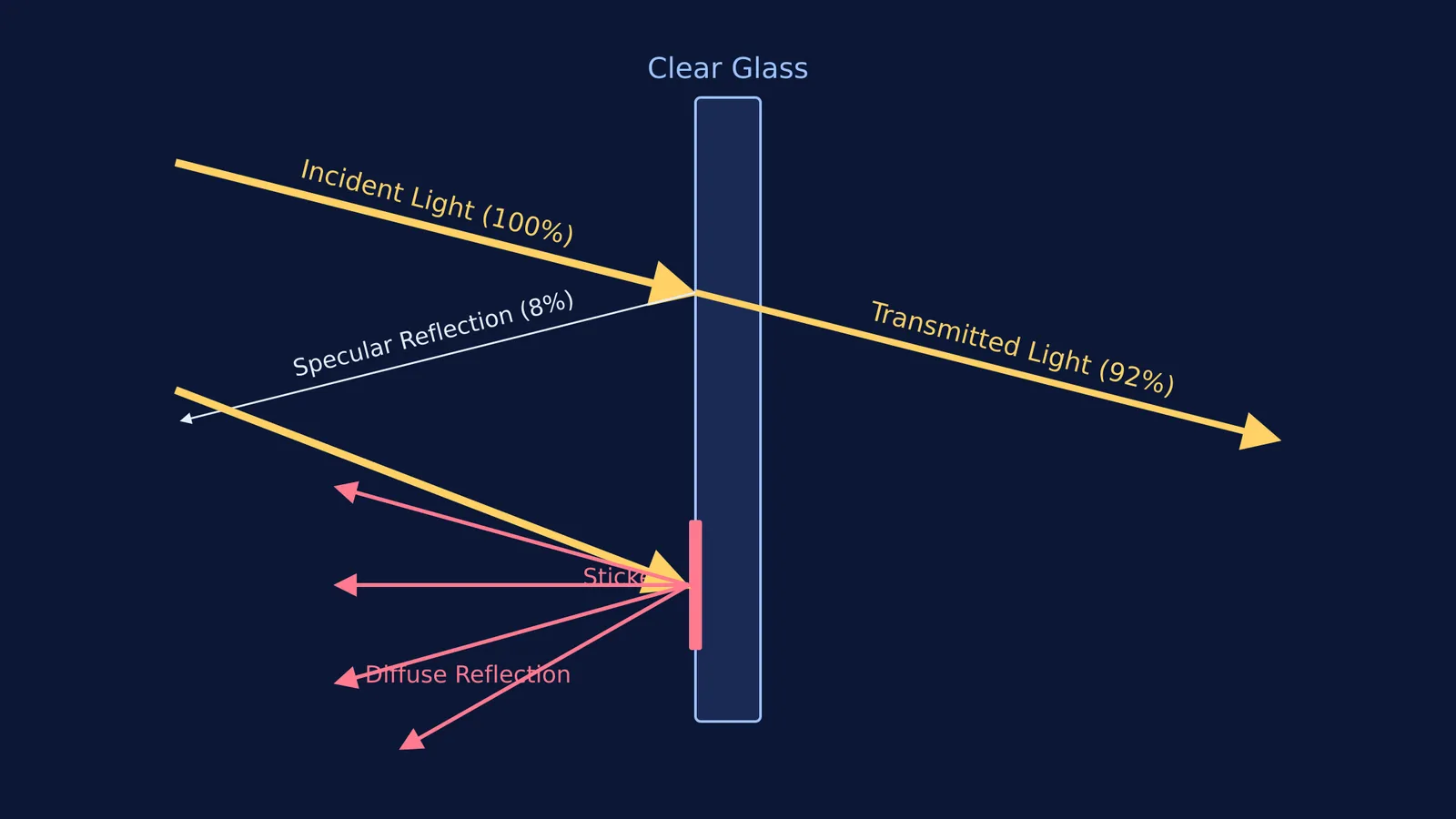
Glass, on the other hand, is manufactured to be incredibly smooth. When light hits it, the reflection is specular. All the light rays bounce off at the same angle they arrived, just like a mirror. If you are not standing exactly in the path of that specific reflected angle, you will not see the reflection.
Furthermore, only a small fraction of the light reflects at all. According to the Fresnel equations in optical physics, when light hits a standard pane of clear glass, about 4% reflects off the front surface, and another 4% reflects off the back surface. The remaining 92% is mostly transmitted. Unless there is a bright light source reflecting directly into your eyes, the glass remains practically invisible. Your brain processes the transmitted light from the room beyond and assumes the path is completely clear.
Why do glass doors have stickers on them?
To stop people from walking into the glass, safety codes require a visible cue. This is usually a sticker, decal, or frosted band placed at eye level.
Stickers work by changing how light interacts with the barrier. An opaque sticker does not transmit light. Instead, its rough printed surface causes diffuse reflection, scattering the room's ambient light in every direction. No matter where you stand or where the light comes from, some of that scattered light reaches your eyes. Your brain instantly recognises an object in the foreground, breaking the illusion of empty space and preventing a collision.
If you are trying to understand physical phenomena that are hard to picture, such as the paths of light rays or specular reflection, the Fermi Simulation Lab has interactive simulations for the ideas that are easier to see than to read.
How does this apply to your study habits?
There is a striking parallel between walking into a glass door and the way many students revise for exams.
When you read a textbook chapter for the third time, it feels clear. The words make sense, and the logic flows. This is known as the illusion of fluency, a phenomenon covered in Why rereading feels like learning, and what to do instead. Like looking through clear glass, the transmission of information feels effortless, so you assume there is no barrier to your understanding.
You only discover the barrier when you sit down for the exam and find you cannot solve the problem. You crash into the concepts you do not actually know.
How can you test your understanding?
To study effectively, you need to put "stickers" on your learning. You need points of friction that scatter your attention and prove a gap in understanding exists. As explored in Carl Wieman: why a Nobel physicist moved beyond the lecture, active learning forces you to confront what you actually know.
Do not rely on the feeling of clarity. Use this checklist to place visible cues on your study path:
Close the book. After reading a section, shut the textbook. Can you write down the three main points on a blank sheet of paper?
Solve from scratch. Do not just read worked examples. Hide the solution and attempt the problem yourself. If you get stuck, the Fermi Problem Library has worked problems with a step-by-step solver that explains the reasoning rather than printing an answer.
Teach the concept. Explain the idea aloud to a friend or a parent. If you stumble over your words, you have found the glass.
If you hit a barrier and need help finding your way through, Fermi's AI tutor can work out what you already know and build a plan for the session, so you sit down to a clear next step.


