

On this page
When you come down with a severe cold, even your favourite meal can feel like chewing on cardboard. You might assume your taste buds have been temporarily broken by the virus. However, the real culprit is usually a blocked back door to your nose, a pathway that provides the vast majority of what we experience as flavour.
Taste vs flavour: what is the difference?
Many people use the terms "taste" and "flavour" interchangeably in everyday conversation, but in sensory science, they describe very different biological processes.
Taste, or gustation, happens exclusively on your tongue. Your taste buds are designed to detect only five basic, broad categories of quality: sweet, salty, sour, bitter and umami. (You can read more about how the savoury, rich taste of umami was first formally identified in our profile of Kikunae Ikeda and the discovery of umami taste).
Flavour, on the other hand, is a complex, multisensory experience. It combines the basic gustatory signals from your tongue with the nuanced, highly specific aromas detected by your nose. Your olfactory receptors can distinguish thousands of different volatile molecules. Without this olfactory input, a strawberry tastes merely sweet and slightly acidic; you need your nose to actually tell your brain that it is a strawberry.
Why does food taste bland when your nose is blocked?
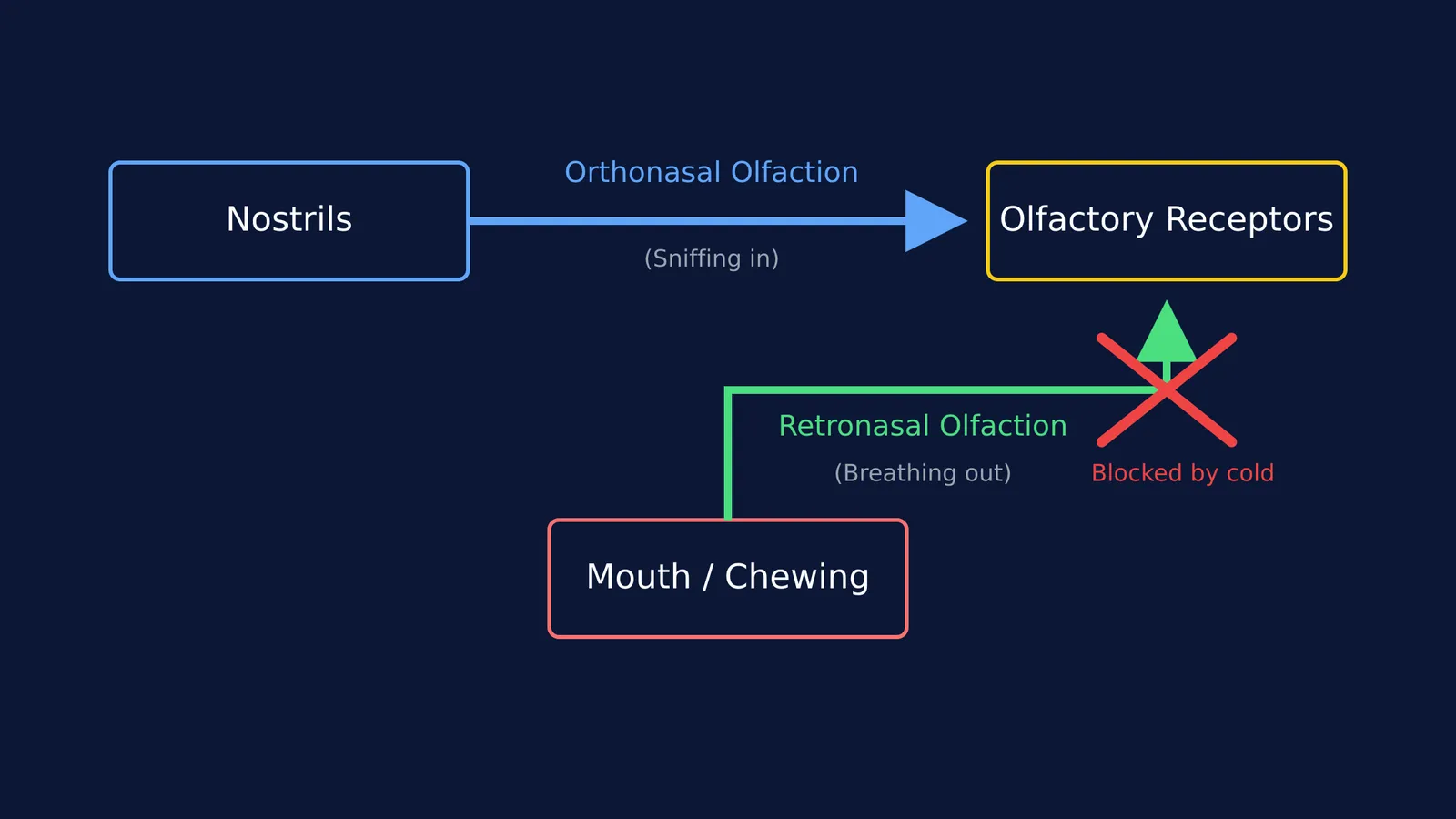
There are two distinct ways that aromas reach the olfactory sensors located high up in your nasal cavity. The first is sniffing or inhaling through your nostrils, which scientists call orthonasal olfaction. The second is retronasal olfaction, where aromas travel from the back of your throat up into your nasal cavity while you chew and breathe out.
A 2015 study published in the journal *PNAS* by researchers including Rui Ni and Gordon M. Shepherd analysed how the human airway is adapted for this exact process. Using an anatomically based flow dynamic model, they found that the structure at the back of the human mouth acts as a physical "curtain" or valve. This shape actively enhances the transport of food volatiles up into the nose during expiration while limiting them from going into the lungs during inspiration. If you find it hard to picture how airflow carries molecules through complex anatomical passages, the Simulation Lab provides interactive simulations for the ideas that are easier to see than to read.
When you have a cold, this delicate retronasal pathway is heavily compromised. The narrow channel leading to your olfactory sensors—known as the olfactory cleft—becomes inflamed and swollen. Furthermore, excess mucus physically coats the receptors and fills the passage. Without the upward flow of air to carry the aroma molecules past this barrier, your brain never receives the critical olfactory signals, leaving you with only the basic, unrefined tastes from your tongue.
How does the pinched-nose jelly bean test work?
You do not need to wait until your next cold to experience the sudden loss of retronasal olfaction. You can prove its dominance in flavour perception right now using a simple jelly bean.
Take a fruit-flavoured jelly bean, but before eating it, pinch your nose tightly shut so absolutely no air can flow through your nostrils.
Put the jelly bean in your mouth and begin to chew. Pay close attention to the sensation. You will taste the basic sweetness of the sugar, and perhaps a bit of sour acidity, but the specific fruit flavour will be entirely missing.
Keep chewing, and then release your nose and exhale normally.
The moment you let go and breathe out, the trapped air rushes up the back of your throat, delivering a sudden, unmistakable burst of cherry, lemon or lime flavour to your olfactory sensors.
How does the brain build a flavour map?
To create the final, unified perception of your meal, your brain must integrate these disparate signals in real time. It combines the gustatory signals from the tongue, the olfactory signals arriving via the retronasal passage, and somatosensory input like the texture and temperature of the food.
This complex sensory integration happens across several regions of the brain. (You can explore how different structures coordinate such inputs in our guide to the Parts of the human brain: forebrain, midbrain and hindbrain roles). When a cold cuts off the olfactory input, the brain's flavour map is left largely blank.
Fortunately, this type of conductive olfactory dysfunction is usually temporary. Once your immune system clears the virus, the inflammation subsides, and the mucus drains, the retronasal airway opens back up, allowing your full sense of flavour to return.


