

On this page
For decades, most of us were taught a simple answer for why our hands get pruney in the bath: our skin absorbs water like a sponge and swells up, causing it to fold.
But medical researchers noticed something strange nearly a century ago. If the nerve to a finger is severed or damaged, that finger does not wrinkle when soaked in water. This simple observation shifted the scientific consensus. The wrinkling is not a passive chemical reaction to water; it is an active, neurological response.
Why do fingers wrinkle after a long bath?
When you spend a long time in the bath, your autonomic nervous system—the same system that controls your heartbeat and fight-or-flight response—detects the prolonged moisture. It triggers a response in the sympathetic nerves connected to your fingertips and toes.
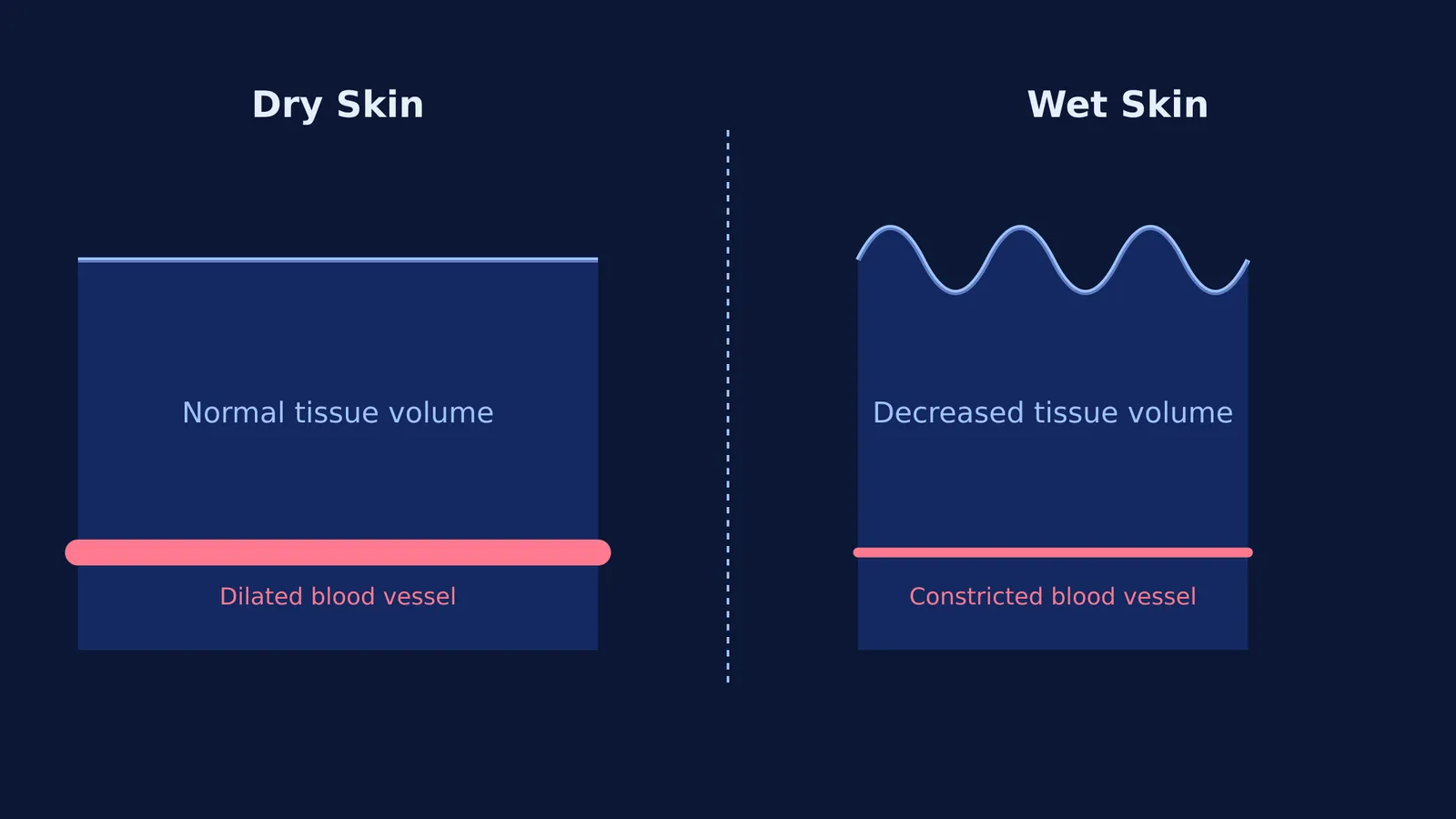
These nerves cause vasoconstriction, which is the narrowing of the tiny blood vessels beneath the skin. As the blood vessels tighten, the volume of the soft tissue (the pulp) inside your fingertip decreases. The outer layer of your skin (the epidermis) remains the exact same size. So, as the tissue underneath shrinks, the outer skin is forced to buckle and fold into wrinkles.
Visualizing how invisible internal processes like vasoconstriction alter tissue volume can be difficult. You can explore interactive models of biology and human physiology in the Fermi Simulation Lab for ideas that are easier to see than to read.
Are wrinkles an evolutionary adaptation for better grip?
If the nervous system is actively spending energy to wrinkle our fingers, there must be an evolutionary reason. In 2011, evolutionary neurobiologist Mark Changizi and his colleagues published a paper in *Brain, Behavior and Evolution* (10.1159/000328223) arguing that these wrinkles act like the treads on a rain tire.
They proposed that the specific pattern of wrinkles on our fingertips creates an effective drainage network, efficiently channelling water away as you press your finger against a wet surface to improve grip.
To test this hypothesis, a 2013 study published in *Biology Letters* (10.1098/rsbl.2012.0999) by researchers at Newcastle University timed participants moving submerged objects. The study found that submerged objects are handled more quickly with wrinkled fingers than with unwrinkled fingers, while the wrinkles made no difference when handling dry objects. This suggests that wrinkling is a specialized adaptation for wet conditions, perhaps helping our ancestors gather food from streams or maintain their footing on wet rocks.
If you are studying human biology and find yourself struggling with how these kinds of evolutionary adaptations connect to the parts of the human brain, you can look it up in the Fermi Concept Library for a dedicated lesson and its place in the overall concept map.
How can you test the rain tread hypothesis at home?
A great way to fully understand experimental biology is to reproduce the published results for yourself. You can set up a simplified version of the Newcastle University experiment at home.
Your experimental protocol:
Set up: Fill a large bowl with water. Drop in 15 smooth, identical objects (like glass marbles or heavy coins). Place an empty bowl next to it.
The dry run (control): Using your thumb and index finger, move the objects one by one from the water to the empty bowl as fast as you can. Time yourself with a stopwatch and record the result.
The soak: Soak your hands in warm water for 15 to 20 minutes until your fingertips are visibly wrinkled.
The wet run (test): Put the objects back into the water bowl. Repeat the timed transfer using your newly wrinkled fingers.
Analyze your data: Did your time improve? In the original 2013 study, researchers found that participants were consistently faster at moving wet objects with wrinkled fingers. If you want a deeper challenge, try graphing your results or comparing the times across multiple family members to see if the rain tread advantage holds up.


