

On this page
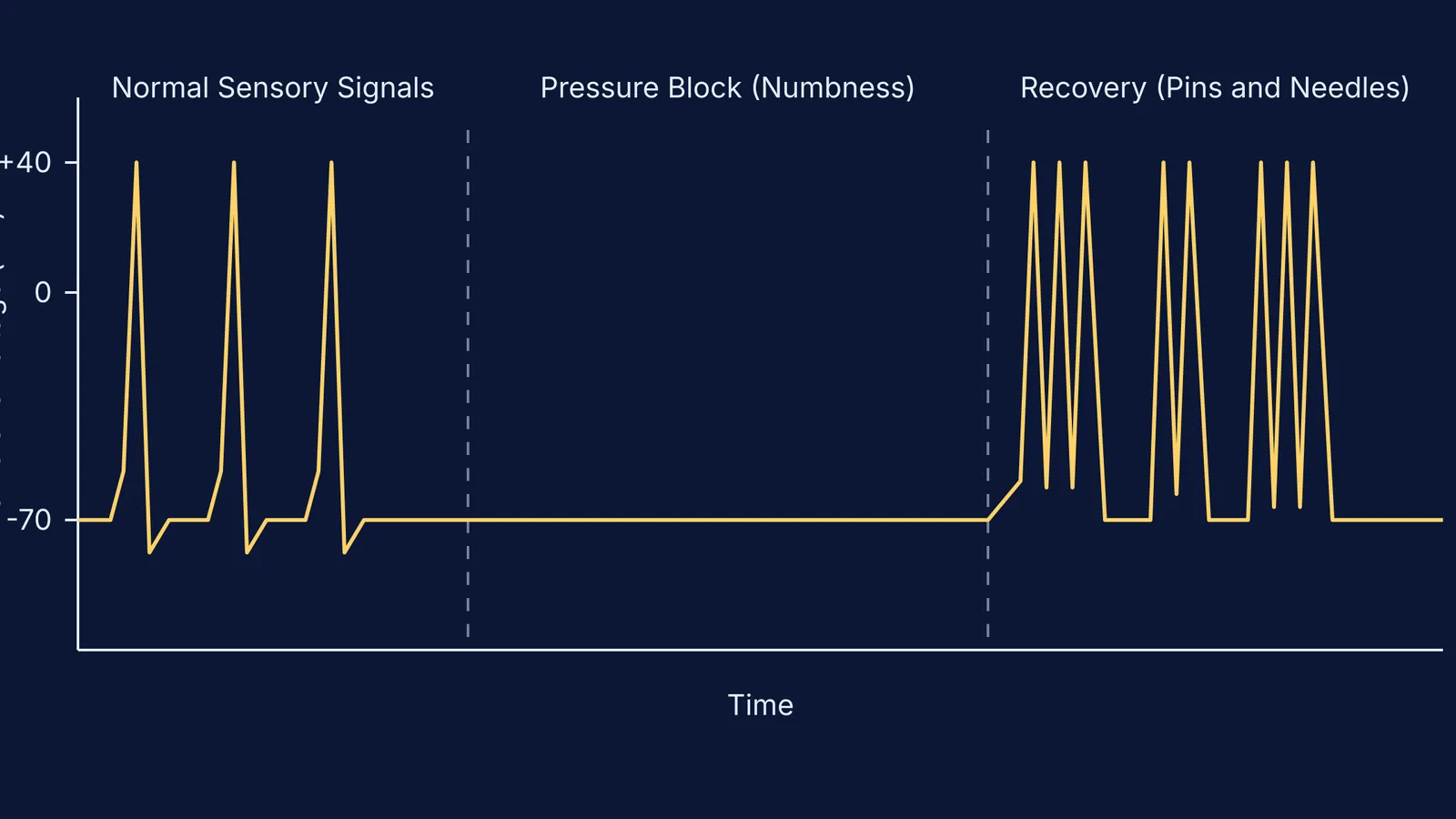
In short Your foot falls asleep because sustained pressure squeezes the nerves and restricts their blood supply, blocking the electrical signals sent to your brain. A 1989 study found that a pressure of 200 mmHg stops signals in large myelinated nerve fibres in just 23 minutes. When the pressure is released, the nerve recovers and fires disorganized bursts of impulses, creating the familiar "pins and needles" sensation.
Why does your foot fall asleep and tingle?
When you sit with your legs crossed or rest your entire body weight on a foot, you apply direct mechanical pressure to the peripheral nerves in your leg. This pressure acts like a kink in a garden hose. It physically compresses the nerve fibres, preventing them from transmitting the electrical impulses that carry essential sensory information up to your brain.
At the same time, the pressure squeezes shut the tiny blood vessels, or capillaries, that supply the nerve with oxygen and glucose. Nerves are highly sensitive to this loss of blood flow, a physiological state known as ischemia. Without a steady, uninterrupted supply of energy, the nerve membrane cannot maintain its resting electrical charge, and the communication signal stops. A classic 1989 experimental study demonstrated that applying 200 mmHg of pressure completely blocks the signal conduction in large myelinated nerve fibres in approximately 23 minutes.
With the signal effectively blocked, the brain receives no sensory input from the affected foot, making it feel heavy, dead or numb—a temporary state doctors call obdormition.
What causes pins and needles?
The tingling sensation, medically known as paresthesia, rarely happens while the foot is completely compressed under your weight. It actually begins the very moment you change position and release the pressure.
As fresh blood rushes back into the capillaries, the nerve fibres begin to wake up. However, they do not recover their function instantly or simultaneously. Instead, the sudden return of oxygen causes the nerve membrane to depolarize rapidly, firing spontaneous and entirely disorganized bursts of action potentials. Because these electrical signals are erratic, the brain cannot interpret them as normal touch or temperature. It translates this chaotic electrical noise into the familiar prickling, burning, or "pins and needles" feeling.
Understanding how electrical impulses travel down a nerve requires visualising voltage changes across a membrane. For the ideas that are easier to see than to read, the Fermi Simulation Lab offers interactive simulations that let you explore exactly how systems like this work.
Is it dangerous to let your foot fall asleep?
Temporary paresthesia is entirely harmless. It is a universal human experience that resolves completely within a few minutes once the mechanical pressure is lifted and normal blood flow resumes to the limb.
However, if you experience frequent or persistent tingling without an obvious postural cause, it may point to an underlying medical condition such as a pinched nerve, poor circulation, or a vitamin B12 deficiency.
When to see a doctor about persistent tingling?
While a foot falling asleep from sitting awkwardly is perfectly normal, persistent paresthesia warrants a proper check-up. Mention these symptoms to a doctor if you notice:
The tingling happens without any external pressure being applied.
The sensation spreads further up your leg or affects both sides of your body equally.
It is accompanied by sharp pain, muscle weakness, or sudden changes in your vision.
The numbness lasts much longer than a few minutes after changing your physical position.


