

On this page
When you watch a cricket match on a dry day-four pitch, you often see a puff of dust as the ball lands, followed by a sharp deviation that beats the bat. The reason for this dramatic movement lies in the classical mechanics of contact and friction.
A dry, dusty pitch lacks moisture and healthy grass. Without these natural lubricants, the bare soil becomes highly abrasive, drastically increasing the coefficient of friction between the leather ball and the ground. This allows the pitch to exert a much stronger lateral force on the ball during the fraction of a second it is grounded.
Why do dry and dusty pitches help spin bowlers?
In physics, the force of friction is what translates spinning motion (rotational kinetic energy) into a change of direction (linear motion).
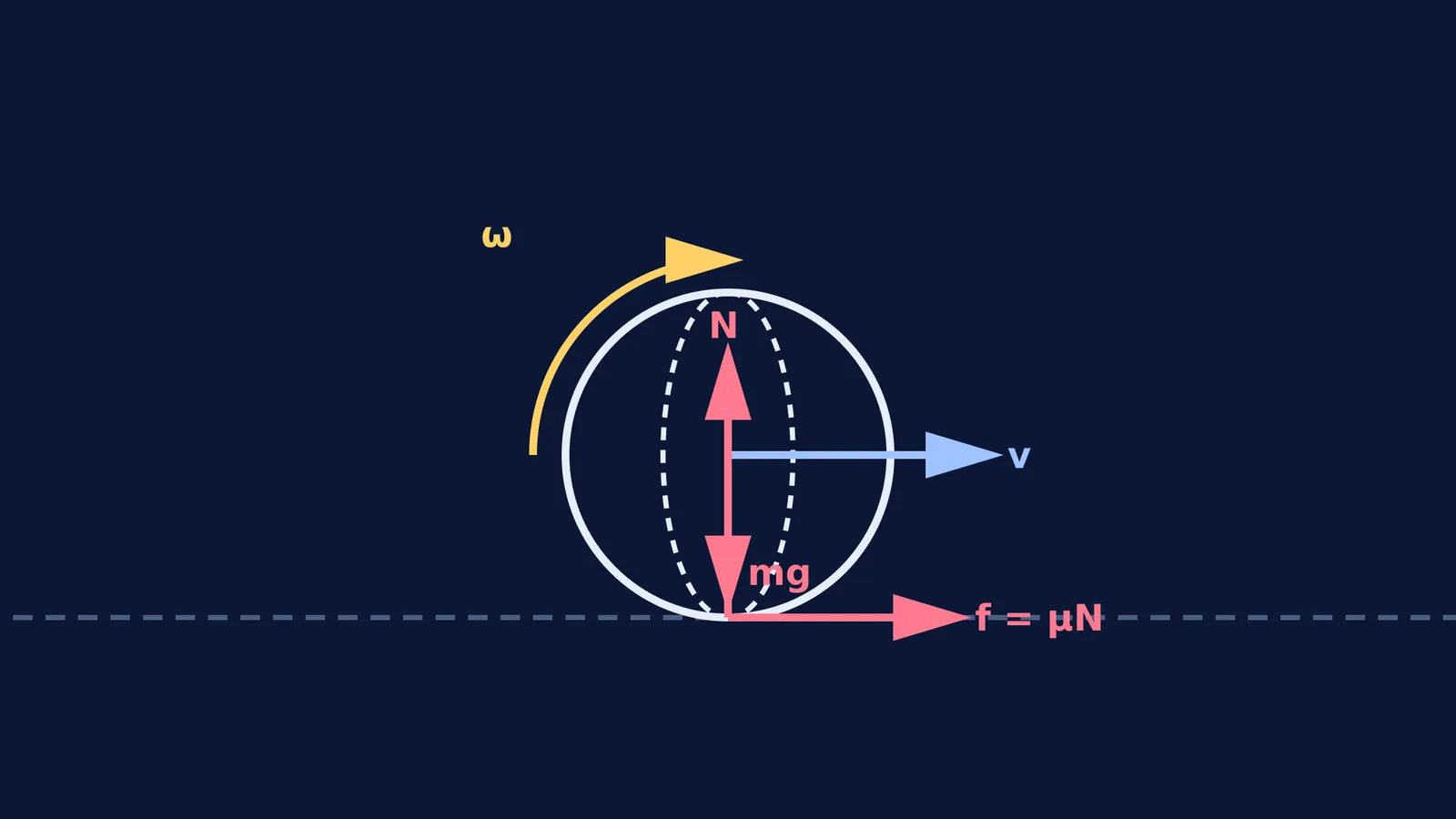
When a spinner releases the ball, they impart "revs", giving the ball a high angular velocity (ω). If that spinning ball lands on a frictionless surface like ice, the bottom of the ball will simply slip. It will keep spinning but skid straight ahead, maintaining its forward momentum.
On a cricket pitch, the friction force (f = μN, where N is the normal force) opposes this slipping. The pitch physically "grabs" the rotating seam. Because friction acts in the opposite direction to the slip, it creates a massive impulse in the millisecond the ball is grounded. This sideways impulse pulls the ball off its original line. You can picture this exact force balance in the Fermi Simulation Lab, where adjusting the surface friction instantly changes how far a rotating sphere deviates.
How does grass change the coefficient of friction?
Sports engineering research has investigated how much these surface interactions vary. In a 2004 study published in *Sports Engineering*, researchers confirmed that a pitch's performance is closely correlated with its soil composition and grass cover James, Carré & Haake, 2004.
On a pitch with a green covering of grass, the coefficient of friction (μ) is lower. The grass blades retain moisture and fold under the ball, acting as a natural lubricant. The leather slides over the green surface more easily. Because the friction is lower, the ball retains most of its horizontal velocity. It "skids" onto the bat quickly—a condition fast bowlers love.
However, on a dry, bare pitch, the coefficient of friction rises significantly. The baked soil acts like sandpaper against the ball's seam. This high friction decelerates the ball and provides the severe grip needed for the spin to take maximum lateral effect. (To understand how μ is derived, read our guide on the angle of repose and angle of friction).
Where do footmarks and cracks come in?
As a match progresses, a dry pitch undergoes severe desiccation. The soil bakes under the sun, loses its binding moisture, and begins to crack. The bowlers' follow-throughs also scuff up the earth, creating "rough" patches or deep footmarks.
These degraded areas add a physical, mechanical advantage. When a heavily spinning ball lands in a dusty footmark or catches the edge of a crack, the seam physically lodges against the uneven ridges. Instead of just rubbing against a flat surface, the ball finds a solid pivot point. The torque generated about this pivot causes extreme turn, often much sharper than what surface friction alone would produce. (For a breakdown of how forces create rotation, see our walkthrough on torque as r × F).
While the turn off the pitch is what beats the bat, spinners also rely on aerodynamics in the air before the bounce—a phenomenon explored in our post on Gustav Magnus and the physics of a spinning ball's curve. But once the ball hits the deck, the abrasive friction of a dry pitch finishes the job.
How can you read a spin-friendly pitch?
If you are playing a match or watching a broadcast, use this checklist to predict if the surface will grip and turn:
Surface colour: Look for a pale, straw-coloured or white surface rather than green. Light colours indicate dead grass and zero surface moisture.
The dust test: Watch the first few overs. If a visible puff of dust rises when the ball lands, the top layer of soil is loose and highly abrasive.
Footmarks: Look for roughed-up, darker patches outside the batter's off-stump. These are created by bowlers' boots and are prime targets for spinners.
Cracking: Are there visible fissures running down the length of the pitch? If the cracks are widening in the heat, the mechanical grip will be immense.


