

On this page
How does dew form on a cricket outfield at night?
Dew condenses in place when an outfield cools to the saturation threshold of the surrounding air. During daylight hours, the ground absorbs solar radiation, but after sunset under clear skies, the outfield sheds thermal energy through infrared radiation directly into space. Because thin grass blades have minimal thermal mass and poor thermal conduction from deep soil, their surface temperature plummets faster than the air above.
When grass chills to the dew point, relative humidity reaches 100%, causing water vapour to condense into liquid droplets, releasing latent heat as explained in evaporation and latent heat of condensation. Under the saturation formulation established by Alduchov and Eskridge (1996)035<0601:imfaos>2.0.co;2), air at 28 °C and 75% relative humidity has a dew point of 23.1 °C. Radiative cooling routinely cools grass 3 °C to 5 °C below ambient air, triggering dew within ninety minutes of sunset.
When connecting phase changes, saturation vapour pressure, and heat transfer across thermal physics, the Fermi Concept Library maps every concept in physics and chemistry to show where these principles fit into the broader syllabus.
Why does dew make bowling difficult in night matches?
As aerodynamicist Rabindra Mehta documents in Sports Engineering, a standard men's cricket ball has a regulation mass between 156 g and 163 g. When the ball rolls across wet grass, its leather casing and primary stitched seam absorb water droplets. Waterlogged leather creates severe release problems for both spin and pace bowlers.
Spinners impart 2000 to 2400 revolutions per minute to the ball by exerting tangential traction with their finger pads during release. On dry leather, the static friction coefficient ranges from 0.40 to 0.60. When excess water coats the ball, it forms a fluid film across the finger-leather interface. As demonstrated by Peng and colleagues in Physical Review Letters, multiasperity interfaces exhibit nonmonotonic friction governed by capillary adhesion across humidity regimes; when excess liquid water coats the surfaces, macroscopic boundary lubrication takes over, causing the friction coefficient to plunge below 0.20. Bowlers lose the traction needed to exert rotational torque, resulting in slips and erratic release points. For seam bowlers, wetness softens the raised seam and disrupts the boundary-layer trip mechanism documented by Mehta, suppressing the asymmetric pressure differentials explored in Gustav Magnus and the physics of aerodynamic curve.
This loss of traction creates a substantial second-innings disadvantage under floodlights. As evening dew accumulates on the outfield, the ball absorbs more water with every over. Bowlers struggling to grip the slippery ball concede control over length and line, while deliveries slide harmlessly without the deviation or sharp dip that troubled batters earlier in the day.
What happens when a wet ball impacts the pitch?
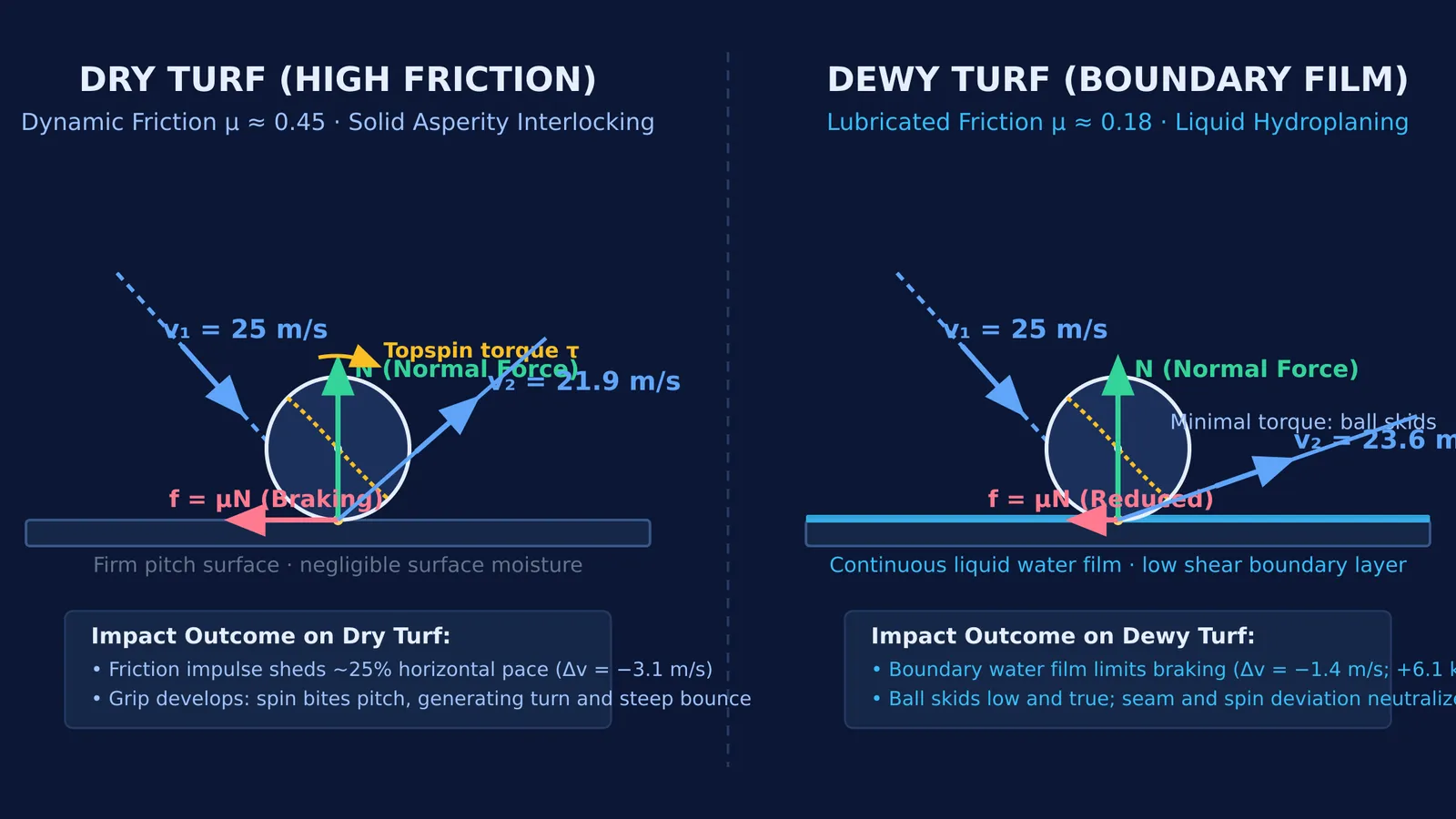
On dry turf, dynamic friction measures 0.35 to 0.50, as documented by James, Carré, and Haake in Sports Engineering. During the 4-millisecond impact, friction opposes sliding at the contact patch: v_contact = v_horizontal − R × ω. This frictional impulse converts horizontal momentum into topspin and bounce, as analysed in static and kinetic friction forces. The ball bites into the surface, shedding 20% to 30% of its forward pace and turning sharply.
When moisture coats the ball and pitch, a lubricating liquid film intervenes. Under the impact dynamics formulated by Rod Cross in the American Journal of Physics, when friction drops below 0.20, sliding never transitions to grip:
Lateral deviation vanishes because spin cannot exert horizontal traction on slick turf.
Forward speed is preserved, with the ball losing only 10% to 12% of its horizontal pace.
The rebound trajectory flattens, skidding onto the bat at a true height.
Where static diagrams fail to capture how contact friction and angular momentum interact during an oblique bounce, the Fermi Simulation Lab provides interactive simulations for the ideas that are easier to see than to read, letting students adjust friction coefficients to observe skid and grip.
How can bowlers adapt when dew sets in?
Applying the oblique impact and impulse equations formulated by Cross (2002), a worked calculation demonstrates the loss of pitch braking for a delivery arriving at 25 m/s with a ball mass of 0.160 kg and a normal impact impulse of 1.24 N·s:
On dry turf with dynamic friction μ = 0.40, the friction impulse is J_x = 0.40 × 1.24 = 0.496 N·s. The horizontal deceleration is Δv_x = −0.496 / 0.160 = −3.10 m/s, slowing the ball to 21.9 m/s.
On dewy turf with lubricated friction μ = 0.18, the friction impulse drops to J_x = 0.18 × 1.24 = 0.223 N·s. The horizontal loss is only Δv_x = −0.223 / 0.160 = −1.39 m/s, leaving arrival speed at 23.6 m/s—a 1.7 m/s (6.1 km/h) boost in retained pace.
To manage this skidding ball, fielding sides adopt four tactical steps:
Bowl cross-seam deliveries so the leather face impacts the turf irregularly, generating variable bounce.
Shorten bowling lengths by half a metre to counter the fast, low skid.
Keep dual microfibre towels on the field to dry the ball seam immediately before every delivery.
Deploy sawdust across the bowling crease to restore shoe spike friction on damp soil.
For students solving rotational impulse and friction problems, the Fermi Problem Library offers worked problems with a step-by-step solver that explains the reasoning rather than printing an answer.


