

On this page
Have you ever left a dark shirt on the clothesline for too long, only to find the shoulders have turned a dull, dusty grey? Fading is not the fabric losing its dye into the air; it is the result of a permanent chemical reaction happening right on the threads.
To understand why this happens, we have to look at the chemistry of colour and the physics of sunlight.
Why do coloured clothes fade in the sun?
The colour of any garment comes from specific molecules called dyes. Inside a dye molecule is a region called a chromophore. A chromophore is an arrangement of atoms—often featuring a long chain of alternating single and double bonds, known as a conjugated system—that absorbs certain wavelengths of visible light and reflects others. The reflected wavelengths are the colours your eyes see.
According to the Library of Congress, fading is a process called photodegradation. When sunlight strikes these chromophores, the high-energy ultraviolet (UV) radiation can literally break the chemical bonds holding the molecule together. Once those bonds snap, the chromophore loses its ability to absorb light in the same way. Instead of reflecting a crisp blue or black, the broken molecules reflect a washed-out mix of wavelengths, making the fabric look faded.
How does UV light break chemical bonds?
In physics, light is carried by particles called photons. The energy a photon carries depends entirely on its wavelength: the shorter the wavelength, the higher the energy.
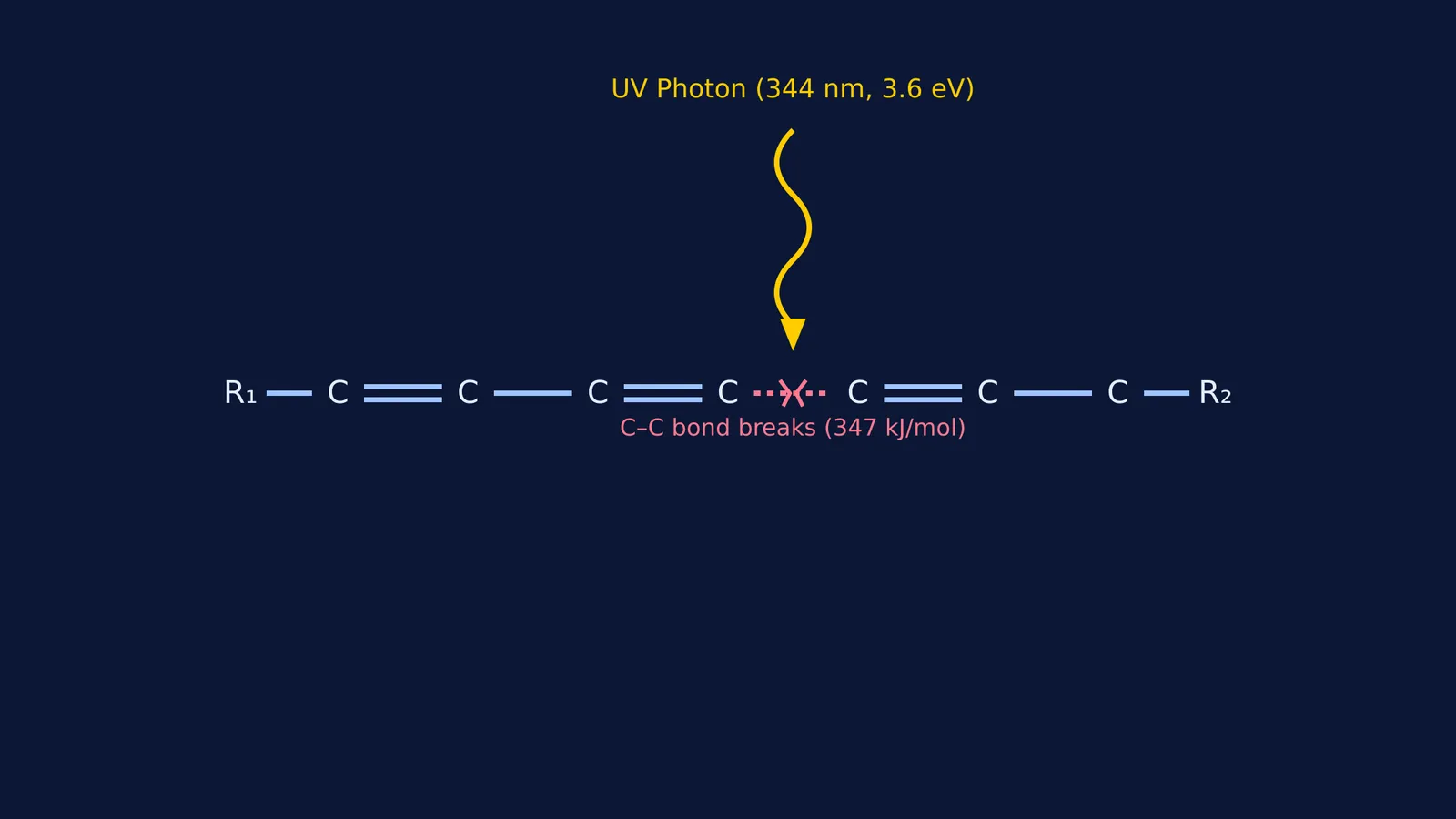
While visible light bounces off the dye harmlessly, UV light is much more energetic. For example, a UV photon with a wavelength of 344 nm carries about 3.6 eV of energy (using the rule for photon energy in electron-volts, E = 1240 / λ). This number rivals the bond dissociation energy of a typical single carbon-carbon bond (C–C), which is 347 kJ/mol—roughly 3.6 eV per bond, according to chemical reference tables/Chemical_Bonding/Fundamentals_of_Chemical_Bonding/Bond_Energies). Because the UV photon packs exactly the energy needed to match the bond's strength, it can act like a pair of chemical scissors, cleaving the bond entirely.
Why do dark clothes fade faster?
Dark colours like black, navy and deep crimson fade more noticeably for two reasons.
First, dark dyes absorb a much wider spectrum of light energy than light colours, meaning they take the brunt of the sun's radiation. Second, the heavy absorption generates heat. This heat acts as a catalyst, speeding up the rate of everyday oxidation and driving the chemical breakdown even faster. Furthermore, black dyes are often a complex mixture of reds, blues and yellows. Because different dye molecules break down at different rates, a black shirt may not fade evenly to grey, but might turn a rusty brown or purple as the weakest bonds fail first.
If you struggle to picture how invisible photons break physical bonds, the Fermi Simulation Lab has interactive simulations for the ideas that are easier to see than to read. You can fire photons of varying wavelengths at a molecule and watch exactly when the energy threshold is crossed and the bond breaks.
How do you test if light will break a bond?
If you are studying photochemistry, you can always test whether a specific type of light will degrade a compound. Here is the three-step framework:
Find the bond energy: Look up the bond dissociation energy for the weakest bond in the molecule (e.g., 347 kJ/mol for C–C, according to chemical reference tables/Chemical_Bonding/Fundamentals_of_Chemical_Bonding/Bond_Energies)).
Convert to electron-volts (eV): Divide the kJ/mol value by 96.48 to get the energy per bond in eV. (For C–C, 347 / 96.48 ≈ 3.6 eV).
Check the photon energy: Use E = 1240 / λ (with λ in nm) for the incoming light. If the photon's energy is greater than the bond's eV, the bond can break.
Applying this rule is a classic physics and chemistry overlap. If you get stuck on questions involving wavelength and bond energy conversions, the Fermi Problem Library has worked problems with a step-by-step solver that explains the reasoning rather than printing an answer. You can see exactly how the units cancel out.
For your clothes, the physics leaves a clear lesson: to protect the chemical bonds in your favourite dark shirt, wash it in cold water and hang it to dry in the shade.


