

On this page
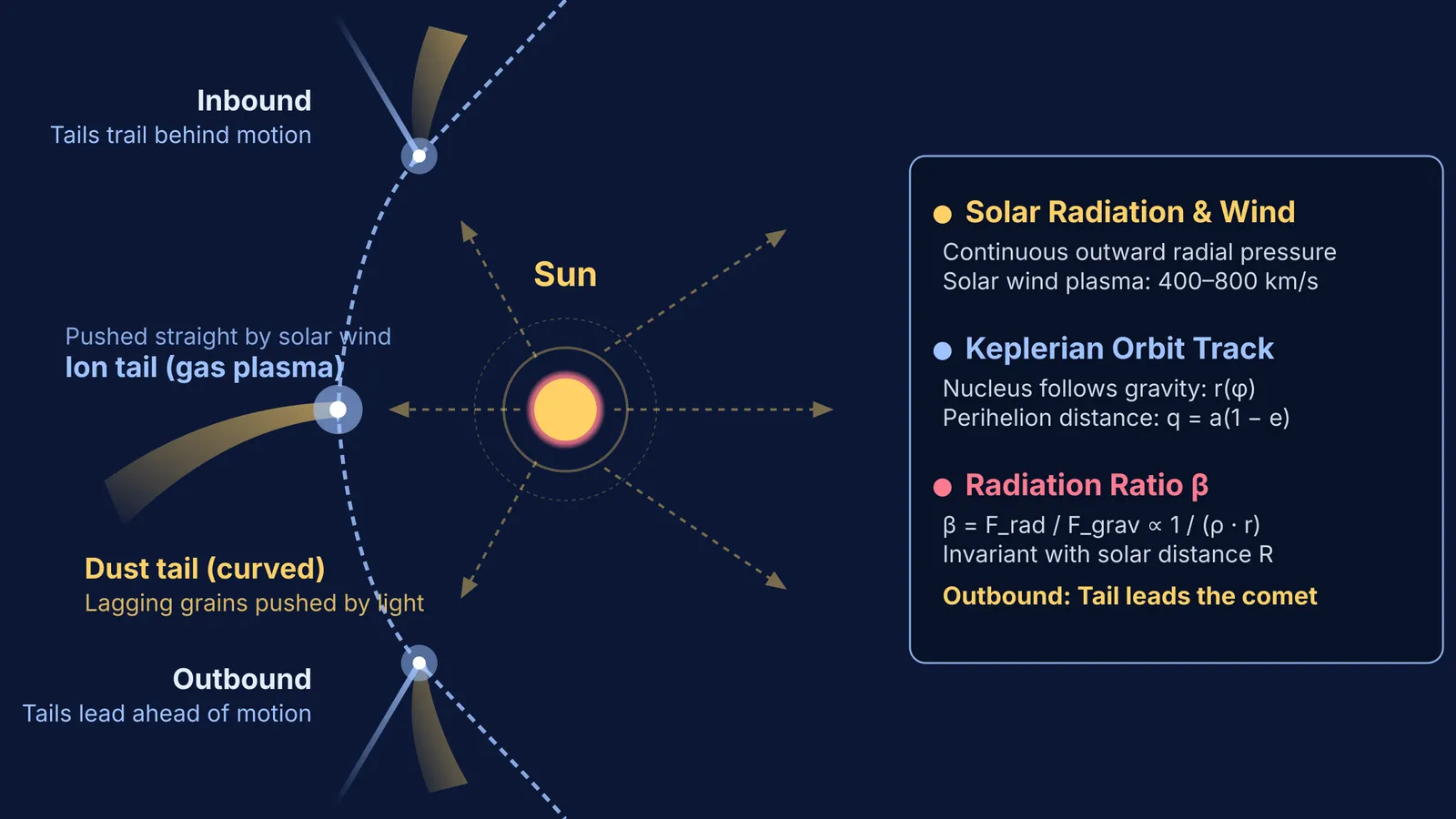
When an aircraft leaves a contrail or a meteor streaks across the sky, debris trails behind due to atmospheric drag. In the near-vacuum of space, comets face no air resistance. Instead, their tails are driven by two outward solar forces: radiation pressure from sunlight and the stream of the solar wind. Because both push outward from the Sun, comet tails always point away, even traveling ahead of the nucleus when receding after perihelion.
Why does a comet have two distinct tails?
As a comet approaches the Sun, solar heat sublimates volatile ices to form a glowing coma, as outlined in NASA's Solar System Exploration comets guide. The Sun separates this material into two distinct tails:
The ion tail: Solar ultraviolet radiation ionizes gases like CO⁺. The solar wind—magnetized plasma flowing at 400 to 800 km/s according to the NOAA Space Weather Prediction Center—sweeps these ions directly along radial lines. Moving far faster than the comet, this straight plasma tail glows blue through fluorescence.
The dust tail: Microscopic dust grains are pushed by photon momentum and radiation pressure. Because dust particles are heavier than ions, they retain forward orbital velocity, forming a broad, curved yellow-white fan lagging behind the comet.
How does sunlight push dust grains against gravity?
As formulated by Joseph Burns, Philippe Lamy, and Steven Soter in Icarus90050-2), light carries momentum despite photons having zero rest mass. When light of energy U is absorbed, it delivers momentum p = U / c, where c is the speed of light (3.0 × 10⁸ m/s), producing radiation pressure P = I / c from solar irradiance I.
For a spherical grain of radius r and density ρ at distance R from the Sun, outward radiation force is F_rad = (L_sun × r²) / (4c × R²), where L_sun is solar luminosity (3.828 × 10²⁶ W). Simultaneously, the Sun exerts gravitational pull F_grav = (4π G M_sun ρ r³) / (3R²).
Both forces decrease as 1 / R². Their ratio β is invariant throughout the comet's orbit:
β = F_rad / F_grav = (3 L_sun) / (16π c G M_sun ρ r)
This ratio depends solely on grain size and density (ρ × r). For large bodies, β is negligible. For submicron grains, β can match or exceed 1, allowing sunlight to repel gravity.
Worked example: Can radiation pressure overcome solar gravity?
To see why cometary dust escapes on unbounded orbits, calculate β for a typical silicate grain using the solar parameters from Burns, Lamy, and Soter90050-2):
Astronomical constants: L_sun = 3.828 × 10²⁶ W, M_sun = 1.989 × 10³⁰ kg, G = 6.674 × 10⁻¹¹ N·m²/kg², and c = 2.998 × 10⁸ m/s.
Constant prefactor: C = (3 L_sun) / (16π c G M_sun) ≈ 5.74 × 10⁻⁴ kg/m².
Silicate grain with radius r = 0.5 μm (0.5 × 10⁻⁶ m) and density ρ = 2000 kg/m³:
ρ × r = 1.0 × 10⁻³ kg/m² β = (5.74 × 10⁻⁴) / (1.0 × 10⁻³) = 0.574 ≈ 0.57
With β = 0.57, radiation pressure offsets 57% of gravity, reducing net attraction to F_net = 0.43 F_grav. For a grain on an eccentric orbit, losing over half of effective central gravity makes its orbital energy positive, launching it onto a hyperbolic escape path. For grains smaller than 0.28 μm, β exceeds 1, turning gravity into net repulsion.
Why does the tail lead the comet when leaving the Sun?
A comet's orientation follows Kepler's laws and orbital mechanics. In 1619, Johannes Kepler observed that comet tails always face away from the Sun, proposing that sunlight carries mechanical pressure.
Inbound toward perihelion, the nucleus moves toward the Sun while solar wind and radiation push outward, so tails trail behind. At perihelion, the nucleus whips past closest approach, and the tails swing outward. Outbound, the comet recedes from the Sun, but solar forces still point outward. The tails now travel ahead of the nucleus, leading the comet into deep space.
This geometry drove a major discovery: in 1951, Ludwig Biermann showed that ion tails accelerate at hundreds of kilometers per second—too fast for light pressure alone—proving the Sun continuously emits charged particles. This inspired Eugene Parker's solar wind theory in 1958, while missions like ESA's Rosetta directly tracked how solar wind and heating shape cometary gas and dust through perihelion.
How to master orbital radiation forces for exams
In exams like JEE Advanced and CBSE Class 12 Physics, questions on radiation pressure test field-driven forces in a vacuum. A common pitfall is forgetting that photons carry momentum or that both solar gravity and radiation force scale as 1 / R².
To visualize how non-gravitational forces reshape Keplerian orbits, students can explore interactive models in the Fermi Simulation Lab, which provides interactive simulations for ideas that are easier to see than to read. Seeing how grain size converts closed ellipses into hyperbolic escape trajectories makes the β ratio intuitive.
For practice balancing radiation forces against gravity, the Fermi Problem Library offers worked problems with a step-by-step solver that explains the reasoning rather than printing an answer. Deriving force balances from core electrodynamics builds lasting exam mastery.


