

On this page
Water is much denser than air. Yet clouds, which can hold vast amounts of water, float. The secret is that clouds do not sit still. The droplets are constantly falling, but they are falling so slowly that the rising air of the atmosphere easily pushes them back up.
Why do clouds float if they are made of water?
When a water droplet forms in the atmosphere, gravity pulls it down. But as it falls, it pushes against the air, creating drag. Eventually, the droplet reaches its terminal velocity, the constant speed where the upward force of air resistance exactly balances the downward pull of gravity.
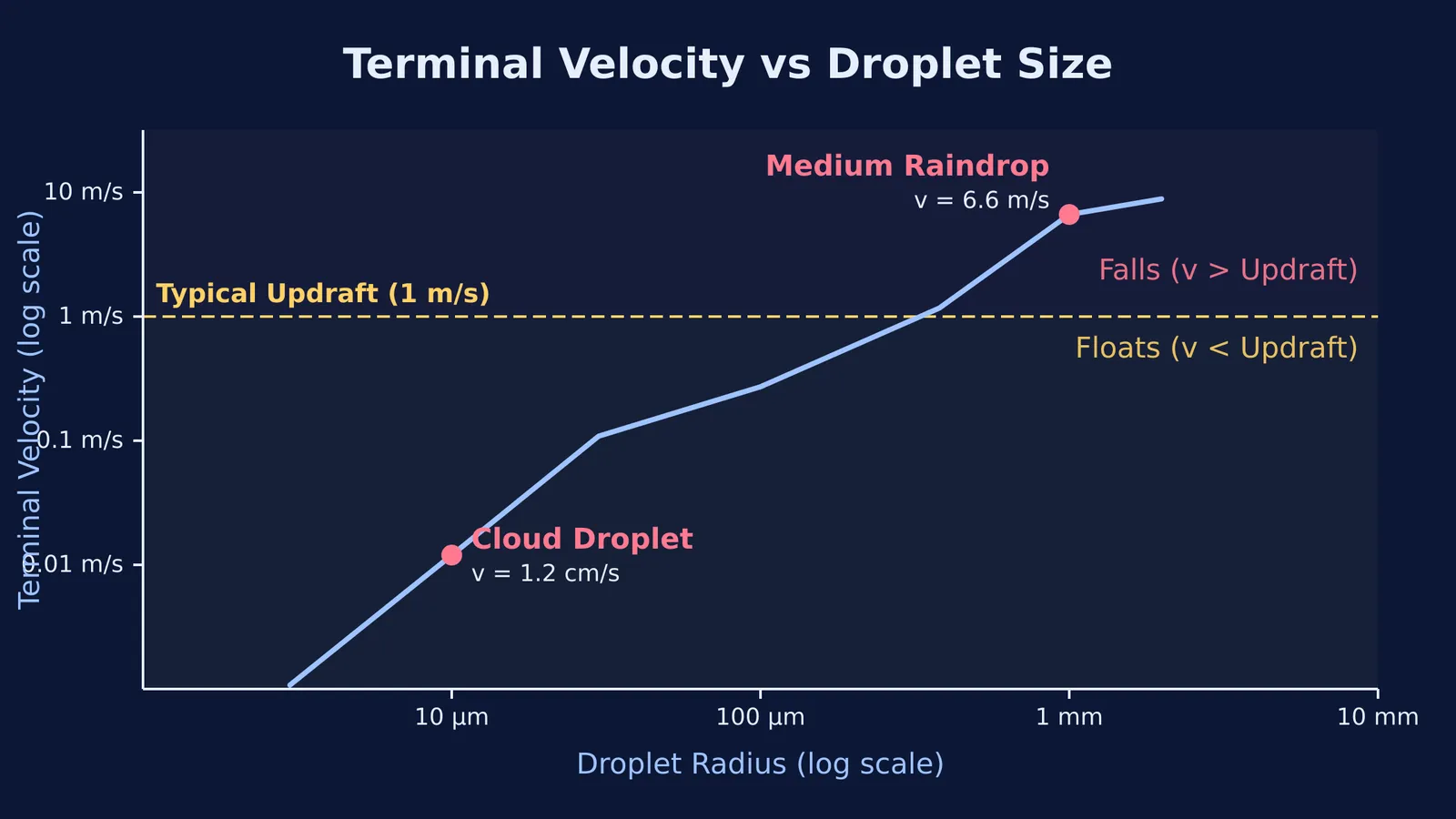
According to the National Weather Service, a typical cloud droplet has a radius of about 10 micrometers (µm). At this microscopic scale, the air acts like a thick syrup, and the droplet's terminal velocity is roughly 1.2 cm/s [source].
To put that speed in perspective, it would take more than 20 hours for a cloud droplet to fall one kilometre in perfectly still air.
How does the air hold the droplets up?
The atmosphere is rarely still. Even on a clear day, the sun warms the ground, which heats the air directly above it. This warm air becomes less dense and rises, creating updrafts.
According to the National Weather Service, as long as the upward velocity of the air is greater than the falling speed of the droplets, the cloud remains suspended in the sky. The droplets are technically falling through the air around them, but that air is rushing upward faster than they can drop.
Here is a simple framework to determine if water in the sky will float as a cloud or fall as rain:
Find the droplet's radius (for example, 10 µm for a cloud droplet, or 1000 µm for a raindrop).
Look up its terminal velocity.
Compare that velocity to the local updraft speed.
If the updraft is faster, the droplet stays in the cloud; if the terminal velocity is faster, it falls to the ground.
This balance between a droplet's properties and the surrounding fluid is a classic physics problem. You can explore similar mechanics, such as Surface tension and viscosity: capillary rise to terminal velocity, to understand the rules of falling spheres.
If you want to visualise how these forces interact, you can use the Fermi Simulation Lab. You can change a droplet's radius and watch in real time as the terminal velocity and drag adapt, seeing for yourself why tiny drops float while large ones fall.
When does a cloud finally fall?
For a cloud to release rain, its droplets must grow. Through collisions and coalescence, millions of tiny cloud droplets merge to form a single raindrop [source].
A medium-sized raindrop has a diameter of 2.0 mm (a 1 mm radius), which is 100 times larger than a cloud droplet. Because terminal velocity increases rapidly with size, a raindrop of this size reaches a terminal velocity of about 6.6 m/s.
Updrafts that easily hold up 1.2 cm/s cloud droplets are no match for a 6.6 m/s raindrop, which crashes through the rising air and reaches the ground.
If you are solving kinematics problems where drag changes with speed, mastering Acceleration given as a function of v or x: how to integrate it is the key to proving how a falling object reaches its terminal limit.


