

On this page
You wake up to the sound of heavy rain. A few hours later, the streets in your neighbourhood are knee-deep in water, and the local stream has breached its banks. This is a common sight in modern cities, and it is not just about how much rain is falling—it is about what the ground is made of. The natural water cycle has been short-circuited by urbanization.
What is the "10% rule" of natural ground?
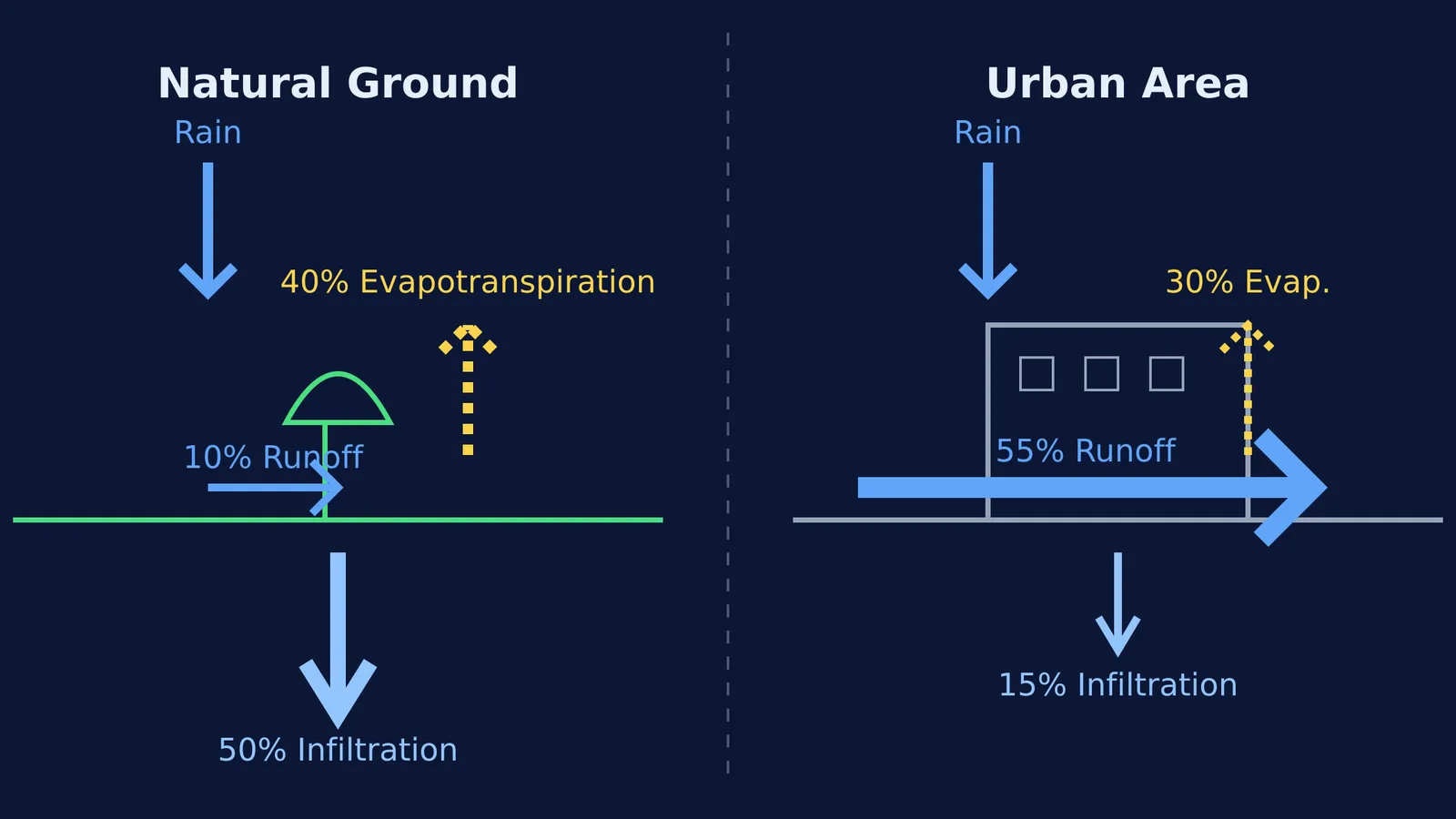
In a forest or woodland, the ground acts as a giant sponge. According to the US Environmental Protection Agency (EPA), in a natural landscape with thick vegetation, only about 10% of rainfall becomes surface runoff. Around 50% of the water infiltrates into the soil to replenish groundwater, and 40% returns to the atmosphere through evapotranspiration.
When rain falls on natural ground, it moves slowly. It has to meander through roots, leaves, and uneven terrain, which gives the soil plenty of time to absorb the moisture. This steady infiltration is crucial not just during the storm, but months later; groundwater slowly feeds streams, keeping them flowing during dry weather.
Why do cities flood after just a few hours of rain?
When we build cities, we pave over the sponge. Concrete, asphalt, and rooftops are impervious surfaces, meaning they stop water from soaking into the earth. The EPA notes that in highly developed urban areas with 75% to 100% impervious cover, surface runoff leaps to 55%, while infiltration drops to a mere 15% (source). The same report warns that even a watershed with as little as 10% impervious cover can suffer significant stream degradation.
This means a massive volume of water is instantly diverted over the surface. Because urban runoff completely bypasses the natural soil filter, it also picks up heavy metals and pollutants like those Ellen Swallow Richards mapped before flushing them directly into waterways. According to the EPA, this runoff is the leading source of water quality impairment to surveyed estuaries. Furthermore, the loss of infiltration means that while urban streams flood violently in the rain, they often run unusually low during dry periods.
How does velocity change the peak flood?
It is not just the total volume of water that causes flooding; it is how fast that water moves. In a natural river basin, there is a long lag time separating the peak of the rainfall from the peak water level in the stream.
In a city, gutters, storm sewers, and lined channels are specifically designed to shoot water away as quickly as possible. These networks concentrate runoff into smooth conduits, increasing its speed and erosional power. A study by the US Geological Survey (USGS) explains that this hydraulic efficiency drastically reduces lag time, causing urban streams to rise much earlier and more rapidly than rural ones (source).
Because the runoff arrives at the stream all at once rather than trickling in slowly, the peak discharge (the maximum flow rate) spikes. The USGS found that for a frequent two-year storm, the peak flow in an urban stream increases by 100% to 600% compared to a natural basin. The effect on frequency is just as stark: the USGS noted that in the Anacostia River, daily discharge exceeding 1,000 cubic feet per second surged from 1 to 2 times a year in the 1950s to up to 6 times a year in the 1990s.
How do you calculate runoff volume?
Engineers often predict flooding using the rational equation, a formula that connects rainfall to runoff. We can simplify this based on the EPA's percentage data to look at the total volume of water on a 1000 m² plot of land during a 50 mm (or 0.05 m) downpour.
The total rain falling on the plot is the area multiplied by the depth: 1000 m² × 0.05 m = 50 m³ (which is 50,000 litres of water).
If the plot is a woodland (10% runoff): Only 5 m³ (5,000 litres) of water flows away across the surface.
If the plot is a paved parking lot (55% runoff): 27.5 m³ (27,500 litres) of water flows immediately into the drains.
That is an extra 22,500 litres of water from just one small plot of land, hitting the storm drains in a matter of minutes. When you scale this across an entire city during heavy monsoon rains seen from space, it is easy to see why the infrastructure overflows.
How can you master the physics of the water cycle?
Understanding flooding means thinking about systems: how volume, capacity, and speed interact. This kind of physical intuition is exactly what the Fermi Simulation Lab is built for. With its interactive simulations for ideas that are easier to see than to read, you can change variables—adjusting the flow rate or the channel size—to see exactly when and why a system breaks down.
If you want to understand the equations that govern these forces, Fermi's AI tutor teaches through the physics step by step. By explaining the reasoning and checking understanding as it goes, the tutor helps you connect the dots between the rain on your roof and the river down the street.


