

On this page
You bang your shin on the bed. By evening there is a dark blue-purple patch. Later the edges turn green, then the whole patch fades to yellow. The same trapped blood is being taken apart one chemical step at a time, and each step has its own colour.
What is a bruise, chemically?
A bruise is blood that has leaked from small damaged vessels into the tissue under your skin and cannot get back into circulation. The leak stops when the blood clots (here is how platelets, thrombin and fibrin seal a vessel). On broken skin the same process forms a scab. Under intact skin, the blood stays where it is.
The red colour comes from haemoglobin, the iron-containing protein in red blood cells. Once blood is stranded outside a vessel, your body treats it as waste, and clearing it means breaking haemoglobin down.
Why does a fresh bruise look blue if blood is red?
The blood in a new bruise is still red. It looks blue or purple because of the way light travels through skin. A 1996 study in Applied Optics, Why do veins appear blue? by Alwin Kienle and colleagues, looked at blood vessels rather than bruises. It showed that the colour we see depends on four things: how skin scatters and absorbs each wavelength, how much oxygen the blood carries, how deep the blood sits and how wide the vessel is, and how our eyes and brain read the result.
Blood under skin is seen through a layer that treats each colour of light differently, so the colour reaching your eye is not the colour of the blood itself. At this stage only the optics have changed. The pigment is still haemoglobin.
Why does a bruise turn green and then yellow?
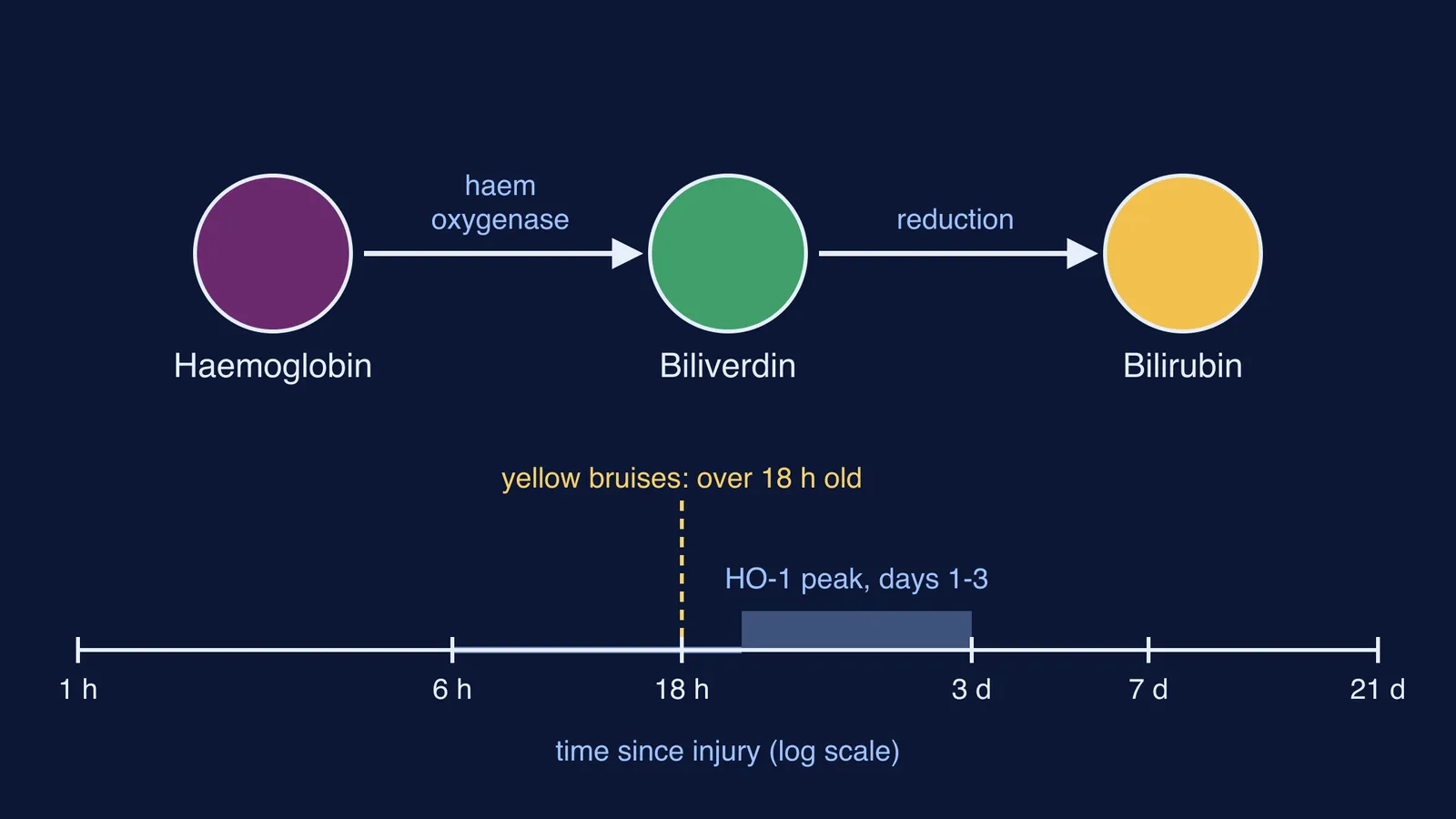
This is where the chemistry starts. A 2015 paper by Neil Langlois and colleagues in Forensic Science, Medicine and Pathology describes the first step: the enzyme haem oxygenase breaks down the haem in haemoglobin to make biliverdin, and biliverdin is then reduced to bilirubin. An ANSTO case study on infrared work at Flinders University and the Australian Synchrotron identifies biliverdin and bilirubin as the green and yellow parts of a bruise.
So the colours on your shin follow a reaction pathway:
Haemoglobin: red, but seen as blue-purple through skin
Haem oxygenase acts on haem to give biliverdin: green
Biliverdin is reduced to bilirubin: yellow
The pigments are cleared away and the skin returns to its normal colour
Bilirubin may sound familiar. StatPearls' review of bilirubin notes that bilirubin and its metabolites give bile and stool their yellow colour. A bruise runs that chemistry where you can watch it.
Why does the yellow take a day or more to appear?
The enzymes have to arrive first. In the 2015 study, which used a rat bruise model, haem oxygenase-1 rose above background from 6 hours after injury and peaked between days 1 and 3 (Langlois and colleagues, 2015). Macrophages, the immune system's clean-up cells, showed strong expression of the enzyme. The authors suggest that yellow may be delayed partly because macrophages take time to reach the injury.
A study in people fits this picture. In 1991, Langlois and Gresham collected 369 photographs of bruises in 89 people aged 10 to 100. Turning yellow was the most significant change over time, and it happened faster in people under 65. The only firm conclusion they could draw was that a bruise with yellow in it was more than 18 hours old.
Colour is only a rough guide, though, not a clock. A 2005 systematic review in Archives of Disease in Childhood on bruises in children found that clinicians dated a bruise to within 24 hours of its occurrence less than 40% of the time, and that any colour could appear in fresh, intermediate or old bruises.
How can you turn a bruise into a revision note?
The next time you have a bruise, use it as a worked example. Each colour links to a topic in your syllabus:
Blue-purple (first): the pigment is haemoglobin. The topic is light: how skin scatters and absorbs different wavelengths.
Green (next): the pigment is biliverdin. The topic is enzymes: haem oxygenase, strongly expressed by macrophages.
Yellow (later): the pigment is bilirubin. The topic is reduction, and the same pigment colours bile.
Fading (last): the pigments are cleared. The topic is the immune system and tissue repair.
Then test yourself without notes. Which enzyme makes the green pigment? Why might yellow take time to appear? Why can't colour give a bruise's exact age?
If pictures help you, the Fermi Simulation Lab has interactive simulations for ideas that are easier to see than to read. For the enzyme side, the Fermi Concept Library gives every biology and chemistry concept its own lesson, with its place in the map.
For how bruises heal and when one needs a doctor, see the MedlinePlus page on bruises.


