

On this page
You reach for a slice of bread during the monsoon, only to find it covered in a cottony white fuzz dotted with black pinheads. This is a common sight in humid weather, but the speed at which it takes over a seemingly fresh loaf can be surprising.
The culprit is usually *Rhizopus stolonifer*, a fast-growing fungus commonly known as black bread mould. Its spores are ubiquitous in the air around us, waiting for the right conditions to land and grow. Unlike plants, fungi cannot make their own food, meaning they must find a hospitable environment rich in nutrients to survive.
Why does bread get fuzzy mould in humid weather?
Fungal spores act like microscopic seeds, but they lack the stored energy and water of a true plant seed. To "wake up" and germinate, they require a specific environment. The two most critical factors are temperature and moisture.
Moisture is the limiting factor. Airborne spores of fungi like *Rhizopus stolonifer* depend on high humidity to trigger rapid mycelial growth, according to mycological research. When the air is dry, the spores remain dormant, floating harmlessly through your kitchen. But during humid weather, moisture settles on the porous, spongy surface of the bread, providing the perfect hydration for the spores to break their dormancy.
The temperature must also be right. *Rhizopus stolonifer* grows optimally between 25 °C and 30 °C (77 °F to 86 °F) as detailed in biological profiles, which is exactly the typical room temperature during a warm, wet season. Once these conditions are met, the fungus releases digestive enzymes into the bread. These enzymes break down the complex starches and sugars into simpler molecules, which the fungus then absorbs to fuel its rapid expansion.
How do fungal spores reproduce on food?
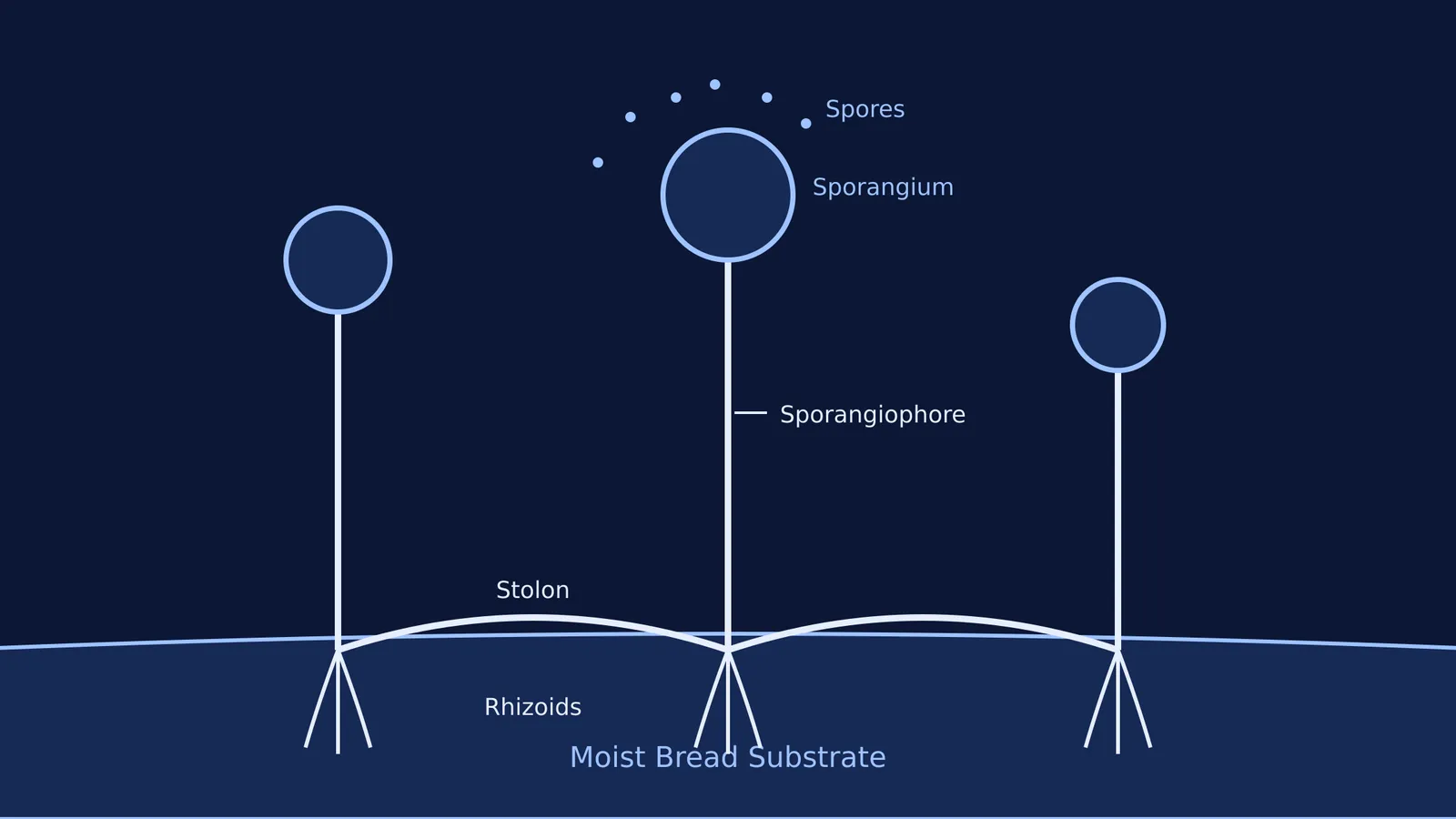
Once a spore germinates, it sends root-like structures called rhizoids deep into the bread to absorb those broken-down nutrients. It then spreads horizontally across the surface using runners called stolons. This is why the mould seems to cover the entire slice almost overnight.
Within a couple of days, the fungus begins asexual reproduction, according to its Wikipedia profile. It sends up vertical stalks called sporangiophores, each topped with a round, balloon-like structure called a sporangium. As these sporangia mature, they turn from white to a dark black—giving the mould its distinct speckled appearance. Inside each sporangium, new haploid spores are forming. When the sporangium is fully mature, it bursts open, allowing the spores to be carried away by air currents to start the cycle all over again on another food source.
If reading about stolons and sporangia leaves you confused, the Fermi Simulation Lab has interactive simulations for the ideas that are easier to see than to read. You can watch complex biological processes unfold instead of trying to picture them from a textbook.
How can you observe mould growth at home?
Instead of just throwing the bread away, a mouldy loaf offers a perfect chance for biology students to observe a fungal life cycle firsthand. Rather than reading about it in a textbook, you can map its growth stages right on your kitchen counter.
Seal the mouldy bread inside a clear, airtight zip-lock bag. This prevents new spores from spreading throughout your house and contaminating other food.
Place the bag in a warm, dark place, ideally one that stays close to the 25 °C to 30 °C range, the optimal temperature for its growth.
Observe it daily with a magnifying glass. Initially, you will likely see the white, cotton-like mycelial network spreading across the surface.
Note how many days it takes for the white fuzz to develop the vertical stalks and black sporangia.
Record the changes in temperature and humidity in a logbook to see if warmer days correlate with faster mould expansion.
When you bring your observation data to Fermi's AI tutor, it works out what you already know and builds a plan for the session, helping you link your kitchen experiment directly to your biology syllabus.
For more on how different organisms reproduce, read about Microsporogenesis and the structure of a pollen grain in plants, or explore Viruses, viroids and lichens: the misfits of five-kingdom biology.


