

On this page
When you buy a bottle of soda or water, you will notice a gap between the liquid and the cap. This empty space is not a factory error or an attempt to shortchange you. It is a carefully engineered feature that relies on the physics of thermal expansion to keep the bottle intact during transport and storage.
Why are cold drink bottles never filled to the top?
The gap at the top of a bottle is technically known as the headspace or ullage. Its primary job is to act as a shock absorber for temperature changes.
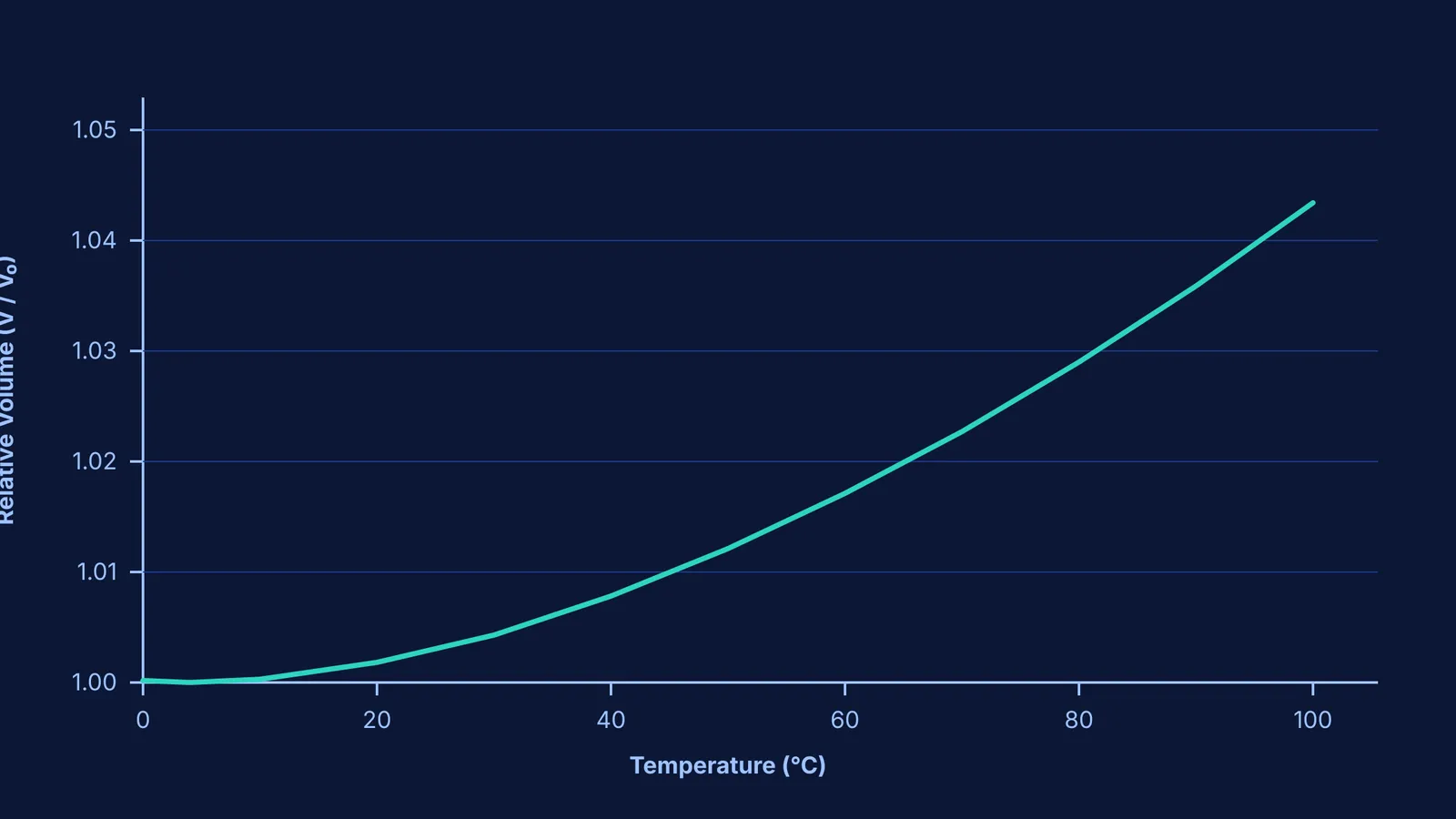
Most materials expand when they get warmer, but liquids expand significantly more than solids. The coefficient of volume expansion for water at room temperature is approximately 2.14 × 10⁻⁴ K⁻¹ (Engineering ToolBox). In contrast, the glass used in bottles has a much lower expansion coefficient, meaning that for every degree the temperature rises, the liquid inside expands much more than the glass container holding it.
If a bottle were filled to the brim and sealed at a cool factory, leaving it in a hot car would cause the liquid to outgrow the container. Because liquids are nearly incompressible, the expanding drink would act like a hydraulic piston, exerting immense force on the walls and the cap.
The International Technical Centre for Bottling publishes strict guidelines for this headspace to ensure it is large enough to absorb thermal expansion without failing (Cetie). The gas in the headspace is highly compressible, so as the liquid expands, it simply squashes the air or carbon dioxide without shattering the glass or rupturing the plastic.
How much does a drink expand in a hot car?
To see exactly why this empty space matters, we can calculate the volume change using a worked example. The formula for volume expansion is ΔV = V₀ × γ × ΔT, where V₀ is the initial volume, γ is the coefficient of volume expansion, and ΔT is the change in temperature. We will use the coefficient for water, which is 2.14 × 10⁻⁴ K⁻¹ (Engineering ToolBox).
Suppose a 500 mL bottle of water is sealed at a cool factory temperature of 10 °C and later left inside a parked car that reaches 50 °C in the afternoon sun. With a temperature increase (ΔT) of 40 °C, the expansion calculation looks like this: ΔV = 500 mL × (2.14 × 10⁻⁴ K⁻¹) × 40 K ΔV = 4.28 mL
The water alone demands an extra 4.28 millilitres of space. While 4 millilitres might sound small, the liquid is incompressible. If there were zero headspace, the expanding liquid would forcefully push against the rigid walls of a glass bottle, resulting in a shattered container. This simple calculation proves why bottlers always leave a gap in a standard half-litre bottle, giving the liquid a safe and compressible cushion.
What happens if a bottle is filled to the brim?
If you remove that safety margin entirely, the container is completely at the mercy of temperature swings. Even a small increase in heat will cause the internal pressure to spike rapidly once the liquid has nowhere to go, causing the cap to blow off or the bottle to burst.
This physics rule extends beyond just the summer heat. If you have ever forgotten a full bottle of water in the freezer, you have likely returned to find it cracked. This is due to water's anomalous expansion: while it contracts as it cools down to 4 °C (Engineering ToolBox), it expands as it cools further and freezes into ice. Without a sufficient headspace to accommodate this extra volume, the outward push of the forming ice will break the bottle.
Thermal expansion can sometimes be hard to picture from a textbook table alone. In the Fermi Simulation Lab, you can raise the temperature of a virtual liquid and watch the molecules push apart, seeing exactly how heat translates into a change in volume. For another everyday example of this concept, you can explore how thermal expansion causes a pendulum clock to lose time in summer.
What role does carbonation play?
For soft drinks, the headspace serves a second purpose related to pressure. Fizzy drinks contain dissolved carbon dioxide. When the bottle is warmed, the gas becomes less soluble in the liquid and escapes into the gap.
A properly sized headspace provides room for this gas to collect safely. It also prevents the drink from violently overflowing the moment you twist the cap and break the seal.
Understanding these physical properties shows why the gap in your bottle is not wasted space—it is the very reason the drink makes it to your hands safely. To see how water's unique behaviour affects the natural world, read about the time for ice to form on a pond.


